
Penny Dreadfuls, 1849 · page 259 of 394
The Mysteries of the Court of London — page 259: what you’re looking at
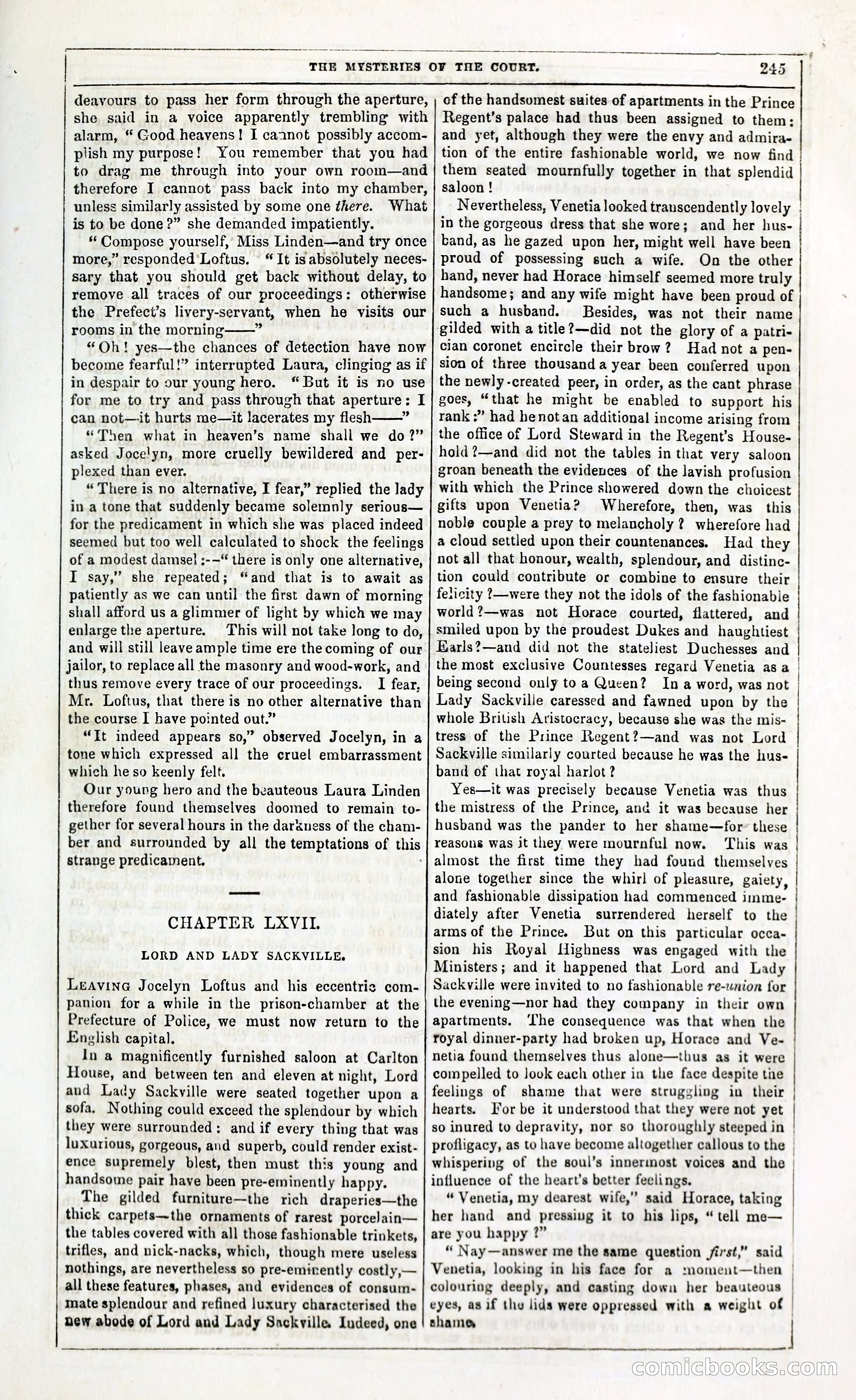
A restored page from Penny Dreadfuls, 1849. Page through the whole issue in the reader above.
📄 Transcribed text from this page (OCR, searchable)
Machine-transcribed from the original scan — historical spelling and the odd misread are preserved.
deavours to pass her form through the aperture, she said in a voice apparently trembling with alarm, “ Good heavens! I caanot possibly accom- plish my purpose! You remember that you had to drag me through into your own room—and therefore I cannot pass back into my chamber, unless similarly assisted by some one there. What is to be done ?” she demanded impatiently. ** Compose yourself, Miss Linden—and try once more,” responded'Loftus. It is absolutely neces- sary that you should get back without delay, to remove all traces of our proceedings: otherwise the Prefect’s livery-servant, when he visits our rooms in the morning——” “Oh! yes—the chances of detection have now become fearful!” interrupted Laura, clinging as if in despair to our young hero. “But it is no use for me to try and pass through that aperture: I can not—it hurts me—it lacerates my flesh——” * Then what in heaven’s name shall we do 2” asked Jocelyn, more cruelly bewildered and per- plexed than ever. “There is no alternative, I fear,” replied the lady in a tone that suddenly became solemnly serious— for the predicament in which she was placed indeed seemed but too well calculated to shock the feelings of a modest damsel} ;:-—“ there is only one alternative, I say,” she repeated; “and that is to await as patiently as we can until the first dawn of morning shall afford us a glimmer of light by which we may enlarge the aperture. This will not take long to do, and will still leave ample time ere the coming of our jailor, to replace all the masonry and wood-work, and thus remove every trace of our proceedings. I fear, Mr. Loftus, that there is no other alternative than the course I have pointed out.” “It indeed appears s0,” observed Jocelyn, in a tone which expressed all the cruel embarrassment which he so keenly felt. Our young hero and the beauteous Laura Linden therefore found themselves doomed to remain to- gether for several hours in the darkness of the cham- ber and surrounded by all the temptations of this strange predicament. CHAPTER LXVIL. LORD AND LADY SACKVILLE. Leavine Jocelyn Loftus and his eccentrig com- panion for a while in the prison-chamber at the Prefecture of Police, we must now return to the English capital. In a magnificently furnished saloon at Carlton House, and between ten and eleven at night, Lord aud Lacy Sackville were seated together upon a sofa, Nothing could exceed the splendour by which they were surrounded: and if every thing that was luxurious, gorgeous, and superb, could render exist- ence supremely blest, then must this young and handsome pair haye been pre-eminently happy. The gilded furniture—the rich draperies—the thick carpets~the ornaments of rarest porcelain— the tables covered with all those fashionable trinkets, trifles, and nick-nacks, which, though mere useless nothings, are nevertheless so pre-emirently costly,— all these features, phases, and evidences of consum- mate splendour and refined luxury characterised the new abode of Lord and Lady Sackville. Indeed, one ee a ee ee a ssp Scns THE MYSTERIES O¥ THE COURT. ee 245 I =e of the handsomest suites of apartments in the Prince Regent’s palace had thus been assigned to them: and yet, although they were the envy and admira- tion of the entire fashionable world, we now find them seated mournfully together in that splendid saloon ! Nevertheless, Venetia looked transcendently lovely in the gorgeous dress that she wore; and her hus- cand, as he gazed upon her, might well have been proud of possessing such a wife. On the other hand, never had Horace himself seemed more truly handsome; and any wife might have been proud of such a husband. Besides, was not their name gilded with a title?—did not the glory of a patri- clan coronet encircle their brow? Had not a pen- sion of three thousand a year been conferred upon the newly-created peer, in order, as the cant phrase goes, “that he might be enabled to support his rank ;” had henotan additional income arising from the office of Lord Steward in the Regent’s House- hold ?—and did not the tables in that very saloon groan beneath the evidences of the lavish profusion with which the Prince showered down the choicest gifts upon Venetia? Wherefore, then, was this noble couple a prey to melancholy 2? wherefore had a cloud settled upon their countenances. Had they not all that honour, wealth, splendour, and distinc- tion could contribute or combine to ensure their feiicity 2—were they not the idols of the fashionable world ?—was not Horace courted, flattered, and smiled upon by the proudest Dukes and haughtiest Earls?—and did not the stateliest Duchesses and the most exclusive Countesses regard Venetia as a being second only toa Queen? In a word, was not Lady Sackville caressed and fawned upon by the whole British Aristocracy, because she was the mis- tress of the Prince Regent?—and was not Lord Sackville similarly courted because he was the hus- band of that royal harlot ? Yes—it was precisely because Venetia was thus the mistress of the Prince, and it was because her husband was the pander to her shame—for~ these reasons was it they were mournful now. This was almost the first time they had found themselves alone together since the whirl of pleasure, gaiety, and fashionable dissipation had commenced imme- diately after Venetia surrendered herself to the arms of the Prince. But on this particular occa- sion his Royal Uighness was engaged with the Ministers; and it happened that Lord and Lady Sackville were invited to no fashionable re-union for the evening—nor had they company in their own apartments. ‘lhe consequence was that when the royal dinner-party had broken up, Horace and Ve- netia found themselves thus alone—thbus as it were compelled to Jook each other in the face despite tne feelings of shame that were struggling in their hearts. lor be it understood that they were not yet so inured to depravity, nor so thoroughly steeped in profligacy, as to have become altogether callous to the whispering of the soul’s innermost voices and the influence of the heart's better feelings. “ Venetia, my dearest wife,” said Horace, taking her hand and pressivg it to his lips, “ tell me— are you happy 2” “ Nay—answer me the same question jist,” said ———- = ’ | | | Venetia, looking in his face for a momeut—then | colouring deeply, and casting down her beauteous eyes, as if the lids were oppressed with a weight of shame ee be ECOMICLMoOoks (CO)