
Penny Dreadfuls, 1849 · page 252 of 394
The Mysteries of the Court of London — page 252: what you’re looking at
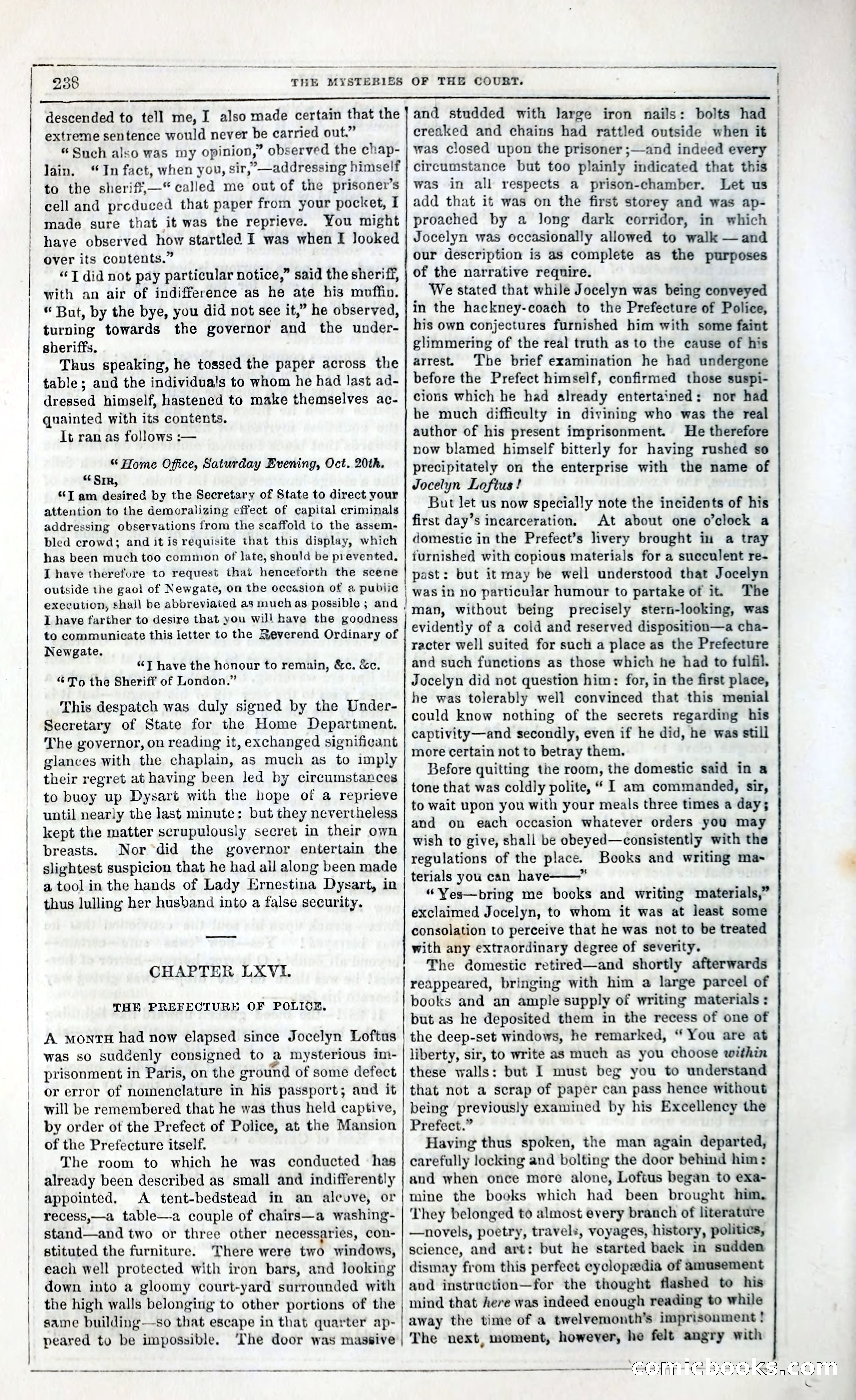
A restored page from Penny Dreadfuls, 1849. Page through the whole issue in the reader above.
📄 Transcribed text from this page (OCR, searchable)
Machine-transcribed from the original scan — historical spelling and the odd misread are preserved.
owen oe sit ee ee ee tee ee Oe 238 descended to tell me, I also made certain that the extreme sentence would never be carried out.” “ Such also was my opinion,” observed the chap- lain. “In fact, when you, sir,’—addressing himself to the sheriff,—“ called me out of the prisoner’s cell and preduced that paper from your pocket, I made sure that it was the reprieve. You might have observed how startled I was when I looked over its contents.” “T did not pay particular notice,” said the sheriff, with an air of indifference as he ate his muffin. “ But, by the bye, you did not see it,” he observed, turning towards the governor and the under- sheriffs. Thus speaking, he tossed the paper across the table; and the individuals to whom he had last ad- dressed himself, hastened to make themselves ac- quainted with its contents. It ran as follows :— “ Home Office, Saturday Evening, Oct. 20th. ‘¢ SIR, “T am desired by the Secretary of State to direct your attention to the demoralizing effect of capital criminals addressing observations from the scaffold to the assem- bled crowd; and it is requisite that this display, which has been much too common of late, should be prevented. I have therefore to request that henceforth the scene outside the gaol of Newgate, on the occasion of a public execution, shall be abbreviated as muchas possible ; and I have farther to desire that you will have the goodness to communicate this letter to the Reverend Ordinary of Newgate. “JT have the honour to remain, &c. &c. “To the Sheriff of London.” This despatch was duly signed by the Under- Secretary of State for the Home Department. The governor, on reading it, exchanged significant glances with the chaplain, as much as to imply their regret at having been led by circumstances to buoy up Dysart with the hope of a reprieve until nearly the last minute; but they nevertheless kept the matter scrupulously secret in their own breasts. Nor did the governor entertain the slightest suspicion that he had all along been made a tool in the hands of Lady Ernestina Dysart, in thus lulling her husband into a false security. CHAPTER LXVI. THE PREFECTURE OF POLICE. A. monts had now elapsed since Jocelyn Loftus was so suddenly consigned to a mysterious im- prisonment in Paris, on the ground of some defect or error of nomenclature in his passport; and it will be remembered that he was thus held captive, by order of the Prefect of Police, at the Mansion of the Prefecture itself. The room to which he was conducted has already been described as small and indifferently appointed. A tent-bedstead in an alevuve, or recess,—a table—a couple of chairs—a washing- stand—and two or three other necessaries, con- stituted the furniture. There were two windows, each well protected with iron bars, and looking down into a gloomy court-yard surrounded with the high walls belonging to other portions of the same building—so that escape in that quarter ap- peared to be impossible. ‘The door was massive THE MYSTERIES OF THE COURT. re ae ne a SSS sss nen em eee ae Oe ae eC ee ee ee ee. ee and studded with large iron nails: bolts had creaked and chains had rattled outside when it a rd was closed upon the prisoner ;—and indeed every _ circumstance but too plainly indicated that this | was in all respects a prison-chamber. add that it was on the first storey and was ap- proached by a long dark corridor, in which Jocelyn was occasionally allowed to walk —and our description is as complete as the purposes of the narrative require. We stated that while Jocelyn was being conveyed in the hackney-coach to the Prefecture of Police, his own conjectures furnished him with some faint glimmering of the real truth as to the cause of his arrest. The brief examination he had undergone before the Prefect himself, confirmed those suspi- cions which he had already entertained: nor had be much difficulty in divining who was the real author of his present imprisonment. He therefore now blamed himself bitterly for having rushed so precipitately on the enterprise with the name of Jocelyn Loftus! But let us now specially note the incidents of his first day’s incarceration. At about one o’clock a domestic in the Prefect’s livery brought in a tray iurnished with copious materials for a succulent re- past: but it may he well understood that Jocelyn was in no particular humour to partake of it. The man, without being precisely stern-looking, was evidently of a cold and reserved disposition—a cha- racter well suited for such a place as the Prefecture and such functions as those which he had to fulfil. Jocelyn did not question him: for, in the first place, he was tolerably well convinced that this menial could know nothing of the secrets regarding his captivity—and secondly, even if he did, he was still more certain not to betray them. Before quitting the room, the domestic said in a tone that was coldly polite, * I am commanded, sir, to wait upon you with your meals three times a day; and on each occasion whatever orders you may wish to give, shall be obeyed—consistently with the regulations of the place. Books and writing ma- terials you can have——” “Yes—bring me books and writing materials,” exclaimed Jocelyn, to whom it was at least some consolation to perceive that he was not to be treated with any extraordinary degree of severity. The Gomestic retired—and shortly afterwards reappeared, bringing with him a large parcel of books and an ample supply of writing materials: but as he deposited them in the recess of one of the deep-set windows, he remarked, “ You are at liberty, sir, to write as much as you choose within these walls: but I must beg you to understand that not a scrap of paper can pass hence without being previously examined by his Excellency the Prefect.” Having thus spoken, the man again departed, carefully locking and bolting the door behind him: and when once more alone, Loftus began to exa- mine the books which had been brought him, They belonged to almost every branch of literature —novels, poetry, travels, voyages, history, politics, science, and art: but he started back in sudden dismay from this perfect cyclopzedia of amusement aud instruction—for the thought flashed to his mind that here was indeed enough reading to while away the time of a twelvemonth’s imprisonment! The next, moment, however, he felt angry with Let us | OT COO, S (€@)