
Penny Dreadfuls, 1849 · page 248 of 394
The Mysteries of the Court of London — page 248: what you’re looking at
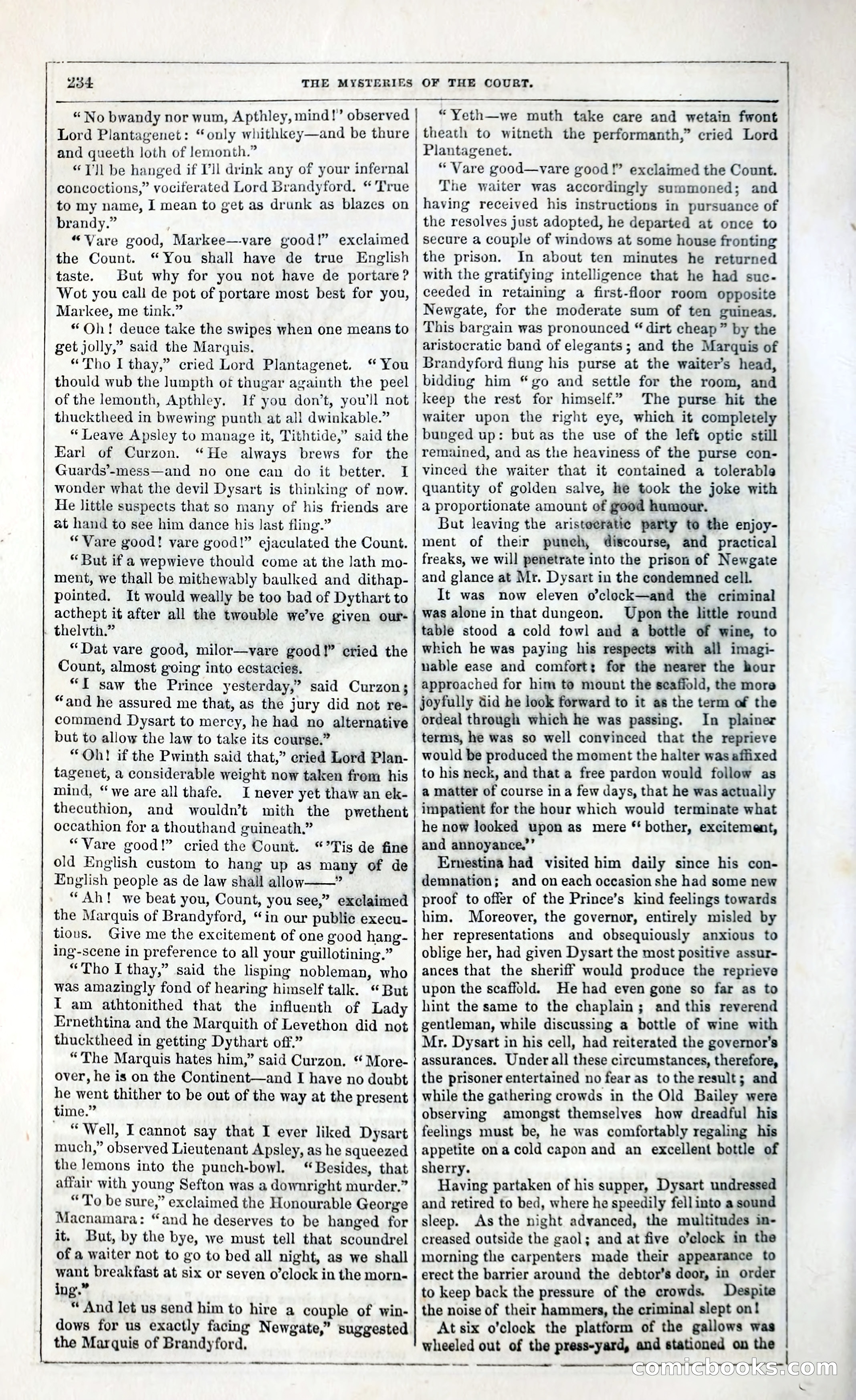
A restored page from Penny Dreadfuls, 1849. Page through the whole issue in the reader above.
📄 Transcribed text from this page (OCR, searchable)
Machine-transcribed from the original scan — historical spelling and the odd misread are preserved.
“ No bwandy nor wum, Apthley, mind!’ observed Lord Plantagenet: “only whithkey—and be thure and queeth loth of lemonth.” “11 be hanged if ll drink any of your infernal concoctions,” vociferated Lord Brandyford. * True to my name, I mean to get as drunk as blazes on brandy.” ) “Ware good, Markee—-vare good!” exclaimed the Count. “You shall have de true English taste. But why for you not have de portare? Wot you call de pot of portare most best for you, Markee, me tink.” , * Oh! deuce take the swipes when one means to get jolly,” said the Marquis. “Tho I thay,” cried Lord Plantagenet. “ You thould wub the lumpth of thugar againth the peel of the lemonth, Apthley. If you don’t, you'll not thucktheed in bwewing punth at all dwinkable.” “Leave Apsley to manage it, Tithtide,” said the Earl of Curzon. “He always brews for the Guards’-mess—and no one can do it better. I wonder what the devil Dysart is thinking of now. He little suspects that so many of his friends are at hand to see him dance his last fling.” “Vare good! vare good!” ejaculated the Count. * But if a wepwieve thould come at the lath mo- ment, we thall be mithewably baulked and dithap- pointed. It would weally be too bad of Dythart to acthept it after all the twouble we’ve given our- . thelvth.” “Dat vare good, milor—vare good!” cried the Count, almost going into ecstacies. “I saw the Prince yesterday,” said Curzon; “and he assured me that, as the jury did not re- commend Dysart to mercy, he had no alternative but to allow the law to take its course.” “Oh! if the Pwinth said that,” eried Lord Plan- tagenet, a considerable weight now taken from his mind, “ we are all thafe. I never yet thaw an ek- thecuthion, and wouldn’t mith the pwethent occathion for a thouthand guineath.” “Vare good!” cried the Count. “’Tis de fine old English custom to hang up as many of de English people as de law shall allow——” “Ah! we beat you, Count, you see,” exclaimed the Marquis of Brandyford, “in our public execu- tious. Give me the excitement of one good hang- ing-scene in preference to all your guillotining.” “Tho I thay,” said the lisping nobleman, who was amazingly fond of hearing himself talk. “But I am athtonithed that the influenth of Lady Ernethtina and the Marquith of Levethon did not thucktheed in getting Dythart off.” “The Marquis hates him,” said Curzon. * More- over, he is on the Continent—and I have no doubt he went thither to be out of the way at the present time.” “Well, Lcannot say that I ever liked Dysart much,” observed Lieutenant Apsley, as he squeezed the Jemons into the punch-bowl. “Besides, that affair with young Sefton was a downright murder.” “To be sure,” exclaimed the Honourable George Macnamara: “and he deserves to be hanged for it. But, by the bye, we must tell that scoundrel of a waiter not to go to bed all night, as we shall want breakfast at six or seven o’clock in the morn- ing.” “ And let us send him to hire a couple of win- dows for us exactly facing Newgate,” suggested the Marquis of Brandyford. THE MYSTERIES OF THE COURT. “Yeth—we muth take care and wetain fwont theath to witneth the performanth,” cried Lord Plantagenet. “ Vare good—vare good!” exclaimed the Count. | - ae ' ' ' The waiter was accordingly summoned; and | having received his instructions in pursuance of the resolves just adopted, he departed at once to — secure a couple of windows at some house fronting | the prison. In about ten minutes he returned with the gratifying intelligence that he had suc- ceeded in retaining a first-floor room opposite Newgate, for the moderate sum of ten guineas. This bargain was pronounced “ dirt cheap” by the aristocratic band of elegants; and the Marquis of Brandyford flung his purse at the waiter’s head, bidding him “go and settle for the room, and keep the rest for himself.” The purse hit the waiter upon the right eye, which it completely bunged up: but as the use of the left optic still remained, and as the heaviness of the purse con- vinced the waiter that it contained a tolerable quantity of golden salve, he took the joke with a proportionate amount of good humour. But leaving the aristoeratie party to the enjoy- ment of their puneh, discourse, and practical freaks, we will penetrate into the prison of Newgate and glance at Mr. Dysart in the condemned cell. It was now eleven o’clock—and the criminal was alone in that dungeon. Upon the little round table stood a cold towl and a bottle of wine, to which he was paying his respects with all imagi- nable ease and comfort; for the nearer the hour approached for him to mount the seafiold, the more joyfully did he look forward to it as the term of the ordeal through which he was passing. In plainer terms, he was so well convinced that the reprieve would be produced the moment the halter was affixed to his neck, and that a free pardon would follow as a matter of course in a few days, that he was actually impatient for the hour which would terminate what he now looked upon as mere * bother, excitement, and annoyance.’ Emestina had visited him daily since his con- demnation; and on each occasion she had some new proof to offer of the Prince’s kind feelings towards him. Moreover, the governor, entirely misled by her representations and obsequiously anxious to oblige her, had given Dysart the most positive assur- ances that the sheriff would produce the reprieve upon the scaffold. He had even gone so far as to hint the same to the chaplain; and this reverend gentleman, while discussing a bottle of wine with Mr. Dysart in his cell, had reiterated the governor's assurances. Under all these circumstances, therefore, the prisoner entertained no fear as tothe result; and while the gathering crowds in the Old Bailey were observing amongst themselves how dreadful his feelings must be, he was comfortably regaling his appetite ona cold capon and an excellent bottle of sherry. Having partaken of his supper, Dysart undressed and retired to bed, where he speedily fellinto a sound sleep. As the night advanced, the multitudes in- creased outside the gaol; and at five o’clock in the morning the carpenters made their appearance to erect the barrier around the debtor’s door, in order to keep back the pressure of the crowds. Despite the noise of their hammers, the criminal slept on! At six o’clock the platform of the gallows was wheeled out of the press-yard, and stationed on the -_——— ee im OOK) CS: CO