
Penny Dreadfuls, 1849 · page 230 of 394
The Mysteries of the Court of London — page 230: what you’re looking at
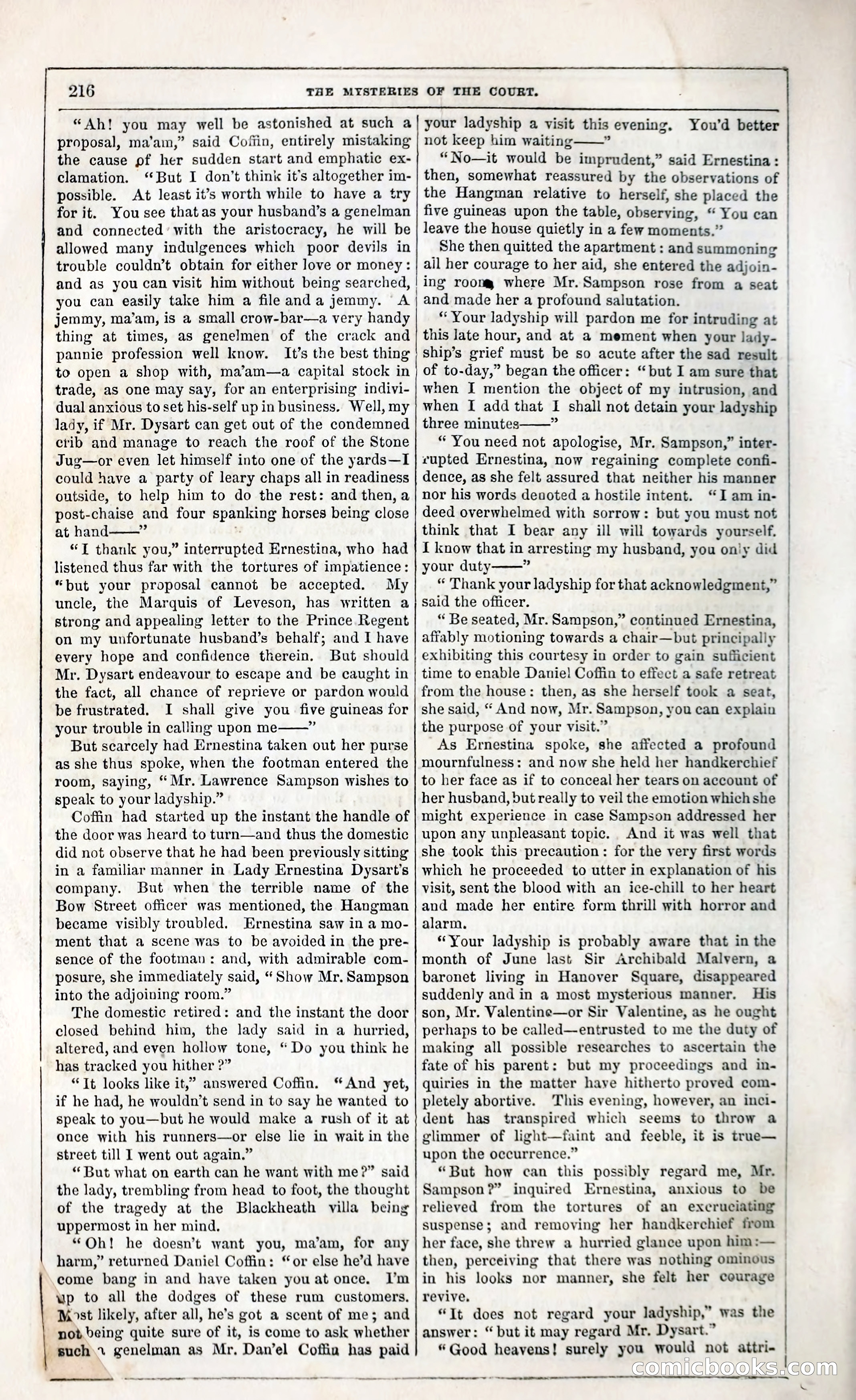
A restored page from Penny Dreadfuls, 1849. Page through the whole issue in the reader above.
📄 Transcribed text from this page (OCR, searchable)
Machine-transcribed from the original scan — historical spelling and the odd misread are preserved.
216 THE MYSTERIES OF THE COURT. DLL DBDDBDBDLL LLL LLL LL LLL il, “Ah! you may well be astonished at such a proposal, ma’am,” said Coffin, entirely mistaking the cause pf her sudden start and emphatic ex- clamation. ‘But I don’t think it’s altogether im- possible. At least it’s worth while to have a try for it. You see thatas your husband’s a genelman and connected’ with the aristocracy, he will be allowed many indulgences which poor devils in trouble couldn’t obtain for either love or money: and as youcan visit him without being searched, you can easily take him a fileanda jemmy. A jemmy, ma’am, is a small crow-bar—a very handy thing at times, as genelmen of the crack and pannie profession well know. It’s the best thing to open a shop with, ma’am—a capital stock in trade, as one may say, for an enterprising indivi- | dual anxious to set his-self up in business. Well, my lady, if Mr. Dysart can get out of the condemned crib and manage to reach the roof of the Stone Jug—or even let himself into one of the yards—I could have a party of leary chaps all in readiness outside, to help him to do the rest: and then, a post-chaise and four spanking horses being close at hand——” * “JT thank you,” interrupted Ernestina, who had listened thus far with the tortures of impatience: “but your proposal cannot be accepted. My uncle, the Marquis of Leveson, has written a strong and appealing letter to the Prince Regent on my unfortunate husband’s behalf; and I have every hope and confidence therein. But should Mr. Dysart endeavour to escape and be caught in the fact, all chance of reprieve or pardon would be frustrated. I shall give you five guineas for your trouble in calling upon me——” But scarcely had Ernestina taken out her purse as she thus spoke, when the footman entered the room, saying, “Mr. Lawrence Sampson wishes to speak to your ladyship.” Coffin had started up the instant the handle of the door was heard to turn—and thus the domestic did not observe that he had been previously sitting in a familiar manner in Lady Ernestina Dysart’s company. But when the terrible name of the Bow Street officer was mentioned, the Hangman became visibly troubled. Ernestina saw in a mo- ment that a scene was to be avoided in the pre- sence of the footman: and, with admirable com- posure, she immediately said, “ Show Mr. Sampson into the adjoining room.” The domestic retired: and the instant the door closed behind him, the lady said in a hurried, altered, and even hollow tone, “Do you think he has tracked you hither ?” “Tt looks like it,’ answered Coffin. And yet, if he had, he wouldn’t send in to say he wanted to speak to you—but he would make a rush of it at once with his runners—or else lie in wait in the street till I went out again.” “But what on earth can he want with me?” said the lady, trembling from head to foot, the thought of the tragedy at the Blackheath villa being uppermost in her mind. * Oh! he doesn’t want you, ma’am, for any harm,” returned Daniel Coffin: “or else he’d have come bang in and have taken youatonce. I’m up to all the dodges of these rum customers. M st likely, after all, he’s got a scent of me; and not being quite sure of it, is come to ask whether such 1 genelman as Mr, Dan’el Coffin has paid | ee een + «0 ee et ee - - —_--=- et your ladyship a visit this evening. You'd better not keep him waiting s “ No—it would be imprudent,” said Ernestina: then, somewhat reassured by the observations of the Hangman relative to herself, she placed the five guineas upon the table, observing, “ You can leave the house quietly in a few moments.” She then quitted the apartment : and summoning ail her courage to her aid, she entered the adjoin- | ing roomy where Mr. Sampson rose from a seat | and made her a profound salutation. “Your ladyship will pardon me for intruding at this late hour, and at a mement when your lady- ship’s grief must be so acute after the sad result — of to-day,” began the officer: “but I am sure that when I mention the object of my intrusion, and when I add that I shall not detain your ladyship three minutes i “ You need not apologise, Mr. Sampson,” inter- rupted Ernestina, now regaining complete confi- dence, as she felt assured that neither his manner nor his words denoted a hostile intent. “Iam in- deed overwhelmed with sorrow: but you must not think that I bear any ill will towards yourself. I know that in arresting my husband, you only did your duty-——” “ Thank your ladyship for that acknowledgment,” said the officer. “ Be seated, Mr. Sampson,” continued Ernestina, affably motioning towards a chair—but principally exhibiting this courtesy in order to gain sufficient time to enable Daniel Coffin to effect a safe retreat from the house: then, as she herself took a seat, she said, “ And now, Mr. Sampson, you can explain the purpose of your visit.” As Ernestina spoke, she affected a profound mournfulness: and now she held her handkerchief to her face as if to conceal her tears on account of her husband, but really to veil the emotion which she might experience in case Sampson addressed her upon any unpleasant topic. And it was well that she took this precaution: for the very first words which he proceeded to utter in explanation of his visit, sent the blood with an ice-chill to her heart and made her entire form thrill with horror and alarm. ‘Your ladyship is probably aware that in the month of June last Sir Archibald Malvern, a baronet living in Hanover Square, disappeared suddenly and in a most mysterious manner. His son, Mr. Valentine—or Sir Valentine, as he ought perhaps to be called—entrusted to me the duty of making all possible researches to ascertain the fate of his parent: but my proceedings and in- quiries in the matter have hitherto proved com- pletely abortive. This evening, however, an inci- dent has transpired which seems to throw a glimmer of light—faint and feeble, it is true— upon the occurrence.” “But how can this possibly regard me, Mr. Sampson?” inquired Ernestina, anxious to be relieved from the tortures of an excruciating suspense; and removing her handkerchief from her face, she threw a hurried glance upon him:— then, perceiving that there was nothing ominous | in his looks nor manner, she felt her courage revive, “It does not regard your ladyship,” was the answer: “but it may regard Mr, Dysart.” “Good heavens! surely you would not attri- A S UEEEEemeemetineeeeen ooo — — GomilGchoo Sh Sr a