
Penny Dreadfuls, 1849 · page 225 of 394
The Mysteries of the Court of London — page 225: what you’re looking at
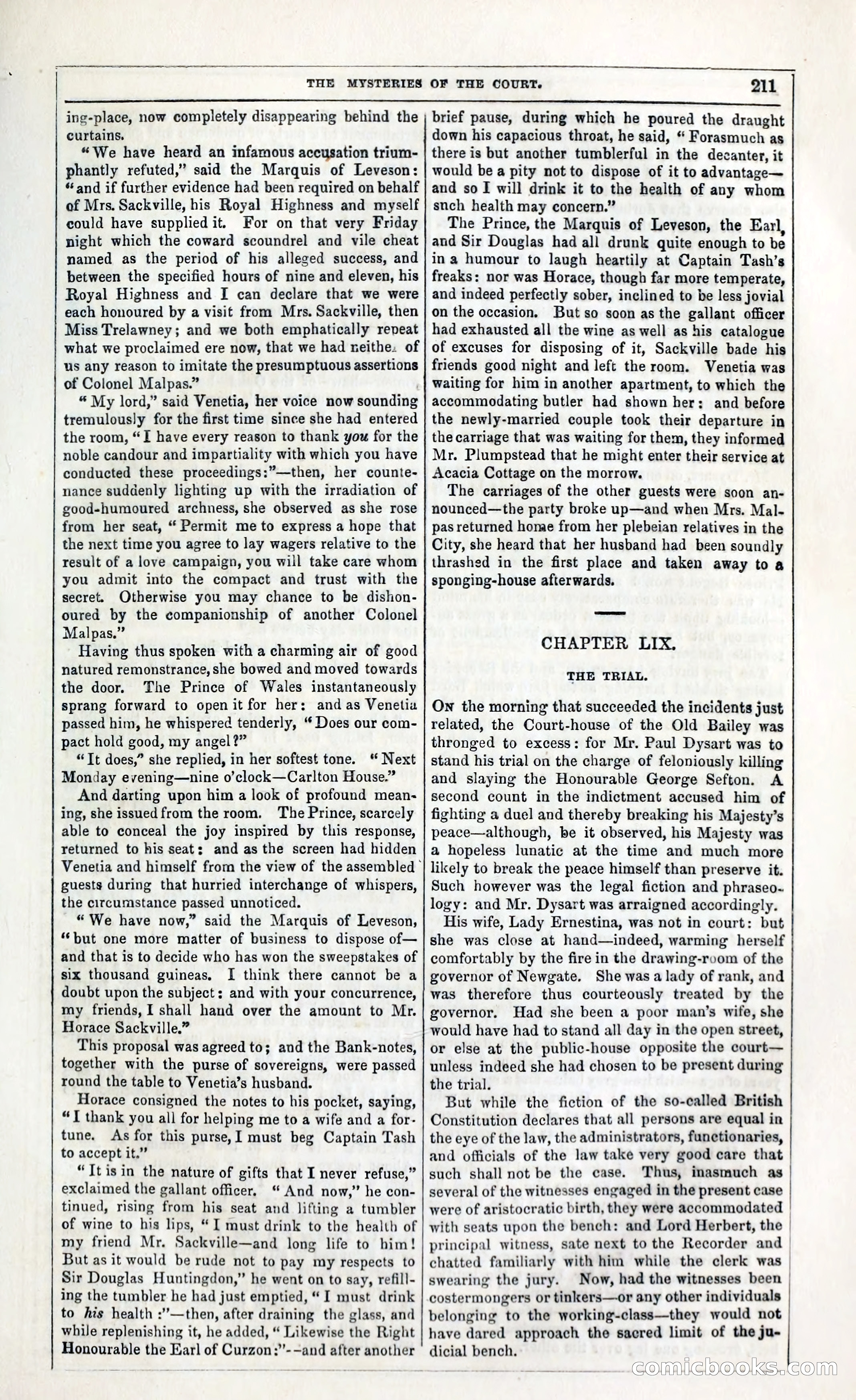
A restored page from Penny Dreadfuls, 1849. Page through the whole issue in the reader above.
📄 Transcribed text from this page (OCR, searchable)
Machine-transcribed from the original scan — historical spelling and the odd misread are preserved.
coeoeeorerr---—— oor eos ee THE MYSTERIES ing-place, now completely disappearing behind the curtains. “We have heard an infamous accusation trium- phantly refuted,” said the Marquis of Leveson: “ and if further evidence had been required on behalf of Mrs. Sackville, his Royal Highness and myself could have supplied it. For on that very Friday night which the coward scoundrel and vile cheat named as the period of his alleged success, and between the specified hours of nine and eleven, his Royal Highness and I can declare that we were each honoured by a visit from Mrs. Sackville, then Miss Trelawney; and we both emphatically repeat what we proclaimed ere now, that we had neithe. of us any reason to imitate the presumptuous assertions of Colonel Malpas.” “ My lord,” said Venetia, her voice now sounding tremulously for the first time since she had entered the room, “I have every reason to thank you for the noble candour and impartiality with which you have conducted these proceedings:”—then, her counte- nance suddenly lighting up with the irradiation of good-humoured archness, she observed as she rose from her seat, “ Permit me to express a hope that the next time you agree to lay wagers relative to the result of a love campaign, you will take care whom you admit into the compact and trust with the secret. Otherwise you may chance to be dishon- oured by the companionship of another Colonel Malpas.” Having thus spoken with a charming air of good natured remonstrance, she bowed and moved towards the door, The Prince of Wales instantaneously sprang forward to openit for her: and as Venetia passed him, he whispered tenderly, “ Does our com- pact hold good, my angel ?” “Tt does,” she replied, in her softest tone. “ Next Monday evening—nine o’clock—Carlton House.” And darting upon him a look of profound mean- ing, she issued from the room. The Prince, scarcely able to conceal the joy inspired by this response, returned to his seat: and as the screen had hidden Venetia and himself from the view of the assembled guests during that hurried interchange of whispers, the circumstance passed unnoticed. “We have now,” said the Marquis of Leveson, ‘‘but one more matter of business to dispose of— and that is to decide who has won the sweepstakes of six thousand guineas, I think there cannot be a doubt upon the subject: and with your concurrence, my friends, I shall hand over the amount to Mr. Horace Sackville.” This proposal was agreed to; and the Bank-notes, together with the purse of sovereigns, were passed round the table to Venetia’s husband. Horace consigned the notes to his pocket, saying, “J thank you all for helping me to a wife and a for- tune. As for this purse, I must beg Captain Tash to accept it “TItisin the nature of gifts that I never refuse,” exclaimed the gallant officer, “ And now,” he con- tinued, rising from his seat and lifting a tumbler of wine to his lips, “I must drink to the health of my friend Mr. Sackville—and long life to him! But as it would be rude not to pay my respects to Sir Douglas Huntingdon,” he went on to say, refill- ing the tumbler he had just emptied, “I must drink to his health :’’—then, after draining the glass, and while replenishing it, he added, “ Likewise the Right Honourable the Earl of Curzon:’’--and after another OF THE COURT. 211 brief pause, during which he poured the draught down his capacious throat, he said, * Forasmuch as there is but another tumblerful in the decanter, it would be a pity not to dispose of it to advantage— and so I will drink it to the health of any whom such health may concern.” The Prince, the Marquis of Leveson, the Earl, and Sir Douglas had all drunk quite enough to be ina humour to laugh heartily at Captain Tash’s freaks: nor was Horace, though far more temperate, and indeed perfectly sober, inclined to be less jovial on the occasion. But so soon as the gallant officer had exhausted all the wine as well as his catalogue of excuses for disposing of it, Sackville bade his friends good night and left the room. Venetia was waiting for him in another apartment, to which the accommodating butler had shown her: and before the newly-married couple took their departure in the carriage that was waiting for them, they informed Mr. Plumpstead that he might enter their service at Acacia Cottage on the morrow. The carriages of the other guests were soon an- nounced—the party broke up—and when Mrs. Mal- pas returned home from her plebeian relatives in the City, she heard that her husband had been soundly thrashed in the first place and taken away to a sponging-house afterwards. CHAPTER LIX. THE TRIAL. On the morning that succeeded the incidents just related, the Court-house of the Old Bailey was thronged to excess: for Mr. Paul Dysart was to stand his trial on the charge of feloniously killing and slaying the Honourable George Sefton. A second count in the indictment accused him of fighting a duel and thereby breaking his Majesty’s peace—although, be it observed, his Majesty was a hopeless lunatic at the time and much more likely to break the peace himself than preserve it. Such however was the legal fiction and phraseo- logy: and Mr. Dysart was arraigned accordingly. His wife, Lady Ernestina, was not in court: but she was close at hand—indeed, warming herself comfortably by the fire in the drawing-room of the governor of Newgate. She was a lady of rank, and was therefore thus courteously treated by the governor. Had she been a poor man’s wife, she would have had to stand all day in the open street, or else at the public-house opposite the court— unless indeed she had chosen to be present during the trial. But while the fiction of the so-called British Constitution declares that all persons are equal in the eye of the law, the administrators, functionaries, and officials of the law take very good care that such shall not be the case. Thus, inasmuch as several of the witnesses engaged in the present case were of aristocratic birth, they were accommodated ee with seats upon the bench: and Lord Herbert, the | principal witness, sate next to the Recorder and chatted familiarly with him while the clerk was swearing the jury. Now, had the witnesses been costermongers or tinkers—or any other individuals belonging to the working-class—they would not have dared approach the sacred limit of the ju- dicial bench. a S) EO) JOO (C C(O)