
Penny Dreadfuls, 1849 · page 197 of 394
The Mysteries of the Court of London — page 197: what you’re looking at
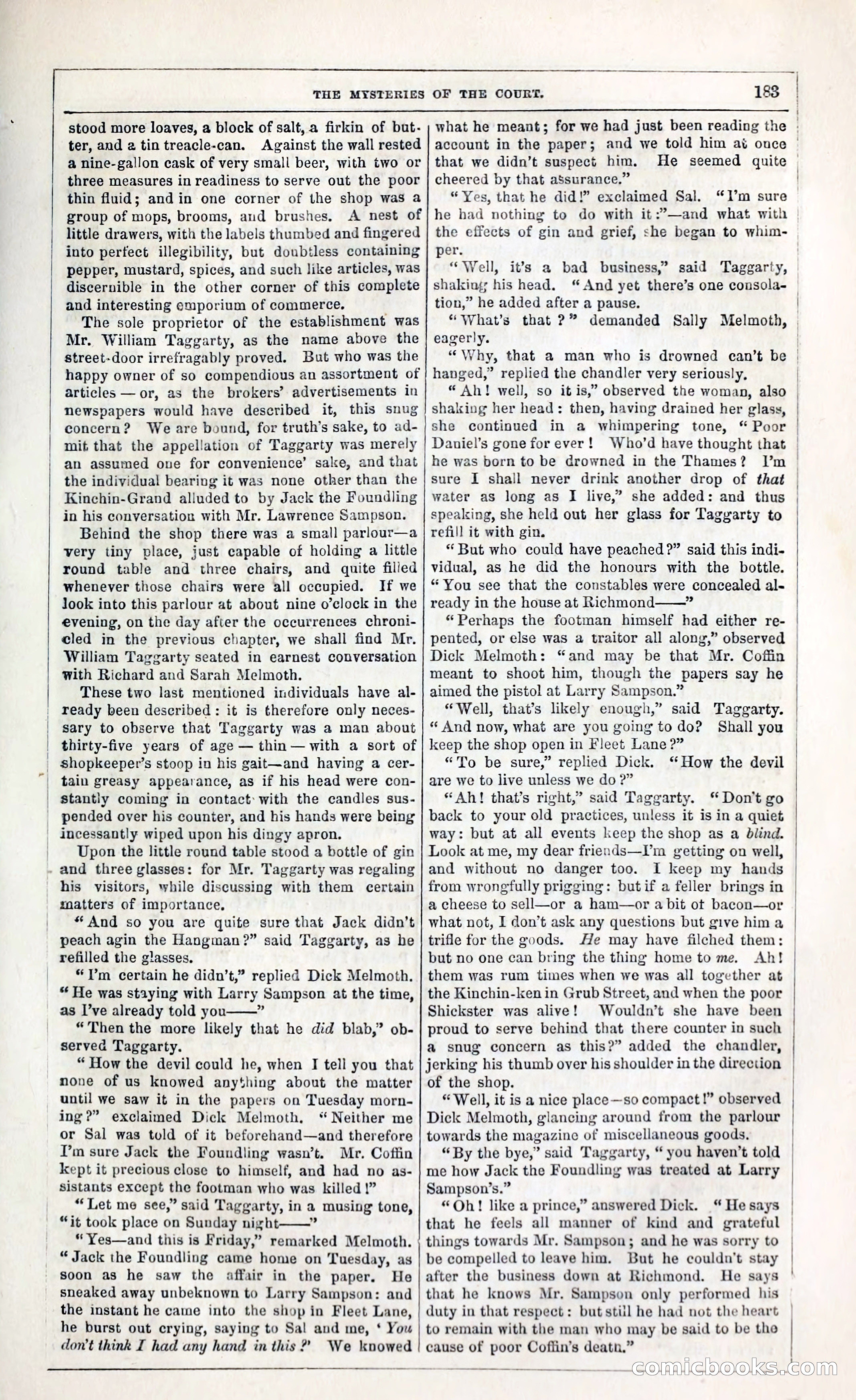
A restored page from Penny Dreadfuls, 1849. Page through the whole issue in the reader above.
📄 Transcribed text from this page (OCR, searchable)
Machine-transcribed from the original scan — historical spelling and the odd misread are preserved.
THE MYSTERIES OF THE COURT. stood more loaves, a block of salt, a firkin of but- ter, and a tin treacle-can. Against the wall rested a nine-gallon cask of very small beer, with two or three measures in readiness to serve out the poor thin fluid; andin one corner of the shop was a group of mops, brooms, aud brushes. A nest of little drawers, with the labels thumbed and fingered into perfect illegibility, but doubtless containing pepper, mustard, spices, and such like articles, was discernible in the other corner of this complete and interesting emporium of commerce. The sole proprietor of the establishment was Mr. William Taggarty, as the name above the street-door irrefragably proved. But who was the happy owner of so compendious an assortment of articles —or, as the brokers’ advertisements in newspapers would have described it, this snug concern? We are bound, for truth’s sake, to ad- mit that the appellation of Taggarty was merely an assumed oue for convenience’ sake, and that the individual bearing it was none other than the Kinchin-Grand alluded to by Jack the Foundling in his conversation with Mr. Lawrence Sampson. Behind the shop there was a small parlour—a very tiny place, just capable of holding a little round table and three chairs, and quite filled whenever those chairs were all occupied. If we Jook into this parlour at about nine o’clock in the evening, on the day after the occurrences chroni- ecled in the previous chapter, we shall find Mr. William Taggarty seated in earnest conversation with Richard and Sarah Melmoth. These two last mentioned individuals have al- ready been described: it is therefore only neces- sary to observe that Taggarty was a man about thirty-five years of age — thin— with a sort of shopkeeper’s stoop in his gait—and having a cer- tain greasy appearance, as if his head were con- stantly coming in contact: with the candles sus- pended over his counter, and his hands were being incessantly wiped upon his dingy apron. Upon the little round table stood a bottle of gin . and three glasses: for Mr. Taggarty was regaling his visitors, while discussing with them certain matters of importance, * And so you are quite sure that Jack didn’t peach agin the Hangman?” said Taggarty, as he refilled the glasses, “1m certain he didn’t,” replied Dick Melmoth. “ He was staying with Larry Sampson at the time, as [I’ve already told you——” “Then the more likely that he did blab,” ob- served Taggarty. “ How the devil could he, when I tell you that none of us knowed anything about the matter until we saw it in the papers on Tuesday morn- ing?” exclaimed Dick Melmoth. ‘“ Neither me or Sal was told of it beforehand—and therefore I’m sure Jack the Foundling wasn’t. Mr. Coffin kept it precious close to himself, and had no as- Sistants except the footman who was killed |” “Let me see,” said Taggarty, in a musing tone, “it took place on Sunday night % * Yes—and this is Friday,’ remarked Melmoth. “Jack the Foundling came home on Tuesday, as soon as he saw the affair in the paper. He sneaked away unbeknown to Larry Sampson: and the instant he came into the shop in Fleet Lane, he burst out crying, saying to Sal and me, ‘* You don’t think I had any hand in this?) We knowed a 183 —- _——_—_—— what he meant; for we had just been reading the . account in the paper; and we told him at once © that we didn’t suspect him. cheered by that aSsurance,” “ Yes, that he did!” exclaimed Sal. “I’m sure he had nothing to do with it:’—and what with the effects of gin and grief, she began to whim- er. “Well, it’s a bad business,” said Taggarty, shakiugs his head. “And yet there’s one consola- tion,” he added after a pause. He seemed quite | “What’s that ?” demanded Sally Melmoth, | eagerly. “Why, that a man who is drowned can’t be hanged,” replied the chandler very seriously, “ Ah! well, so it is,’ observed the woman, also shaking her head: then, having drained her glass, she continued in a whimpering tone, “ Poor Daniel’s gone forever! Who'd have thought that he was born to be drowned in the Thames? sure I shall never drink another drop of that water as long as I live,” she added: and thus speaking, she held out her glass for Tagyarty to refill it with gin. * But who could have peached ?” said this indi- vidual, as he did the honours with the bottle. “You see that the constables were concealed al- ready in the house at Richmond——” “Perhaps the footman himself had either re- pented, or else was a traitor all along,” observed Dick Melmoth: “and may be that Mr. Coffin meant to shoot him, though the papers say he aimed the pistol at Larry Sampson.” “Well, that’s likely enough,” said Taggarty. « And now, what are you going to do? Shall you keep the shop open in Fleet Lane ?” “To be sure,” replied Dick. ‘“ How the devil are we to live unless we do ?” “Ah! that’s right,” said Taggarty. Don't go back to your old practices, unless it is in a quiet way: but at all events keep the shop as a blind. Look at me, my dear friends—I’'m getting on well, and without no danger too. I keep my hands from wrongfully prigging: butif a feller brings in Vm | a cheese to sell—or a ham—or a bit ot bacon—or | what not, I don’t ask any questions but give him a trifle for the goods. He may have filched them: but no one can bring the thing home to me. Ah! them was rum times when we was all together at the Kinchin-ken in Grub Street, and when the poor Shickster was alive! Wouldn’t she have been proud to serve behind that there counter in such | a snug concern as this?” added the chandler, jerking his thumb over his shoulder in the direction of the shop. “Well, it is a nice place—so compact!” observed Dick Melmoth, glancing around from the parlour towards the magazine of miscellaneous goods. “By the bye,” said Taggarty, “ you hayen’t told me how Jack the Foundling was treated at Larry Sampson’s.” “Oh! like a prince,” answered Dick. “ He says that he feels all manner of kind and grateful things towards Mr. Sampson; and he was sorry to be compelled to leave him. But he couldn't stay after the business down at Richmond. He says that he knows Mr, Sampson only performed his duty in that respect: but stiil he had not the heart to remain with the man who may be said to be the cause of poor Coflin’s death.” CORMCEOOOLKS (e©