
Penny Dreadfuls, 1849 · page 19 of 394
The Mysteries of the Court of London — page 19: what you’re looking at
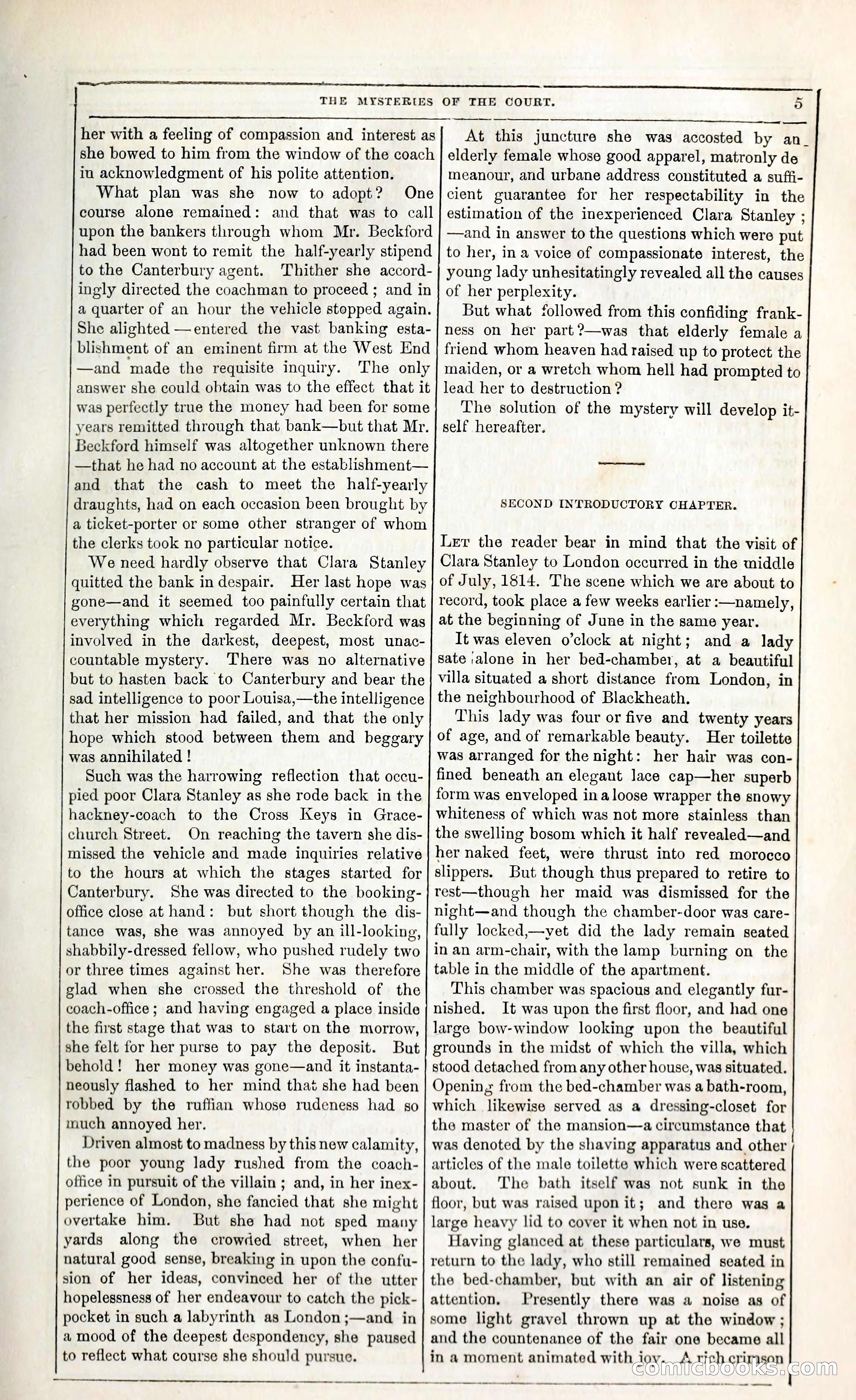
A restored page from Penny Dreadfuls, 1849. Page through the whole issue in the reader above.
📄 Transcribed text from this page (OCR, searchable)
Machine-transcribed from the original scan — historical spelling and the odd misread are preserved.
THE her with a feeling of compassion and interest as she bowed to him from the window of the coach in acknowledgment of his polite attention. What plan was she now to adopt? One course alone remained: and that was to call upon the bankers through whom Mr. Beckford had been wont to remit the half-yearly stipend to the Canterbury agent. Thither she accord- ingly directed the coachman to proceed ; and in a quarter of an hour the vehicle stopped again. She alighted —entered the vast banking esta- blishment of an eminent firm at the West End —and made the requisite inquiry. The only answer she could obtain was to the effect that it was perfectly true the money had been for some years remitted through that bank—but that Mr. Beckford himself was altogether unknown there —that he had no account at the establishment— and that the cash to meet the half-yearly draughts, had on each occasion been brought by a ticket-porter or some other stranger of whom the clerks took no particular notice. We need hardly observe that Clara Stanley quitted the bank in despair. Her last hope was gone—and it seemed too painfully certain that everything which regarded Mr. Beckford was involved in the darkest, deepest, most unac- countable mystery. There was no alternative but to hasten back to Canterbury and bear the sad intelligence to poor Louisa,—the intelligence that her mission had failed, and that the only hope which stood between them and beggary was annihilated ! Such was the harrowing reflection that occu- pied poor Clara Stanley as she rode back in the hackney-coach to the Cross Keys in Grace- church Street. On reaching the tavern she dis- missed the vehicle and made inquiries relative to the hours at which the stages started for Canterbury. She was directed to the booking- office close at hand: but short though the dis- tance was, she was annoyed by an ill-looking, shabbily-dressed fellow, who pushed rudely two or three times against her. She was therefore glad when she crossed the threshold of the coach-office; and having engaged a place inside the first stage that was to start on the morrow, she felt for her purse to pay the deposit. But behold! her money was gone—and it instanta- neously flashed to her mind that she had been robbed by the ruffian whose rudeness had go much annoyed her. Driven almost to madness by this new calamity, the poor young lady rushed from the coach- office in pursuit of the villain ; and, in her inex- perience of London, she fancied that she might overtake him. But she had not sped many yards along the crowded street, when her natural good sense, breaking in upon the confu- sion of her ideas, convinced her of the utter hopelessness of her endeavour to catch the pick- pocket in such a labyrinth as London ;—and in a mood of the deepest despondency, she paused to reflect what course she should pursue. i ee ee —— a MYSTERIES OF THE COURT. a At this juncture she was accosted by an_ elderly female whose good apparel, matronly de meanour, and urbane address constituted a suffi- cient guarantee for her respectability in the estimation of the inexperienced Clara Stanley ; —and in answer to the questions which were put to her, in a voice of compassionate interest, the young lady unhesitatingly revealed all the causes of her perplexity. But what followed from this confiding frank- ness on her part ?—was that elderly female a friend whom heaven had raised up to protect the maiden, or a wretch whom hell had prompted to lead her to destruction ? The solution of the mystery will develop it- self hereafter. SECOND INTRODUCTORY CHAPTER. Ler the reader bear in mind that the visit of Clara Stanley to London occurred in the middle of July, 1814. The scene which we are about to record, took place a few weeks earlier :—namely, at the beginning of June in the same year. It was eleven o’clock at night; and a lady sate ;alone in her bed-chamber, at a beautiful villa situated a short distance from London, in the neighbourhood of Blackheath. This lady was four or five and twenty years of age, and of remarkable beauty. Her toilette | was arranged for the night: her hair was con- fined beneath an elegant lace cap—her superb form was enveloped inaloose wrapper the snowy whiteness of which was not more stainless than the swelling bosom which it half revealed—and her naked feet, were thrust into red morocco slippers. But though thus prepared to retire to rest—though her maid was dismissed for the. night—and though the chamber-door was care- fully locked,—yet did the lady remain seated in an arm-chair, with the lamp burning on the table in the middle of the apartment. This chamber was spacious and elegantly fur- nished. It was upon the first floor, and had one large bow-window looking upon the beautiful grounds in the midst of which the villa, which stood detached from any other house, was situated. Openin, from the bed-chamber was a bath-room, which likewise served as a dressing-closet for the master of the mansion—a circumstance that was denoted by the shaving apparatus and other articles of the male toilette which were scattered about. The bath itself was not sunk in the floor, but was raised upon it; and there was a large heavy lid to cover it when not in use. Having glanced at these particulars, we must return to the lady, who still remained seated in the bed-chamber, but with an air of listening attention, Presently there was a noise as of some light gravel thrown up at the window; and the countenanee of the fair one became all in a moment animated with tox 44 ateh-crunsan ee ee + ee