
Penny Dreadfuls, 1849 · page 188 of 394
The Mysteries of the Court of London — page 188: what you’re looking at
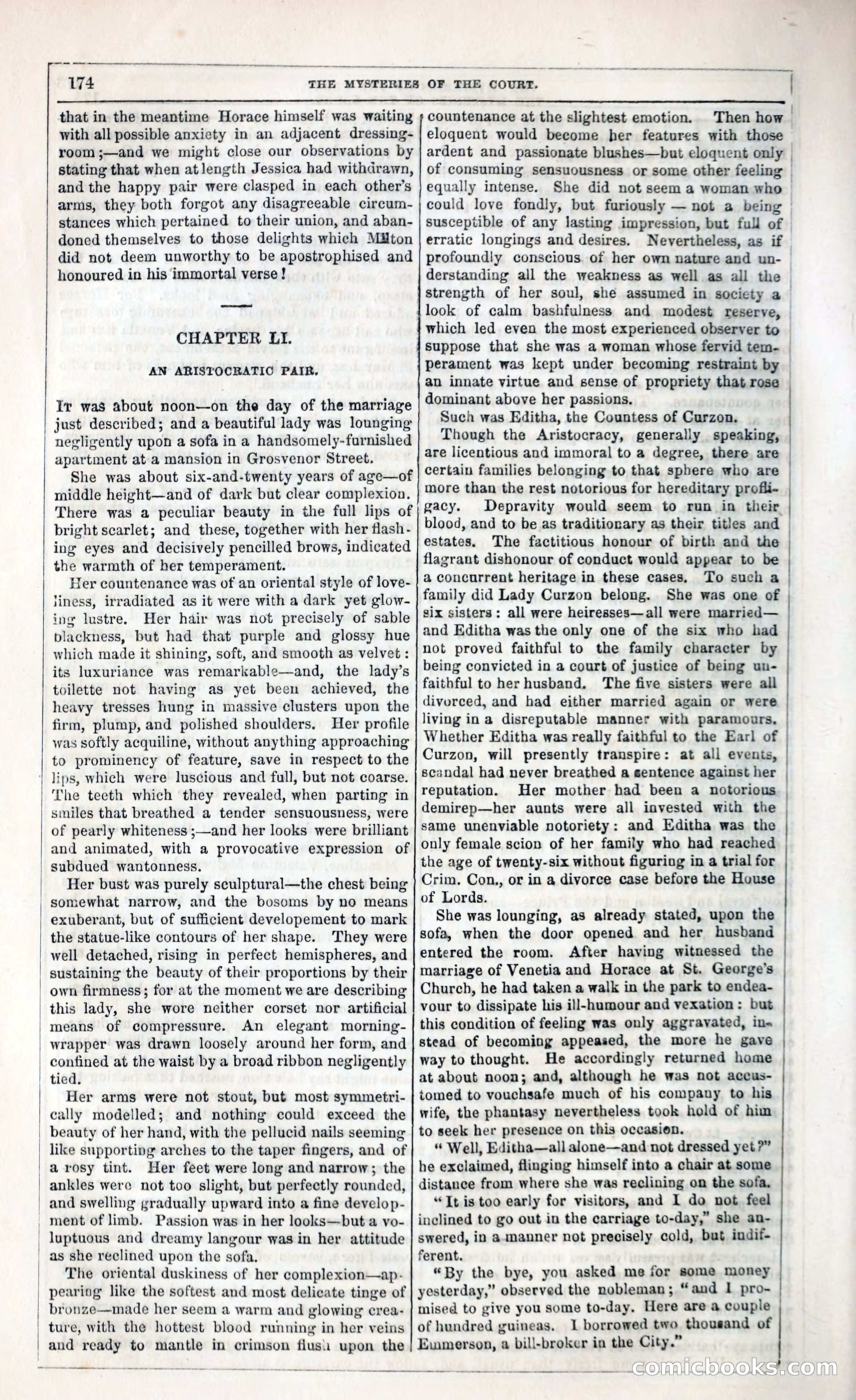
A restored page from Penny Dreadfuls, 1849. Page through the whole issue in the reader above.
📄 Transcribed text from this page (OCR, searchable)
Machine-transcribed from the original scan — historical spelling and the odd misread are preserved.
i — a a a ne 174 that in the meantime Horace himself was waiting with all possible anxiety in an adjacent dressing- room ;—and we might close our observations by stating that when at length Jessica had withdrawn, and the happy pair were clasped in each other’s arms, they both forgot any disagreeable circum- stances which pertained to their union, and aban- doned themselves to those delights which Milton did not deem unworthy to be apostrophised and honoured in his immortal verse! ee CHAPTER LI. AN ARISTOCRATIO PAIR. Irv was about noon—on the day of the marriage just described; and a beautiful lady was lounging negligently upon a sofa in a handsomely-furnished apartment at a mansion in Grosvenor Street, She was about six-and-twenty years of age—of middle height—and of dark but clear complexion. There was a peculiar beauty in the full lips of bright scarlet; and these, together with her flash- ing eyes and decisively pencilled brows, indicated the warmth of her temperament. Her countenance was of an oriental style of love- jiness, irradiated as it were with a dark yet glow- ing lustre. Her hair was not precisely of sable blackness, but had that purple and glossy hue which made it shining, soft, and smooth as velvet: its luxuriance was remarkable—and, the lady’s toilette not having as yet been achieved, the heavy tresses hung in massive clusters upon the firm, plump, and polished shoulders, Her profile was softly acquiline, without anything approaching to prominency of feature, save in respect to the | lips, which were luscious and full, but not coarse. The teeth which they revealed, when parting in smiles that breathed a tender sensuousness, were of pearly whiteness ;—and her looks were brilliant and animated, with a provocative expression of subdued wantonness. Her bust was purely sculptural—the chest being somewhat narrow, and the bosoms by no means exuberant, but of sufficient developement to mark the statue-like contours of her shape. They were well detached, rising in perfect hemispheres, and sustaining the beauty of their proportions by their _ own firmness; for at the moment we are describing this lady, she wore neither corset nor artificial means of compressure. An elegant morning- wrapper was drawn loosely around her form, and confined at the waist by a broad ribbon negligently tied. Her arms were not stout, but most symmetri- cally modelled; and nothing could exceed the beauty of her hand, with the pellucid nails seeming like supporting arches to the taper fingers, and of a rosy tint. Her feet were long and narrow; the | ankles were not too slight, but perfectly rounded, and swelling gradually upward into a fine develop- ment of limb. Passion was in her looks—but a vo- luptuous and dreamy langour was in her attitude as she reclined upon the sofa. The oriental duskiness of her complexion—ap.- pearing like the softest and most delicate tinge of bronze—made her seem a warm and glowing crea- ture, with the hottest blood running in her veins and ready to mantle in crimson flusu upon the —— ee ate THE MYSTERIES OF THE COURT. — ae ae Cee eee ee LOO EE. A te countenance at the slightest emotion. Then how > eloquent would become her features with those ardent and passionate blushes—but eloquent only of consuming sensuousness or some other feeling — equally intense. She did not seem a woman who could love fondly, but furiously — not a being | susceptible of any lasting impression, but full of erratic longings and desires. Nevertheless, as if profoundly conscious. of her own nature and un- derstanding all the weakness as well as all the — strength of her soul, she assumed in society a look of calm bashfulness and modest reserve, which led even the most experienced observer to suppose that she was a woman whose fervid tem- — perament was kept under becoming restraint by an innate virtue and sense of propriety that rose dominant above her passions. Such was Editha, the Countess of Curzon. Though the Aristocracy, generally speaking, are licentious and immoral to a degree, there are certain families belonging to that sphere who are more than the rest notorious for hereditary profli- gacy. Depravity would seem to run in their blood, and to be as traditionary as their titles and estates. The factitious honour of birth and the flagrant dishonour of conduct would appear to be a concurrent heritage in these cases, To such a family did Lady Curzon belong. She was one of six sisters: all were heiresses—all were married— and Editha was the only one of the six who had not proved faithful to the family character by being convicted in a court of justice of being un- faithful to her husband. The five sisters were all divorced, and had either married again or were living ina disreputable manner with paramours, Whether Editha was really faithful to the Earl of Curzon, will presently transpire: at all events, scandal had never breathed a sentence against her reputation. Her mother had been a notorious demirep—her aunts were all invested with the same unenviable notoriety: and Editha was the only female scion of her family who had reached the age of twenty-six without figuring in a trial for Crim. Con., or in a divorce case before the House of Lords. She was lounging, as already stated, upon the sofa, when the door opened and her husband entered the room. After having witnessed the marriage of Venetia and Horace at St. George's Church, he had taken a walk in the park to endea- vour to dissipate his ill-humour and vexation: but this condition of feeling was only aggravated, in-« stead of becoming appeased, the more he gave way to thought. He accordingly returned home at about noon; and, although he was not accus- tomed to vouchsafe much of his company to his wife, the phantasy nevertheless took hold of him to seek her presence on this occasien. “ Well, Editha—all alone—and not dressed yet?” he exclaimed, flinging himself into a chair at some distance from where she was reclining on the sofa. “It is too early for visitors, and I do not feel inclined to go out in the carriage to-day,” she an- swered, in aamanner not precisely cold, but indif- ferent. “By the bye, you asked me for some money yesterday,” observed the nobleman; “and I pro- mised to give you some to-day. Here are a couple of hundred guineas. 1 borrowed two thousand of Emerson, a bill-broker in the City.” ttt ttt ee 2 COmichooks, (E(0)