
Penny Dreadfuls, 1849 · page 179 of 394
The Mysteries of the Court of London — page 179: what you’re looking at
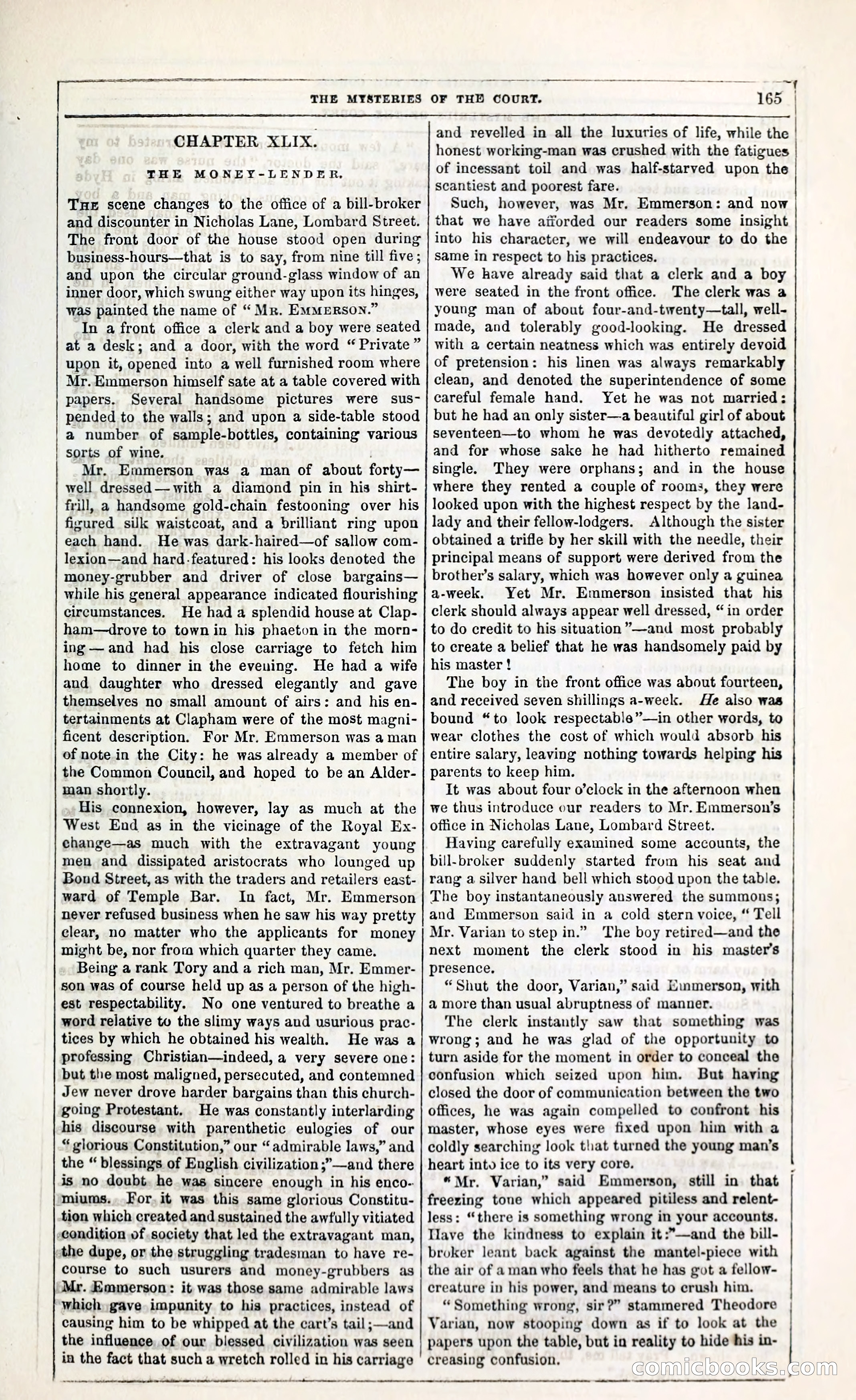
A restored page from Penny Dreadfuls, 1849. Page through the whole issue in the reader above.
📄 Transcribed text from this page (OCR, searchable)
Machine-transcribed from the original scan — historical spelling and the odd misread are preserved.
| THE MYSTERIES OF THE COURT. CHAPTER XLIX. THE MONEY-LENDER. THE scene changes to the office of a bill-broker and discounter in Nicholas Lane, Lombard Street. The front door of the house stood open during business-hours—that is to say, from nine till five; and upon the circular ground-glass window of an inner door, which swung either way upon its hinges, was painted the name of “ Mr. EMMERSON.” In a front office a clerk and a boy were seated at a desk; and a door, with the word “ Private ” upon it, opened into a well furnished room where Mr. Emmerson himself sate at a table covered with papers. Several handsome pictures were sus- pended to the walls; and upon a side-table stood a number of sample-bottles, containing various sorts of wine. Mr. Emmerson was a man of about forty— well dressed— with a diamond pin in his shirt- frill, a handsome gold-chain festooning over his fizured silk waistcoat, and a brilliant ring upon each hand. He was dark-haired—of sallow com- lexion—and hard-featured: his looks denoted the money-grubber and driver of close bargains— while his general appearance indicated flourishing circumstances. He had a splendid house at Clap- ham—drove to town in his phaeton in the morn- ing — and had his close carriage to fetch him home to dinner in the evening. He had a wife and daughter who dressed elegantly and gave themselves no small amount of airs: and his en- tertainments at Clapham were of the most magni- ficent description. For Mr. Emmerson was a man of note in the City: he was already a member of the Common Council, and hoped to be an Alder- man shortly. His connexion, however, lay as much at the West End as in the vicinage of the Royal Ex- ehange—as much with the extravagant young men and dissipated aristocrats who lounged up Bond Street, as with the traders and retailers east- ward of Temple Bar. In fact, Mr. Emmerson never refused business when he saw his way pretty clear, no matter who the applicants for money might be, nor frora which quarter they came. Being a rank Tory and a rich man, Mr. Emmer- son was of course held up as a person of the high- est respectability. No one ventured to breathe a word relative to the slimy ways aud usurious prac- tices by which he obtained his wealth. He was a professing Christian—indeed, a very severe one: but the most maligned, persecuted, and contemned Jew never drove harder bargains than this church- going Protestant. He was constantly interlarding his discourse with parenthetic eulogies of our “ glorious Constitution,” our “admirable laws,” and the “ blessings of English civilization ;”—and there is no doubt. he was sincere enough in his enco- miums.. For. it was this same glorious Constitu- tion which created and sustained the awfully vitiated condition of society that led the extravagant man, the dupe, or the struggling tradesman to have re- course to such usurers and money-grubbers as Mr. Emmerson: it was those same admirable laws which gave impunity to his practices, instead of causing him to be whipped at the cart’s tail ;—and the influence, of our blessed civilization was seen in the fact that such a wretch rolled in his carriage it ee me mm ee er ee es 75 165 | and revelled in all the luxuries of life, while the | honest working-man was crushed with the fatigues of incessant toil and was half-starved upon the scantiest and poorest fare. Such, however, was Mr. Emmerson: and now that we have aiiorded our readers some insight into his character, we will endeavour to do the Same in respect to his practices. We have already said that a clerk and a boy were seated in the front office. The clerk was a young man of about four-and-twenty—tall, well- made, and tolerably good-looking. He dressed with a certain neatness which was entirely devoid of pretension: his linen was always remarkably clean, and denoted the superintendence of some careful female hand. Yet he was not married: but he had an only sister—a beautiful girl of about seventeen—to whom he was devotedly attached, and for whose sake he had hitherto remained single. They were orphans; and in the house where they rented a couple of rooms, they were looked upon with the highest respect by the land- lady and their fellow-lodgers. Although the sister obtained a trifle by her skill with the needle, their principal means of support were derived from the brother’s salary, which was however only a guinea a-week. Yet Mr. Emmerson insisted that his clerk should always appear well dressed, “in order to do credit to his situation ”—and most probably to create a belief that he was handsomely paid by his master ! The boy in the front office was about fourteen, and received seven shillings a-week. He also was bound “to look respectable”—in other words, to wear clothes the cost of which would absorb his entire salary, leaving nothing towards helping his parents to keep him. It was about four o’clock in the afternoon when we thus introduce our readers to Mr. Emmerson’s office in Nicholas Lane, Lombard Street. Having carefully examined some accounts, the bill-broker suddenly started from his seat and rang a silver hand bell which stood upon the table. The boy instantaneously answered the summons; and Emmerson said in a cold stern voice, “ Tell Mr. Varian to step in.” The boy retired—and the next moment the clerk stood in his master’s presence. “Shut the door, Varian,” said Emmerson, with a more than usual abruptness of manner. The clerk instantly saw that something was wrong; and he was glad of the opportunity to turn aside for the moment in order to conceal the confusion which seized upon him. But having closed the door of communication between the two offices, he was again compelled to confront his master, whose eyes were fixed upon him with a coldly searching look that turned the young man’s heart into ice to its very core. “Mr. Varian,” said Emmerson, still in that freezing tone which appeared pitiless and relent- less: “there is something wrong in your accounts. Ilave the kindness to explain it :”"—and the bill- broker leant back against the mantel-piece with the air of aman who feels that he has got a fellow- creature in his power, and means to crush him. “ Something wrong, sir?” stammered Theodore Varian, now stooping down as if to look at the papers upon the table, but in reality to hide his in- ST creasing confusion. CORNICLOOOKS EO) — ee eee