
Penny Dreadfuls, 1849 · page 176 of 394
The Mysteries of the Court of London — page 176: what you’re looking at
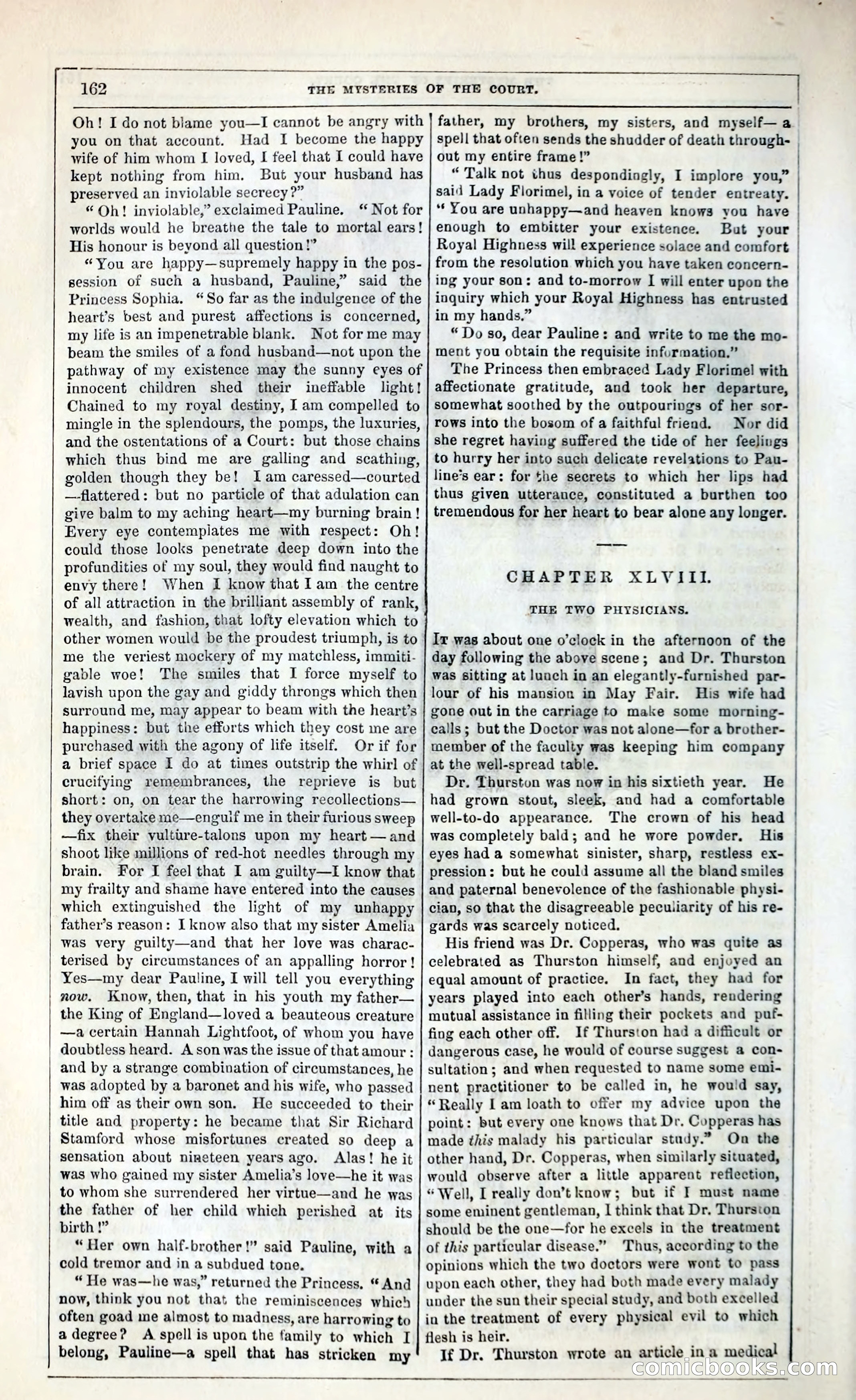
A restored page from Penny Dreadfuls, 1849. Page through the whole issue in the reader above.
📄 Transcribed text from this page (OCR, searchable)
Machine-transcribed from the original scan — historical spelling and the odd misread are preserved.
162 THE MYSTERIES OF THE COURT. | Oh! I do not blame you—I cannot be angry with you on that account. Had I become the happy wife of him whom I loved, I feel that I could have kept nothing from him. But your husband has preserved an inviolable secrecy ?” “ Oh! inviolable,’ exclaimed Pauline. ‘ Not for worlds would he breathe the tale to mortal ears! His honour is beyond all question !” “You are happy—supremely happy in the pos- session of such a husband, Pauline,” said the Princess Sophia. “So far as the indulgence of the heart’s best and purest affections is concerned, my life is an impenetrable blank. Not forme may beam the smiles of a fond husband—not upon the pathway of my existence may the sunny eyes of innocent children shed their ineffable light! Chained to my royal destiny, I am compelled to mingle in the splendours, the pomps, the luxuries, and the ostentations of a Court: but those chains which thus bind me are galling and scathing, golden though they be! 1am caressed—courted —-flattered: but no particle of that adulation can give balm to my aching heart—my burning brain! Every eye contemplates me with respect: Oh! could those looks penetrate deep down into the profundities of my soul, they would find naught to envy there! When I know that Iam the centre of all attraction in the brilliant assembly of rank, wealth, and fashion, that lofty elevation which to other women would be the proudest triumph, is to me the veriest mockery of my matchless, immiti- gable woe! The smiles that I force myself to lavish upon the gay and giddy throngs which then surround me, may appear to beam with the heart’s happiness: but the efforts which they cost ine are purchased with the agony of life itself. Orif for a brief space I do at times outstrip the whirl of crucifying remembrances, the reprieve is but short: on, on tear the harrowing recollections— they overtake me—enguif me in their furious sweep —fix their vulture-talons upon my heart —and shoot like millions of red-hot needles through my brain. For I feel that I am guilty—I know that my frailty and shame have entered into the causes which extinguished the light of my unhappy father’s reason: I know also that my sister Amelia was very guilty—and that her love was charac- terised by circumstances of an appalling horror! Yes—my dear Pauline, I will tell you everything mow. Know, then, that in his youth my father— the King of England—loved a beauteous creature —a certain Hannah Lightfoot, of whom you have doubtless heard. A son was the issue of that amour : and by a strange combination of circumstances, he was adopted by a baronet and his wife, who passed him off as their own son. He succeeded to their title and property: he became that Sir Richard Stamford whose misfortunes created so deep a sensation about nineteen years ago. Alas! he it was who gained my sister Amelia’s love—he it was to whom she surrendered her virtue—and he was the father of her child which perished at its birth !” “Her own half-brother!” said Pauline, with a cold tremor and in a subdued tone. “ He was—he was,” returned the Princess, “And now, think you not that the reminiscences which often goad me almost to madness, are harrowing to a degree? A spell is upon the family to which I belong, Pauline—a spell that has stricken my father, my brothers, my sisters, and myself—a spell that often sends the shudder of death through- out my entire frame!” “Talk not thus despondingly, I implore you,” said Lady Florimel, in a voice of tender entreaty. ‘You are unhappy—and heaven knows you have enough to embitter your existence. But your Royal Highness will experience solace and comfort from the resolution which you have taken concern- ing your son: and to-morrow I will enter upon the inquiry which your Royal Highness has entrusted in my hands,” | “Do so, dear Pauline: and write to me the mo- | ment you obtain the requisite infurmation,” The Princess then embraced Lady Florimel with affectionate gratitude, and took her departure, somewhat soothed by the outpourings of her sor- rows into the bosom of a faithful friend. Nor did she regret having suffered the tide of her feelings to hurry her into such delicate revelations to Pau- line’s ear: for the secrets to which her lips had thus given utterance, constituted a burthen too tremendous for her heart to bear alone any longer. CHAPTER XLVIII. THE TWO PHYSICIANS. Iv was about one o’clock in the afternoon of the day following the above scene; and Dr. Thurston was sitting at luach in an elegantly-furnished par- lour of his mansion in May Fair. His wife had gone out in the carriage to make some morning- calls; but the Doctor was not alone—for a brother- member of the faculty was keeping him company at the well-spread table. Dr. Thurston was now in his sixtieth year. He had grown stout, sleek, and had a comfortable well-to-do appearance. The crown of his head was completely bald; and he wore powder. His eyes had a somewhat sinister, sharp, restless ex- pression: but he could assume all the bland smiles and paternal benevolence of the fashionable physi- cian, so that the disagreeable peculiarity of his re- gards was scarcely noticed. His friend was Dr. Copperas, who was quite as celebrated as Thurston himself, and enjoyed an equal amount of practice. In fact, they had for years played into each other’s hands, rendering mutual assistance in filling their pockets and puf- fing each other off. If Thurston had a difficult or dangerous case, he would of course suggest a con- sultation; and when requested to name sume emi- nent practitioner to be called in, he would say, “Really Lam loath to offer my advice upon the point: but every one knows that Dr. Copperas has made this malady his particular study.” On the other hand, Dr. Copperas, when similarly situated, would observe after a little apparent reflection, “Well, I really don’t know; but if I must name some eminent gentleman, I think that Dr. Thurston should be the one—for he excels in the treatment of this particular disease.” Thus, according to the opinions which the two doctors were wont to pass upon each other, they had both made every malady under the sun their special study, and both excelled in the treatment of every physical evil to which flesh is heir. If Dr. Thurston wrote an article in a medical Eee COMIC DOOKS OS