
Penny Dreadfuls, 1849 · page 162 of 394
The Mysteries of the Court of London — page 162: what you’re looking at
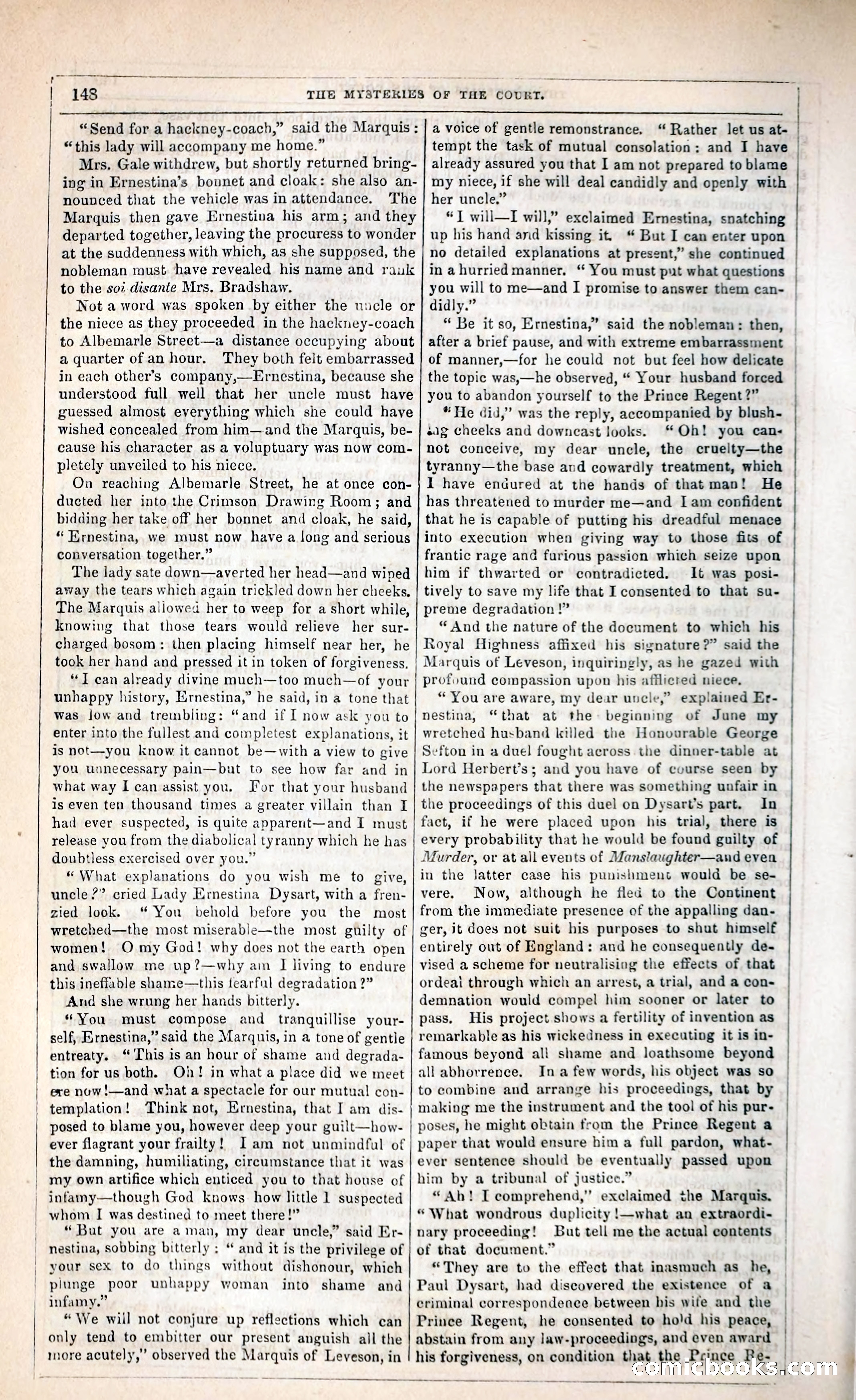
A restored page from Penny Dreadfuls, 1849. Page through the whole issue in the reader above.
📄 Transcribed text from this page (OCR, searchable)
Machine-transcribed from the original scan — historical spelling and the odd misread are preserved.
.>. Sr ee ene SEE ee | 148 THE MYSTERIES OF THE COURT. “Send for a hackney-coach,” said the Marquis; “this lady will accompany me home.” Mrs. Gale withdrew, but shortly returned bring- ing in Ernestina’s bounet and cloak: she also an- nounced that the vehicle was in attendance. The Marquis then gave Ernestina his arm; and they departed together, leaving the procuress to wonder at the suddenness with which, as she supposed, the nobleman must have revealed his name and rauk to the soz. disante Mrs. Bradshaw. Not aword was spoken by either the uncle or the niece as they proceeded in the hackney-coach to Albemarle Street—a distance occupying about a quarter of an hour. They both felt embarrassed in each other’s company,—Ernestina, because she understood full well that her uncle must have guessed almost everything which she could have wished concealed from him—and the Marquis, be- cause his character as a voluptuary was now com- pletely unveiled to his niece. On reaching Albemarle Street, he at once con- ducted her into the Crimson Drawing Room; and bidding her take off her bonnet and cloak, he said, “‘ Hirnestina, we must now have a long and serious conversation together,” The lady sate down—averted her head—and wiped away the tears which again trickled down her cheeks, The Marquis allowed her to weep for a short while, knowing that those tears would relieve her sur- charged bosom: then placing himself near her, he took her hand and pressed it in token of forgiveness. “J can already divine much—too much—of your unhappy history, Ernestina,” he said, in a tone that was low and trembling: “and if I now ask you to enter into the fullest and completest explanations, it is not—you know it cannot be—with a view to give you unnecessary pain—but to see how far and in what way I can assist you. For that your husband is even ten thousand times a greater villain than I had ever suspected, is quite appareut—and I must release you from the diabolical tyranny which he has doubtless exercised over you.” “ What explanations do you wish meé to give, uncle ?” cried Lady Ernestina Dysart, with a fren- zied look. ‘“ You behold before you the most wretched—the most miserable—the most guilty of women! Omy God! why does not the earth open and swallow me up?—why am [| living to endure this ineffable shame—this fearful degradation 2” And she wrung her hands bitterly. “You must compose and tranquillise your- self, Ernestina,” said the Marquis, in a tone of gentle entreaty. “This is an hour of shame and degrada- tion for us both. Oh! in what a place did we meet exe now!—and what a spectacle for our mutual con- templation! Think not, Ernestina, that I am dis- posed to blame you, however deep your guilt—how- ever flagrant your frailty! I am not unmindful of the damning, humiliating, circumstance that it was my own artifice which enticed you to that house of | infamy—though God knows how little 1 suspected whom I was destined to meet there!” * But you are aman, my dear uncle,” said Er- nestina, sobbing bitterly : “ and it is the privilege of your sex to do things without dishonour, which plunge poor unhappy woman into shame and infamy.” “We will not conjure up reflections which ean only tend to embitter our present anguish all the | more acutely,” observed the Marquis of Leveson, in ste a voice of gentle remonstrance. “ Rather Jet us at- tempt the task of mutual consolation: and I have already assured you that I am not prepared to blame my niece, if she will deal candidly and openly with her uncle,” “JY will—I will,” exclaimed Ermestina, snatching up his hand and kissing it, “ But I can enter upon no detailed explanations at present,” she continued in a hurried manner. “ You must put what questions you will to me—and I promise to answer them can- didly.” “ Be it so, Ernestina,” said the nobleman: then, after a brief pause, and with extreme embarrassment of manner,—for he could not but feel how delicate the topic was,—he observed, “ Your husband forced you to abandon yourself to the Prince Regent?” * He did,” was the reply, accompanied by blush- sig cheeks and downceast looks. “Oh! you can- not conceive, my dear uncle, the cruelty—the tyranny—the base and cowardly treatment, which I have endured at the hands of that man! He has threatened to murder me—and I am confident that he is capable of putting his dreadful menace into execution when giving way to those fits of frantic rage and furious passion which seize upon him if thwarted or contradicted. It was posi- tively to save my life that I consented to that su- preme degradation !” “ And the nature of the document to which his Royal Highness affixed his signature?” said the Marquis of Leveson, inquiringly, as he gazed with profound compassion upon his afflicted niece, “ You are aware, my dear uncle,” explained Er- nestina, “that at the beginning of June my wretched husband killed the Honourable George Sefton in a duel fought across the dinner-table at Lord Herbert’s; and you have of course seen by the newspapers that there was something unfair in the proceedings of this duel on Dysart’s part. In fact, if he were placed upon his trial, there is every probability that he would be found guilty of Murder, or at all events of Manslaughter—and even in the Jatter case his punistiment would be se- vere. Now, although he fled to the Continent from the immediate presence of the appalling dan- ger, it does not suit his purposes to shut himself entirely out of England: and he consequently de- vised a scheme for neutralising the effects of that ordeai through which an arrest, a trial, and a con- demnation would compel him sooner or later to pass. His project shows a fertility of invention as remarkable as his wickedness in executing it is in- famous beyond all shame and loathsome beyond all abhorrence. Ina few words, his object was so to combine and arrange his proceedings, that by making me the instrument and the tool of his pur- poses, he might obtain from the Prince Regent a paper that would ensure bim a full pardon, what- ever sentence should be eventually passed upon him by a tribunal of justice.” “ Ah! I comprehend,” exclaimed the Marquis. * What wondrous duplicity !—what an extraordi- nary proceeding! But tell me the actual contents of that document.” “They are to the effect that inasmuch as he, Paul Dysart, had discovered the existence of a criminal correspondence between bis wife and the Prince Regent, he consented to hold his peace, abstain from any law-proceedings, and even award a st — ———— me a ——— % his forgiveness, on condition that the S Gor micbooks Keo) or