
Penny Dreadfuls, 1849 · page 157 of 394
The Mysteries of the Court of London — page 157: what you’re looking at
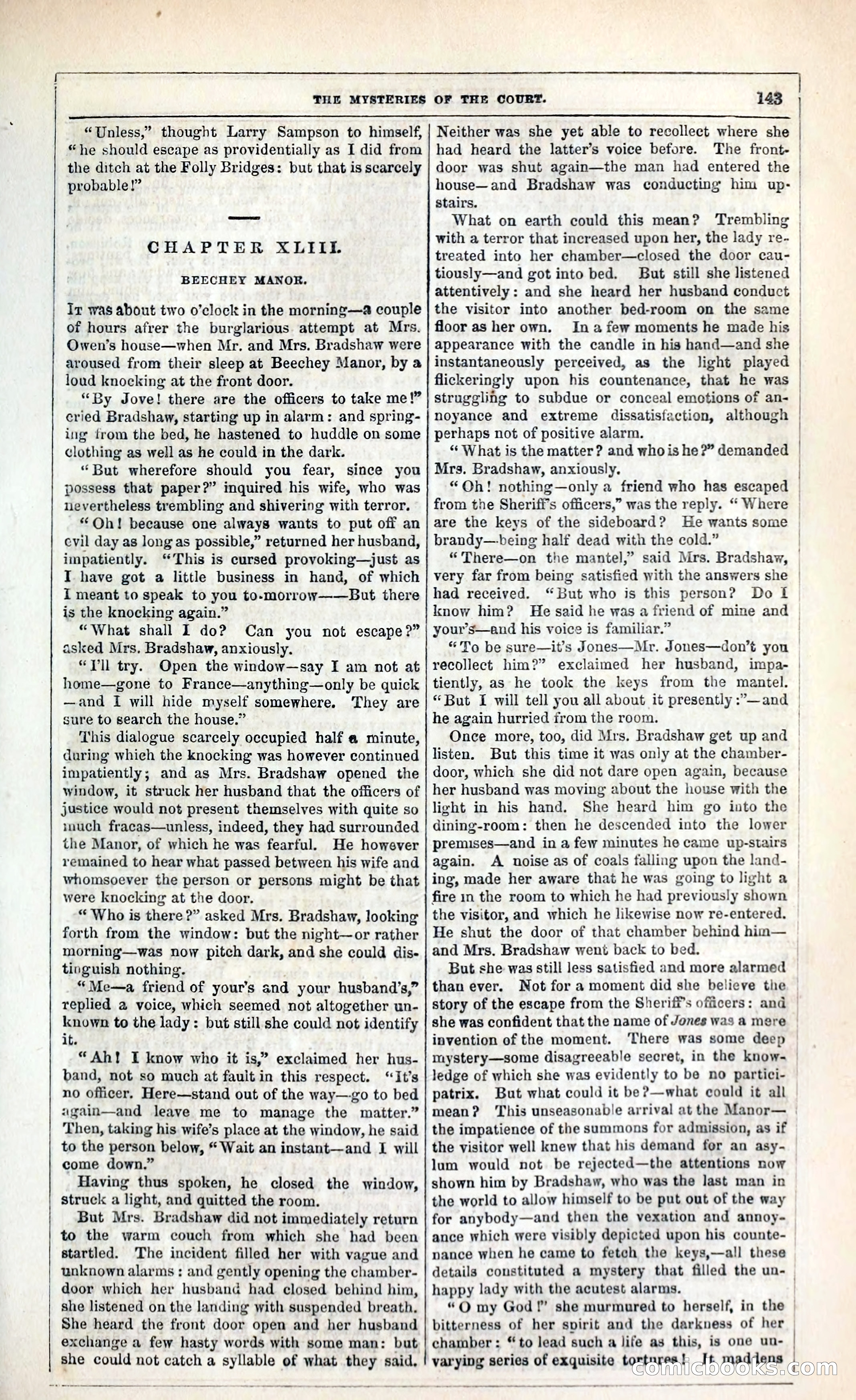
A restored page from Penny Dreadfuls, 1849. Page through the whole issue in the reader above.
📄 Transcribed text from this page (OCR, searchable)
Machine-transcribed from the original scan — historical spelling and the odd misread are preserved.
0 ee ee ee THE MYSTERIES OF THE COURT. “Unless,” thought Larry Sampson to himself, “he should escape as providentially as I did from the ditch at the Folly Bridges: but that is scarcely probable!” CHAPTER XLIII. BEECHEY MANOR. Ir was about two o’clock in the morning—a& couple of hours afrer the burglarious attempt at Mrs. Owen’s house—when Mr. and Mrs. Bradshaw were aroused from their sleep at Beechey Manor, by a loud knocking at the front door. “By Jove! there are the officers to take me!” cried Bradshaw, starting up in alarm: and spring- ing from the bed, he hastened to huddle on some clothing as well as he could in the dark. ‘But wherefore should you fear, since you possess that paper?” inquired his wife, who was nevertheless trembling and shivering with terror. ‘Qh! because one always wants to put off an evil day as long as possible,” returned her husband, impatiently. “This is cursed provoking—just as I have got a little business in hand, of which i meant to speak to you to-morrow——But there is the knocking again.” “What shall I do? Can you not escape?” asked Mrs. Bradshaw, anxiously. “Tl try. Open the window—say I am not at home—gone to France—anything—only be quick —and I will hide myself somewhere. They are sure to search the house.” This dialogue scarcely occupied half a minute, during whieh the knocking was however continued impatiently; and as Mrs. Bradshaw opened the window, it struck her husband that the officers of justice would not present themselves with quite so much fracas—unless, indeed, they had surrounded the Manor, of which he was fearful, He however remained to hear what passed between his wife and whomsoever the person or persons might be that were knocking at the door. “ Who is there?” asked Mrs. Bradshaw, looking forth from the window: but the night—or rather morning—was now pitch dark, and she could dis- tinguish nothing. “Me—a friend of your’s and your husband’s,” replied a voice, which seemed not altogether un- known to the lady: but still she could not identify it. “Ah! I know who it is,’ exclaimed her hus- band, not so much at fauit in this respect. “It’s no officer. Here—stand out of the way—go to bed again—and leave me to manage the matter.” Then, taking his wife’s place at the window, he said to the person below, “ Wait an instant—and I will come down.” Having thus spoken, he closed the window, struck a light, and quitted the room. But Mrs. Bradshaw did not immediately return to the warm couch from which she had been startled. The incident filled her with vague and unknown alarms ; and gently opening the chamber- door which her husband had closed behind him, she listened on the landing with suspended breath. She heard the front door open and her husband exchange a few hasty words with some man: but she could not catch a syllable of what they said, Neither was she yet able to recollect where she had heard the latter’s voice before. The front- door was shut again—the man had entered the | ea = house— and Bradshaw was conducting’ him up- | | stairs. What on earth could this mean? Trembling with a terror that increased upon her, the lady re- treated into her chamber—closed the door cau- tiously—and got into bed. But still she listened attentively: and she heard her husband conduct the visitor into another bed-room on the same floor as her own. Ina few moments he made his appearance with the candle in his hand—and she instantaneously perceived, as the light played flickeringly upon his countenance, that he was struggling to subdue or conceal emotions of an- noyance and extreme dissatisfaction, although perhaps not of positive alarm. “What is the matter? and whois he ?” demanded | Mrs. Bradshaw, anxiously. “Oh! nothing—only a friend who has escaped from the Sheriffs officers,” was the reply. “ Where are the keys of the sideboard? He wants some brandy—-being half dead with the cold.” “ There—on the mantel,” said Mrs. Bradshaw, very far from being satisfied with the answers she | had received. “But who is this person? Do ft know him? He said he was a friend of mine and © your’s—and his voice is familiar.” “To be sure—it’s Jones—Mr. Jones—don’t you recollect him?” exclaimed her husband, impa- tiently, as he took the keys from the mantel. | “But I will tell you all about it presently :"—and he again hurried from the room. Once more, too, did Mrs. Bradshaw get up and | listen. But this time it was only at the chamber- | door, which she did not dare open again, because | her husband was moving about the house with the light in his hand. She heard him go into the dining-room: then he descended into the lower premises—and in a few minutes he came up-stairs again. A noise as of coals falling upon the land- ing, made her aware that he was going to light a fire in the room to which he had previously shown the visitor, and which he likewise now re-entered. He shut the door of that chamber behind hin— and Mrs. Bradshaw went back to bed. But she was still less satisfied and more alarmed than ever. Not for a moment did she believe the story of the escape from the Sheriff's officers: and she was confident that the name of Jones was a mere invention of the moment. ‘There was some deep mystery—some disagreeable secret, in the know- ledge of which she was evidently to be no partici- patrix. But what could it be ?—what could it all mean? This unseasonable arrival at the Manor— the impatience of the summons for admission, as if the visitor well knew that his demand for an asy- lum would not be rejected—the attentions now shown him by Bradshaw, who was the last man in the world to allow himself to be put out of the way for anybody—and then the vexation and annoy- ance which were visibly depicted upon his counte- nance when he came to fetch the keys,—all these details constituted a mystery that filled the un-— happy lady with the acutest alarms. “OQ my God!” she murmured to herself, in the — bitterness of her spirit and the darkness of her chamber: “to lead such a life as this, is one un- ' eO varying series of exquisite tortnres. chiooissn