
Penny Dreadfuls, 1849 · page 123 of 394
The Mysteries of the Court of London — page 123: what you’re looking at
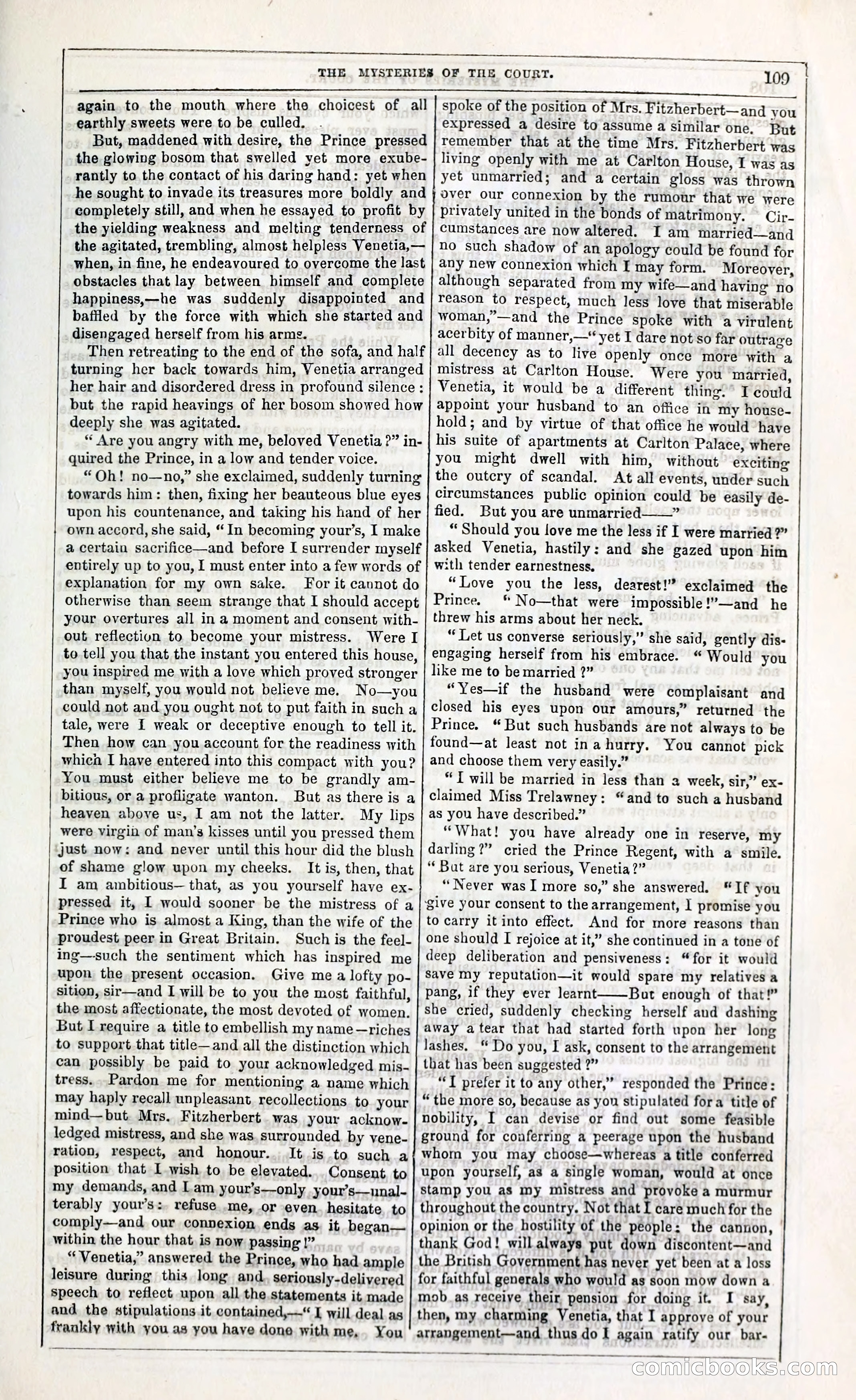
A restored page from Penny Dreadfuls, 1849. Page through the whole issue in the reader above.
📄 Transcribed text from this page (OCR, searchable)
Machine-transcribed from the original scan — historical spelling and the odd misread are preserved.
= eee ond SO a eer PORTE TEER SR Re ee eee eee — MYSTERIES OF THE COURT. THE again to the mouth where the choicest of all earthly sweets were to be culled. But, maddened with desire, the Prince pressed the glowing bosom that swelled yet more exube- rantly to the contact of his daring hand: yet when he sought to invade its treasures more boldly and completely still, and when he essayed to profit by the yielding weakness and melting tenderness of the agitated, trembling, almost helpless Venetia,— when, in fine, he endeavoured to overcome the last obstacles that lay between bimself and complete happiness,—he was suddenly disappointed and baffled by the force with which she started and disengaged herself from his arms. Then retreating to the end of the sofa, and half turning her back towards him, Venetia arranged her hair and disordered dress in profound silence; but the rapid heavings of her bosom showed how deeply she was agitated. “Are you angry with me, beloved Venetia ?” in- quired the Prince, in a low and tender voice. “Oh! no—no,” she exclaimed, suddenly turning towards him: then, fixing her beauteous blue eyes upon his countenance, and taking his hand of her own accord, she said, “In becoming your’s, I make a certain sacrifice—and before I surrender myself entirely up to you, I must enter into a few words of explanation for my own sake. For it cannot do otherwise than seem strange that I should accept your overtures all in a moment and consent with- out reflection to become your mistress. Were I to tell you that the instant you entered this house, you inspired me with a love which proved stronger than myself, you would not believe me. No—you could not and you ought not to put faith in such a tale, were I weak or deceptive enough to tell it. Then how can you account for the readiness with whica I have entered into this compact with you? You must either believe me to be grandly am- bitious, or a profligate wanton. But as there is a heaven above us, I am not the latter. My lips were virgia of man’s kisses until you pressed them just now: and never until this hour did the blush of shame glow upon my cheeks. It is, then, that I am anbitious— that, as you yourself have ex- pressed it, I would sooner be the mistress of a Prince who is almost a King, than the wife of the proudest peer in Great Britain. Such is the feel- ing—such the sentiment which has inspired me upon the present occasion. Give me a lofty po- sition, sir—and I will be to you the most faithful, the most affectionate, the most devoted of women. But I require a title to embellish my name—riches to support that title—and all the distinction which can possibly be paid to your acknowledged mis- tress. Pardon me for mentioning a name which may haply recall unpleasant recollections to your mind—but. Mrs. Fitzherbert was your acknow- ledged mistress, and she was. surrounded by vene- ration, respect, and honour.. It is to such a position that L wish to be elevated... Consent, to my demands, and Lam your’s—only your’s—nnal- terably your's: refuse me, or even. hesitate to comply—and our connexion ends as. it began— within the hour that, is now passing |” “ Venetia,” answered the Prince, who had ample leisure during this long and seriously-delivered speech to reflect upon all the statements it made and the stipulations it contained,—* I will deal as frankly with you as you have done with me, You 109 | spoke of the position of Mrs. Fitzherbert—and you expressed a desire to assume a similar one. But remember that at the time Mrs. Fitzherbert was living openly with me at Carlton House, I was as yet unmarried; and a certain gloss was thrown over our connexion by the rumour that we were privately united in the bonds of matrimony. cumstances are now altered. I am married—and no such shadow of an apology could be found for any new connexion which I may form. Moreover, although separated from my wife—and having no reason to respect, much less love that miserable woman,’—and the Prince spoke with a virulent acerbity of manner,—* yet I dare not so far outrage all decency as to live openly once more with a mistress at Carlton House. Cir- Were you married, Venetia, it would be a different thing. I could appoint your husband to an office in my house- hold; and by virtue of that office he would ‘have his suite of apartments at Carlton Palace, where you might dwell with him, without exciting the outcry of scandal. At all events, under such circumstances public opinion could be easily de- fied. But you are unmarried——” “ Should you love me the less if I were married ?” asked Venetia, hastily: and she gazed upon him w:th tender earnestness, “Love you the less, dearest!” exclaimed the Prince. © No—that were impossible!”—and he threw his arms about her neck. “‘ Let us converse seriously,’’ she said, gently dis- engaging herseif from his embrace. “ Would you like me to be married 2?” “Yes—if the husband were complaisant and closed his eyes upon our amours,” returned the Prince. “But such husbands are not always to be found—at least not inahurry. You cannot pick and choose them very easily.” “T will be married in less than a week, sir,” ex- claimed Miss Trelawney: “and to such a husband as you have described.” ‘What! you have already one in reserve, my darling?” cried the Prince Regent, with a smile. ‘Bat are you serious, Venetia?” “Never wasI more so,” she answered. “If you ‘give your consent to the arrangement, I promise you to carry it into effect. And for more reasons than one should I rejoice at it,” she continued in a tone of deep deliberation and pensiveness: “for it would Save my reputation—it would spare my relatives a pang, if they ever learnt Bat enough of that!” she cried, suddenly checking herself and dashing away a tear that had started forth upon her long lashes. “Do you, I ask, consent to the arrangement that has been suggested 2” “I prefer it to any other,” responded the Prince: “the more so, because as yon stipulated fora title of nobility, I can devise or find out some feasible ground for conferring a peerage upon the husband whom you may choose—whereas a title conferred upon yourself, as a single woman, would at once stamp you as my mistress and provoke a murmur throughout the country. Not that I care much for the opinion or the hostility of the people: the cannon, | thank God! willalways put down discontent—and the British Government has never yet been at a loss for faithful generals who would as soon mow down a mob_as receive their pension for doing it. I say, then, my charming Venetia, that I approve of your arrangement—and thus do I again ratify our bar- EE COn i GOOOkKS (CO) ECO