
Penny Dreadfuls, 1849 · page 107 of 394
The Mysteries of the Court of London — page 107: what you’re looking at
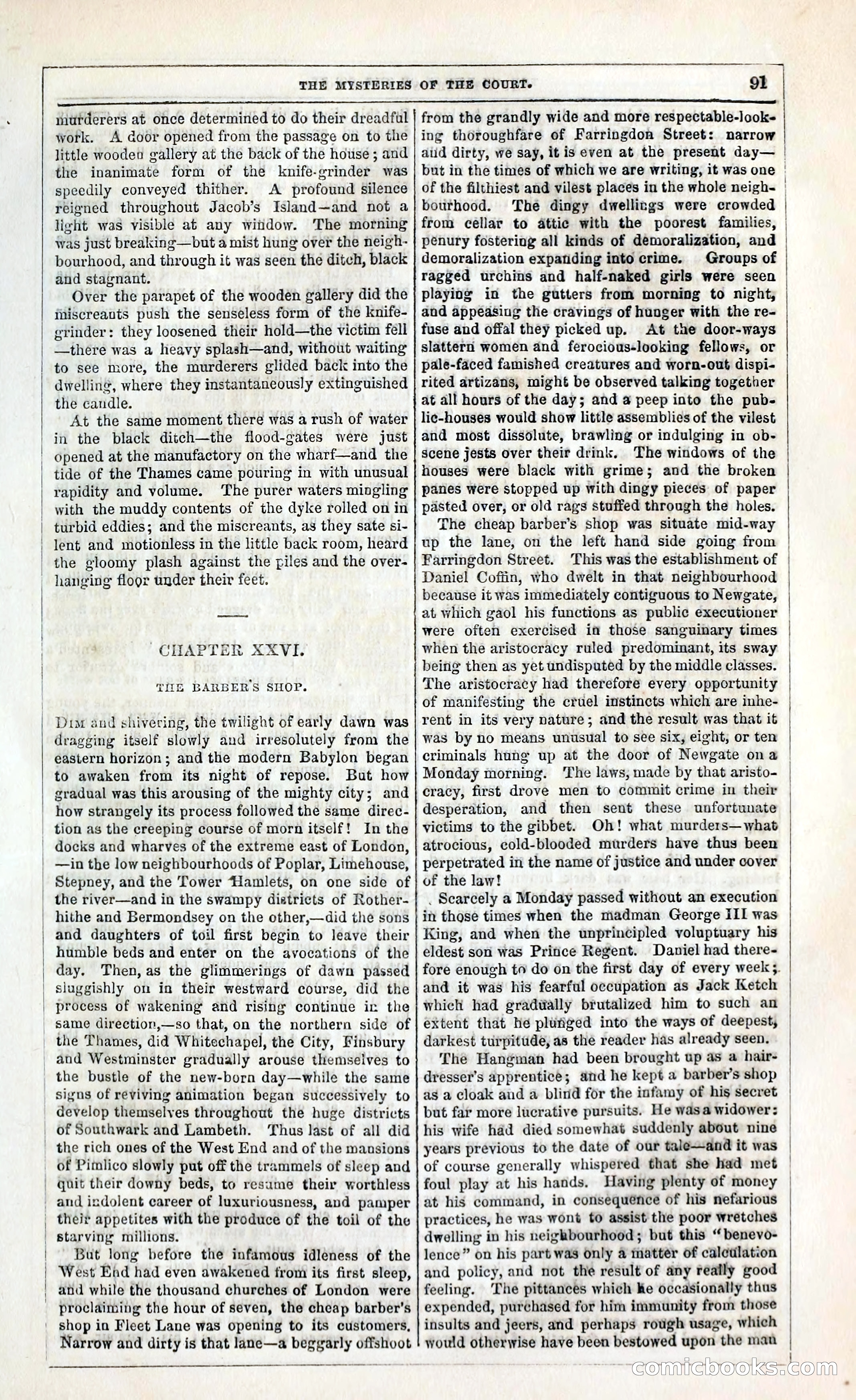
A restored page from Penny Dreadfuls, 1849. Page through the whole issue in the reader above.
📄 Transcribed text from this page (OCR, searchable)
Machine-transcribed from the original scan — historical spelling and the odd misread are preserved.
—_— THE MYSTERIES murderers at once determined to do their dreadful work. A door opened from the passage on to the little wooden gallery at the back of the house; and the inanimate form of the knife-grinder was speedily conveyed thither. A profound silence reigned throughout Jacob’s Island—and not a light was visible at any wiidow. The morning was just breaking—but a mist hung over the neigh- bourhood, and through it was seen the ditch, black and stagnant. Over the parapet of the wooden gallery did the miscreants push the senseless form of the knife- erinder: they loosened their hold—the victim fell —there was a heavy splash—and, without waiting to see more, the murderers glided back into the dwelling, where they instantaneously extinguished the candle. At the same moment there was a rush of water in the black ditch—the flood-gates were just opened at the manufactory on the wharf—and the tide of the Thames came pouring in with unusual rapidity and volume. ‘The purer waters mingling with the muddy contents of the dyke rolled on in turbid eddies; and the miscreants, as they sate si- lent and motionless in the little back room, heard the gloomy plash against the piles and the over- hanging floor under their feet. CHAPTER XXVI. TE BARBERS SHOP. Dim and shivering, the twilight of early dawn was dragging itself slowly and irresolutely from the eastern horizon; and the modern Babylon began to awaken from its night of repose. But how gradual was this arousing of the mighty city; and how strangely its process followed the same direc- _ tion as the creeping course of morn itself! In the _ docks and wharves of the extreme east of London, _ —in the low neighbourhoods of Poplar, Limehouse, Stepney, and the Tower Hamlets, on one side of the river—and in the swampy districts of Rother- hithe and Bermondsey on the other,—did the sons and daughters of toil first begin to leave their humble beds and enter on the avocations of the day. Then, as the glimmerings of dawn passed sluggishly on in their westward course, did the process of wakening and rising continue ic the _ same direction,—so that, on the northern side of the Thames, did Whitechapel, the City, Finsbury and Westminster gradually arouse themselves to the bustle of the new-born day—while the same signs of reviving animation began successively to develop themselves throughout the huge districts of Southwark and Lambeth. ‘Thus last of all did _ the rich ones of the West End and of the mansions of Pitnlico slowly put off the trammels of sleep and quit their downy beds, to resume their worthless and indolent career of luxuriousness, and pamper their appetites with the produce of the toil of the starving millions. But long before the infamous idleness of the West End had even awakened from its first sleep, and while the thousand churches of London were proclaiming the hour of seven, the cheap barber's | shop in Fleet Lane was opening to its customers, Narrow and dirty is that lane—a beggarly offshoot ee + -- - OF THE COURT. from the grandly wide and more respectable-look- ing thoroughfare of Farringdon Street: narrow aud dirty, we say, itis even at the present day— but in the times of which we are writing, it was one of the filthiest and vilest places in the whole neigh- bourhood. The dingy dwellings were crowded from cellar to attic with the poorest families, penury fostering all kinds of demoralization, and demoralization expatiding into crime. Groups of ragged urchins and half-naked girls were seen playing in the gutters from morning to night, and appeasiug the cravings of hunger with the re- fuse and offal they picked up. At the door-ways slattern women and ferocious-looking fellows, or pale-faced famished creatures and worn-out dispi- rited artizans, might be observed talking together at all hours of the day; and @ peep into the pub- lic-houses would show little assemblies of the vilest and most dissolute, brawling or indulging in ob- scene jests over their drink. The windows of the houses were black with grime; and the broken panes were stopped up with dingy pieces of paper pasted over, or old rags stuffed through the holes. The cheap barber’s shop was situate mid-way up the lane, on the left hand side going from Farringdon Street. This was the establishment of Daniel Coftin, who dwelt in that neighbourhood because it was immediately contiguous to Newgate, at. which gaol his functions as public executioner were often exercised in those sanguinary times when the aristocracy ruled predominant, its sway bein® then as yet undisputed by the middle classes. The aristocracy had therefore every opportunity of manifesting the cruel instincts which are inhe- rent in its very nature; and the result was that it was by no means unusual to see six, eight, or ten criminals hung up at the door of Newgate ona Monday morning. ‘The laws, made by that aristo- cracy, first drove men to commit crime in their desperation, and then sent these unfortunate victims to the gibbet. Oh! what murders—what atrocious, cold-blooded murders have thus been perpetrated in the name of justice and under cover of the law! _ Scarcely a Monday passed without an execution in those times when the madman George ill was King, and when the unprincipled voluptuary his eldest son was Pritce Regent. Daniel had there- fore enough to do on the first day of every week 5. and it was his fearful occupation as Jack Ketch which had gradwtally brutalized him to such an extent that hé plunged into the ways of deepest, darkest turpitude, as the reader has already seen. The Hangman had been brought up as a hair- dresser’s apprentice; and he kept a barber’s shop as a cloak aud a blind for the infamy of his secret but far more lucrative pursuits. He wasa widower: his wife had died somewhat suddenly about nine years previous to the date of our tale—and it was of course generally whispered that she had met foul play at his hands. Having plenty of money at his command, in consequénce of his nefarious practices, he was wont to assist the poor wretches dwelling in his neighbourhood; but this “benevo- lence” on his part was only a matter of calctlation and policy, and not the result of any really good feeling. ‘The pittanceés which ke occasionally thus expended, purchased for him immunity from those insults and jeers, and perhaps rough usage, which would otherwise have been bestowed upon the man > oka ot — _ ae —— ————aEEEOEOEOEOEeEeEeEeEeEeEeEeEeGOeeeeeeeeeee eee a eee COMMICLOO CS: (SO)