
Penny Dreadfuls, 1860 · page 302 of 394
The Mysteries of the Court of London — page 302: what you’re looking at
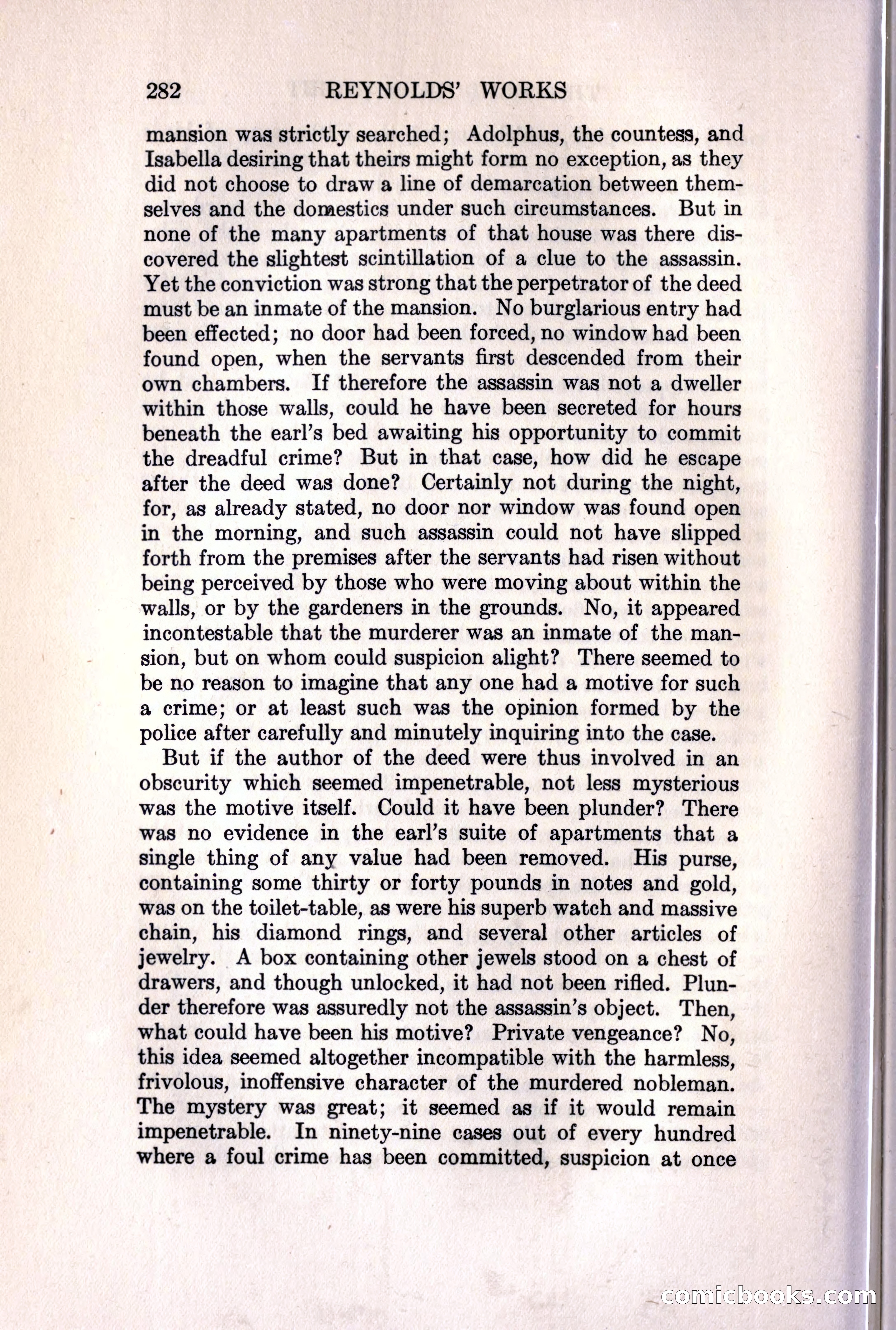
A restored page from Penny Dreadfuls, 1860. Page through the whole issue in the reader above.
📄 Transcribed text from this page (OCR, searchable)
Machine-transcribed from the original scan — historical spelling and the odd misread are preserved.
282 REYNOLDS’ WORKS mansion was strictly searched; Adolphus, the countess, and Isabella desiring that theirs might form no exception, as they did not choose to draw a line of demarcation between them- selves and the domestics under such circumstances. But in none of the many apartments of that house was there dis- covered the slightest scintillation of a clue to the assassin. Yet the conviction was strong that the perpetrator of the deed must be an inmate of the mansion. No burglarious entry had been effected; no door had been forced, no window had been found open, when the servants first descended from their own chambers. If therefore the assassin was not a dweller within those walls, could he have been secreted for hours beneath the earl’s bed awaiting his opportunity to commit the dreadful crime? But in that case, how did he escape after the deed was done? Certainly not during the night, for, as already stated, no door nor window was found open in the morning, and such assassin could not have slipped forth from the premises after the servants had risen without being perceived by those who were moving about within the walls, or by the gardeners in the grounds. No, it appeared incontestable that the murderer was an inmate of the man- sion, but on whom could suspicion alight? There seemed to be no reason to imagine that any one had a motive for such a crime; or at least such was the opinion formed by the police after carefully and minutely inquiring into the case. But if the author of the deed were thus involved in an obscurity which seemed impenetrable, not less mysterious was the motive itself. Could it have been plunder? There was no evidence in the earl’s suite of apartments that a single thing of any value had been removed. His purse, containing some thirty or forty pounds in notes and gold, was on the toilet-table, as were his superb watch and massive chain, his diamond rings, and several other articles of jewelry. A box containing other jewels stood on a chest of drawers, and though unlocked, it had not been rifled. Plun- der therefore was assuredly not the assassin’s object. Then, what could have been his motive? Private vengeance? No, this idea seemed altogether incompatible with the harmless, frivolous, inoffensive character of the murdered nobleman. The mystery was great; it seemed as if it would remain impenetrable. In ninety-nine cases out of every hundred where a foul crime has been committed, suspicion at once GoM () Doo SS (E@)