
Penny Dreadfuls, 1860 · page 249 of 394
The Mysteries of the Court of London — page 249: what you’re looking at
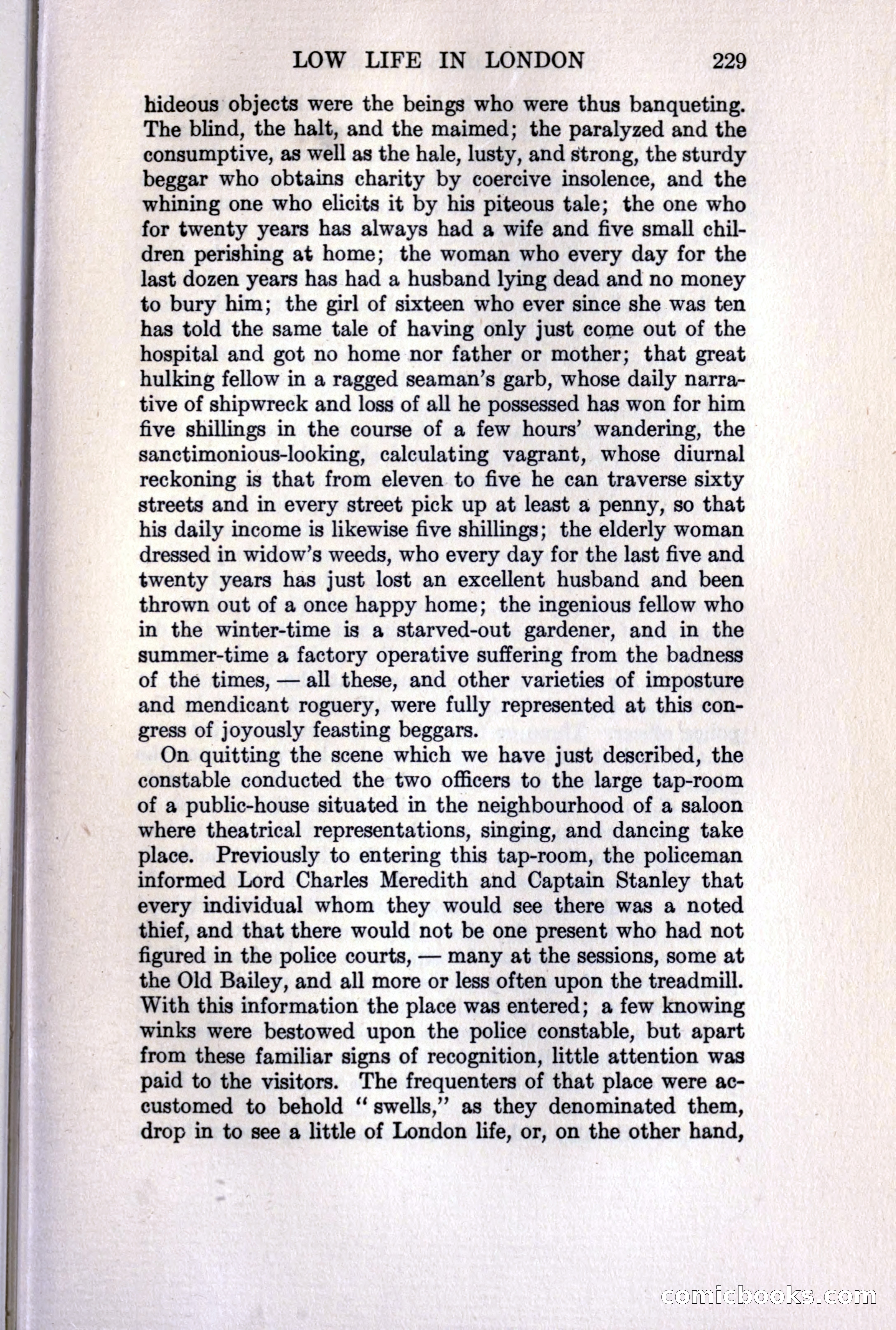
A restored page from Penny Dreadfuls, 1860. Page through the whole issue in the reader above.
📄 Transcribed text from this page (OCR, searchable)
Machine-transcribed from the original scan — historical spelling and the odd misread are preserved.
LOW LIFE IN LONDON 229 hideous objects were the beings who were thus banqueting. The blind, the halt, and the maimed; the paralyzed and the consumptive, as well as the hale, lusty, and strong, the sturdy beggar who obtains charity by coercive insolence, and the whining one who elicits it by his piteous tale; the one who for twenty years has always had a wife and five small chil- dren perishing at home; the woman who every day for the last dozen years has had a husband lying dead and no money to bury him; the girl of sixteen who ever since she was ten has told the same tale of having only just come out of the hospital and got no home nor father or mother; that great hulking fellow in a ragged seaman’s garb, whose daily narra- tive of shipwreck and loss of all he possessed has won for him five shillings in the course of a few hours’ wandering, the sanctimonious-looking, calculating vagrant, whose diurnal reckoning is that from eleven to five he can traverse sixty streets and in every street pick up at least a penny, so that his daily income is likewise five shillings; the elderly woman dressed in widow’s weeds, who every day for the last five and twenty years has just lost an excellent husband and been thrown out of a once happy home; the ingenious fellow who in the winter-time is a starved-out gardener, and in the summer-time a factory operative suffering from the badness of the times, — all these, and other varieties of imposture and mendicant roguery, were fully represented at this con- gress of joyously feasting beggars. On quitting the scene which we have just described, the constable conducted the two officers to the large tap-room of a public-house situated in the neighbourhood of a saloon where theatrical representations, singing, and dancing take place. Previously to entering this tap-room, the policeman informed Lord Charles Meredith and Captain Stanley that every individual whom they would see there was a noted thief, and that there would not be one present who had not figured in the police courts, — many at the sessions, some at the Old Bailey, and all more or less often upon the treadmill. With this information the place was entered; a few knowing winks were bestowed upon the police constable, but apart from these familiar signs of recognition, little attention was paid to the visitors. The frequenters of that place were ac- customed to behold “ swells,’ as they denominated them, drop in to see a little of London life, or, on the other hand, ECORNICLOO® “S (E() mM