
Penny Dreadfuls, 1860 · page 243 of 394
The Mysteries of the Court of London — page 243: what you’re looking at
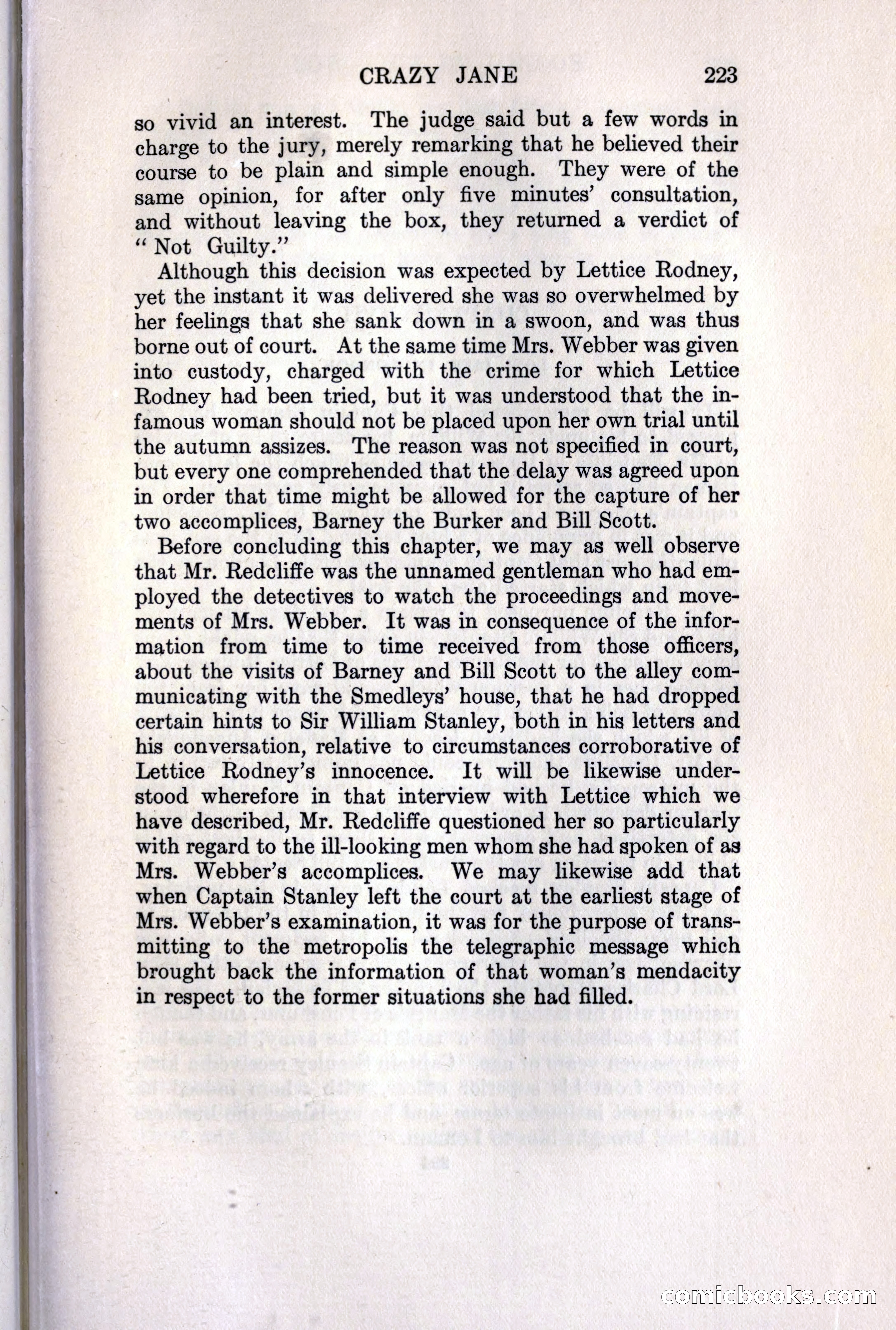
A restored page from Penny Dreadfuls, 1860. Page through the whole issue in the reader above.
📄 Transcribed text from this page (OCR, searchable)
Machine-transcribed from the original scan — historical spelling and the odd misread are preserved.
CRAZY JANE 223 so vivid an interest. The judge said but a few words in charge to the jury, merely remarking that he believed their course to be plain and simple enough. They were of the same opinion, for after only five minutes’ consultation, and without leaving the box, they returned a verdict of “Not Guilty.” Although this decision was expected by Lettice Rodney, yet the instant it was delivered she was so overwhelmed by her feelings that she sank down in a swoon, and was thus borne out of court. At the same time Mrs. Webber was given into custody, charged with the crime for which Lettice Rodney had been tried, but it was understood that the in- famous woman should not be placed upon her own trial until the autumn assizes. The reason was not specified in court, but every one comprehended that the delay was agreed upon in order that time might be allowed for the capture of her two accomplices, Barney the Burker and Bill Scott. Before concluding this chapter, we may as well observe that Mr. Redcliffe was the unnamed gentleman who had em- ployed the detectives to watch the proceedings and move- ments of Mrs. Webber. It was in consequence of the infor- mation from time to time received from those officers, about the visits of Barney and Bill Scott to the alley com- municating with the Smedleys’ house, that he had dropped certain hints to Sir William Stanley, both in his letters and his conversation, relative to circumstances corroborative of Lettice Rodney’s innocence. It will be likewise under- stood wherefore in that interview with Lettice which we have described, Mr. Redcliffe questioned her so particularly with regard to the ill-looking men whom she had spoken of as Mrs. Webber’s accomplices. We may likewise add that when Captain Stanley left the court at the earliest stage of Mrs. Webber’s examination, it was for the purpose of trans- mitting to the metropolis the telegraphic message which brought back the information of that woman’s mendacity in respect to the former situations she had filled. CORNICLOO (CO)