
Penny Dreadfuls, 1860 · page 236 of 394
The Mysteries of the Court of London — page 236: what you’re looking at
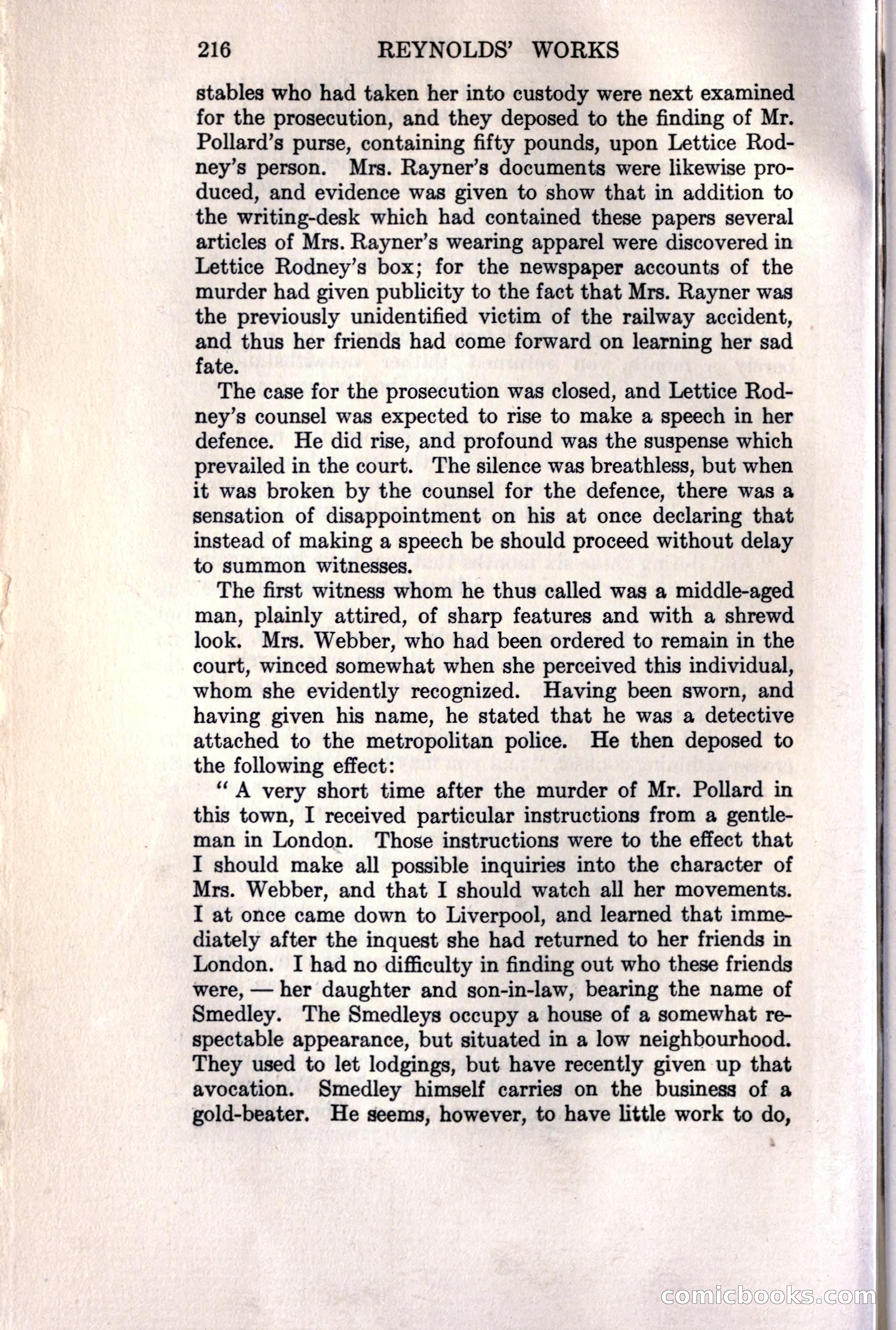
A restored page from Penny Dreadfuls, 1860. Page through the whole issue in the reader above.
📄 Transcribed text from this page (OCR, searchable)
Machine-transcribed from the original scan — historical spelling and the odd misread are preserved.
216 REYNOLDS’ WORKS stables who had taken her into custody were next examined for the prosecution, and they deposed to the finding of Mr. Pollard’s purse, containing fifty pounds, upon Lettice Rod- ney’s person. Mrs. Rayner’s documents were likewise pro- duced, and evidence was given to show that in addition to the writing-desk which had contained these papers several articles of Mrs. Rayner’s wearing apparel were discovered in Lettice Rodney’s box; for the newspaper accounts of the murder had given publicity to the fact that Mrs. Rayner was the previously unidentified victim of the railway accident, and thus her friends had come forward on learning her sad fate. The case for the prosecution was closed, and Lettice Rod- ney’s counsel was expected to rise to make a speech in her defence. He did rise, and profound was the suspense which prevailed in the court. The silence was breathless, but when it was broken by the counsel for the defence, there was a sensation of disappointment on his at once declaring that instead of making a speech be should proceed without delay to summon witnesses. The first witness whom he thus called was a middle-aged man, plainly attired, of sharp features and with a shrewd look. Mrs. Webber, who had been ordered to remain in the court, winced somewhat when she perceived this individual, whom she evidently recognized. Having been sworn, and having given his name, he stated that he was a detective attached to the metropolitan police. He then deposed to the following effect: “A very short time after the murder of Mr. Pollard in this town, I received particular instructions from a gentle- man in London. Those instructions were to the effect that I should make all possible inquiries into the character of Mrs. Webber, and that I should watch all her movements. I at once came down to Liverpool, and learned that imme- diately after the inquest she had returned to her friends in London. I had no difficulty in finding out who these friends were, — her daughter and son-in-law, bearing the name of Smedley. The Smedleys occupy a house of a somewhat re- spectable appearance, but situated in a low neighbourhood. They used to let lodgings, but have recently given up that avocation. Smedley himself carries on the business of a gold-beater. He seems, however, to have little work to do, ECORNICLOOO (CO)