
Penny Dreadfuls, 1860 · page 218 of 394
The Mysteries of the Court of London — page 218: what you’re looking at
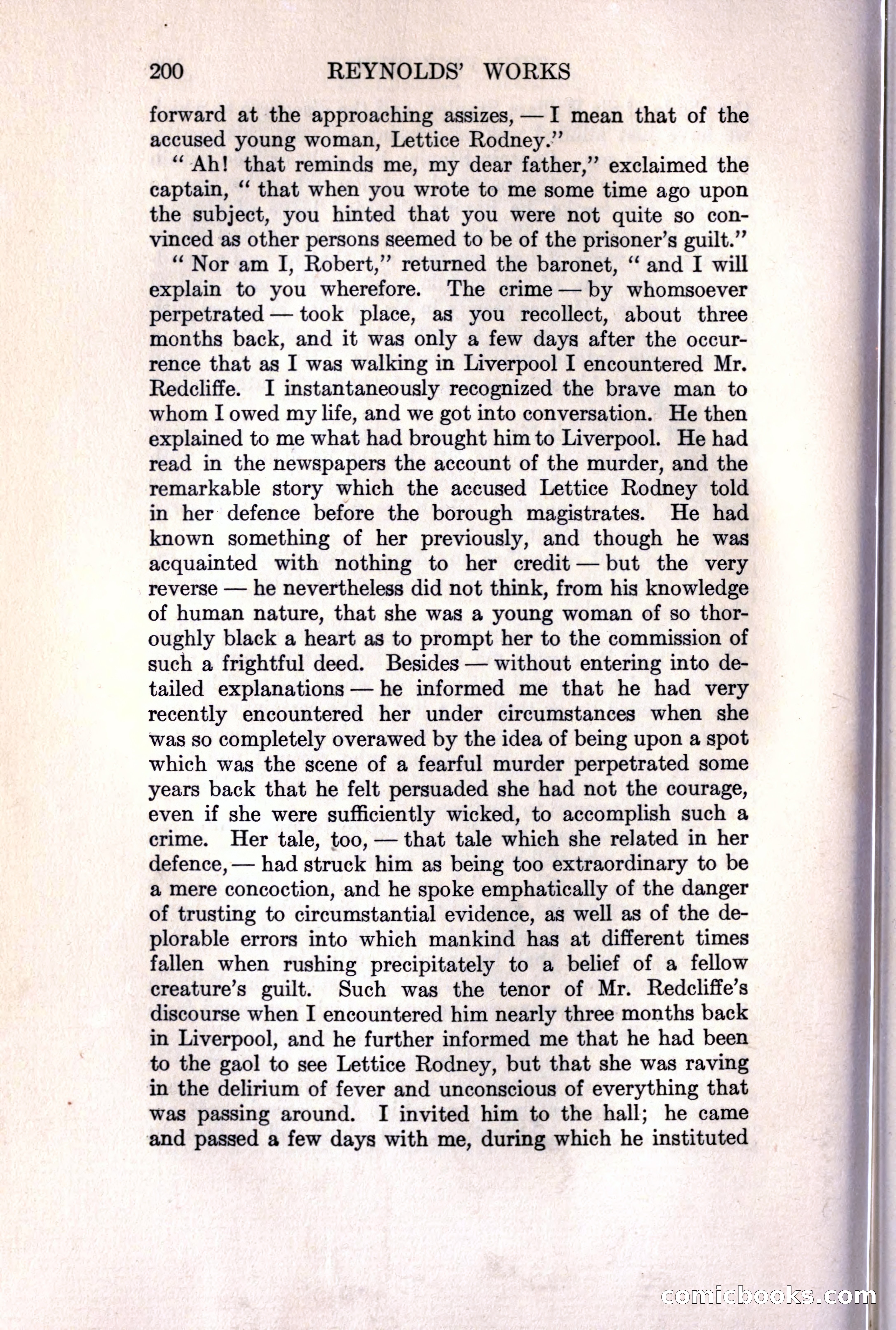
A restored page from Penny Dreadfuls, 1860. Page through the whole issue in the reader above.
📄 Transcribed text from this page (OCR, searchable)
Machine-transcribed from the original scan — historical spelling and the odd misread are preserved.
200 REYNOLDS’ WORKS forward at the approaching assizes, —I mean that of the accused young woman, Lettice Rodney.” “Ah! that reminds me, my dear father,” exclaimed the captain, “ that when you wrote to me some time ago upon the subject, you hinted that you were not quite so con- vinced as other persons seemed to be of the prisoner’s guilt.”’ “Nor am I, Robert,” returned the baronet, “ and I will explain to you wherefore. The crime —by whomsoever perpetrated — took place, as you recollect, about three months back, and it was only a few days after the occur- rence that as I was walking in Liverpool I encountered Mr. Redcliffe. I instantaneously recognized the brave man to whom I owed my life, and we got into conversation. He then explained to me what had brought him to Liverpool. He had read in the newspapers the account of the murder, and the remarkable story which the accused Lettice Rodney told in her defence before the borough magistrates. He had known something of her previously, and though he was acquainted with nothing to her ecredit— but the very reverse — he nevertheless did not think, from his knowledge of human nature, that she was a young woman of so thor- oughly black a heart as to prompt her to the commission of such a frightful deed. Besides — without entering into de- tailed explanations — he informed me that he had very recently encountered her under circumstances when she was so completely overawed by the idea of being upon a spot which was the scene of a fearful murder perpetrated some years back that he felt persuaded she had not the courage, even if she were sufficiently wicked, to accomplish such a crime. Her tale, too, — that tale which she related in her defence, — had struck him as being too extraordinary to be a mere concoction, and he spoke emphatically of the danger of trusting to circumstantial evidence, as well as of the de- plorable errors into which mankind has at different times fallen when rushing precipitately to a belief of a fellow creature’s guilt. Such was the tenor of Mr. Redcliffe’s discourse when I encountered him nearly three months back in Liverpool, and he further informed me that he had been to the gaol to see Lettice Rodney, but that she was raving in the delirium of fever and unconscious of everything that was passing around. I invited him to the hall; he came and passed a few days with me, during which he instituted CORNICLO@O