
Penny Dreadfuls, 1860 · page 168 of 400
The Mysteries of the Court of London — page 168: what you’re looking at
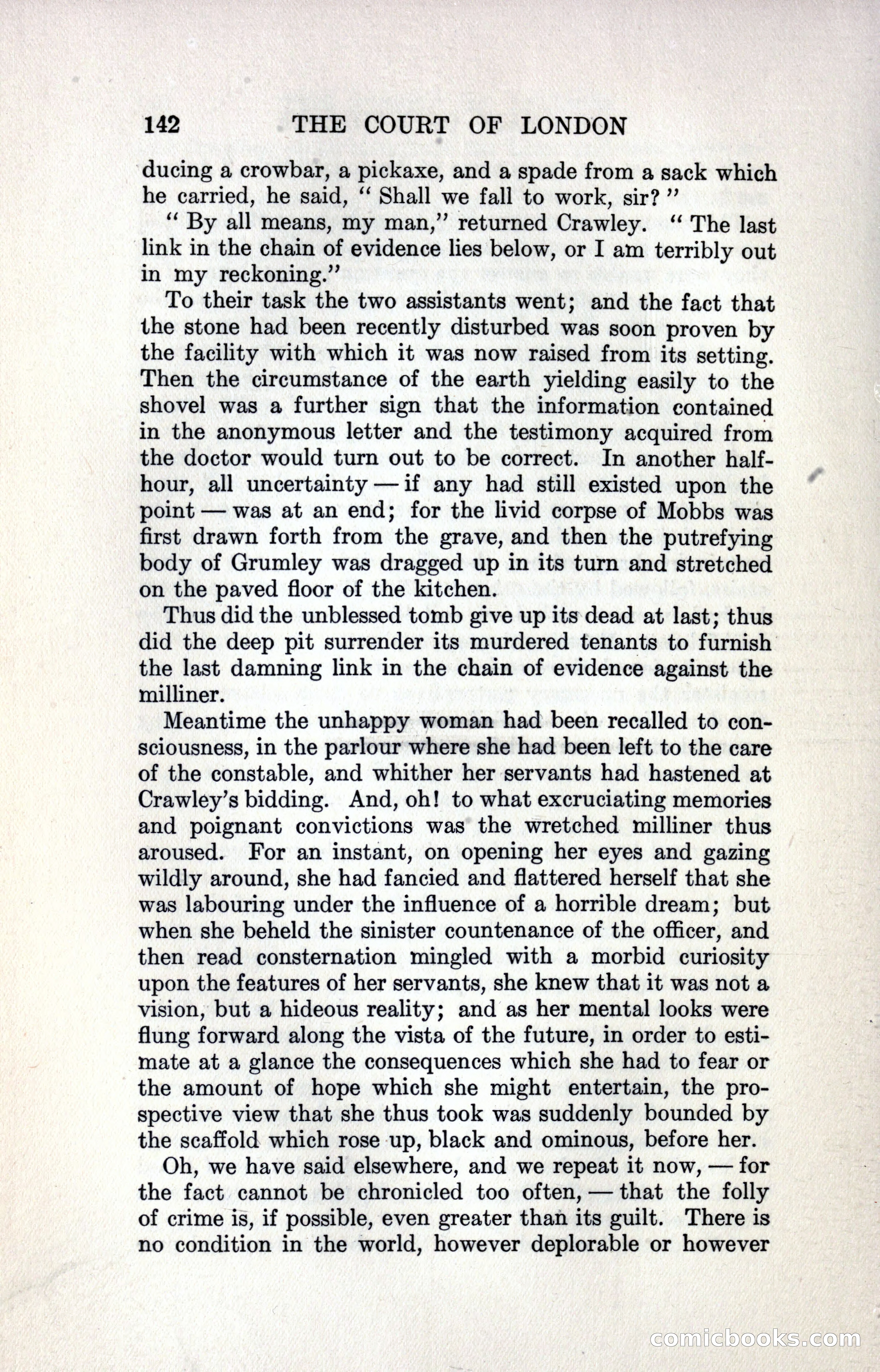
A restored page from Penny Dreadfuls, 1860. Page through the whole issue in the reader above.
📄 Transcribed text from this page (OCR, searchable)
Machine-transcribed from the original scan — historical spelling and the odd misread are preserved.
142 THE COURT OF LONDON ‘ducing a crowbar, a pickaxe, and a spade from a sack which he carried, he said, “‘ Shall we fall to work, sir? ”’ ‘“‘ By all means, my man,” returned Crawley. ‘“ The last link in the chain of evidence lies below, or I am terribly out in my reckoning.” To their task the two assistants went; and the fact that the stone had been recently disturbed was soon proven by the facility with which it was now raised from its setting. Then the circumstance of the earth yielding easily to the shovel was a further sign that the information contained in the anonymous letter and the testimony acquired from the doctor would turn out to be correct. In another half- hour, all uncertainty —if any had still existed upon the point — was at an end; for the livid corpse of Mobbs was first drawn forth from the grave, and then the putrefying body of Grumley was dragged up in its turn and stretched on the paved floor of the kitchen. Thus did the unblessed tomb give up its dead at last; thus did the deep pit surrender its murdered tenants to furnish the last damning link in the chain of evidence against the milliner. Meantime the unhappy woman had been recalled to con- sciousness, in the parlour where she had been left to the care of the constable, and whither her servants had hastened at Crawley’s bidding. And, oh! to what excruciating memories and poignant convictions was the wretched milliner thus aroused. For an instant, on opening her eyes and gazing wildly around, she had fancied and flattered herself that she was labouring under the influence of a horrible dream; but when she beheld the sinister countenance of the officer, and then read consternation mingled with a morbid curiosity upon the features of her servants, she knew that it was not a vision, but a hideous reality; and as her mental looks were flung forward along the vista of the future, in order to esti- mate at a glance the consequences which she had to fear or the amount of hope which she might entertain, the pro- spective view that she thus took was suddenly bounded by the scaffold which rose up, black and ominous, before her. Oh, we have said elsewhere, and we repeat it now, — for the fact cannot be chronicled too often, — that the folly of crime is, if possible, even greater than its guilt. There is no condition in the world, however deplorable or however GOmiicdoo <S m