
Penny Dreadfuls, 1849 · page 80 of 394
The Mysteries of the Court of London — page 80: what you’re looking at
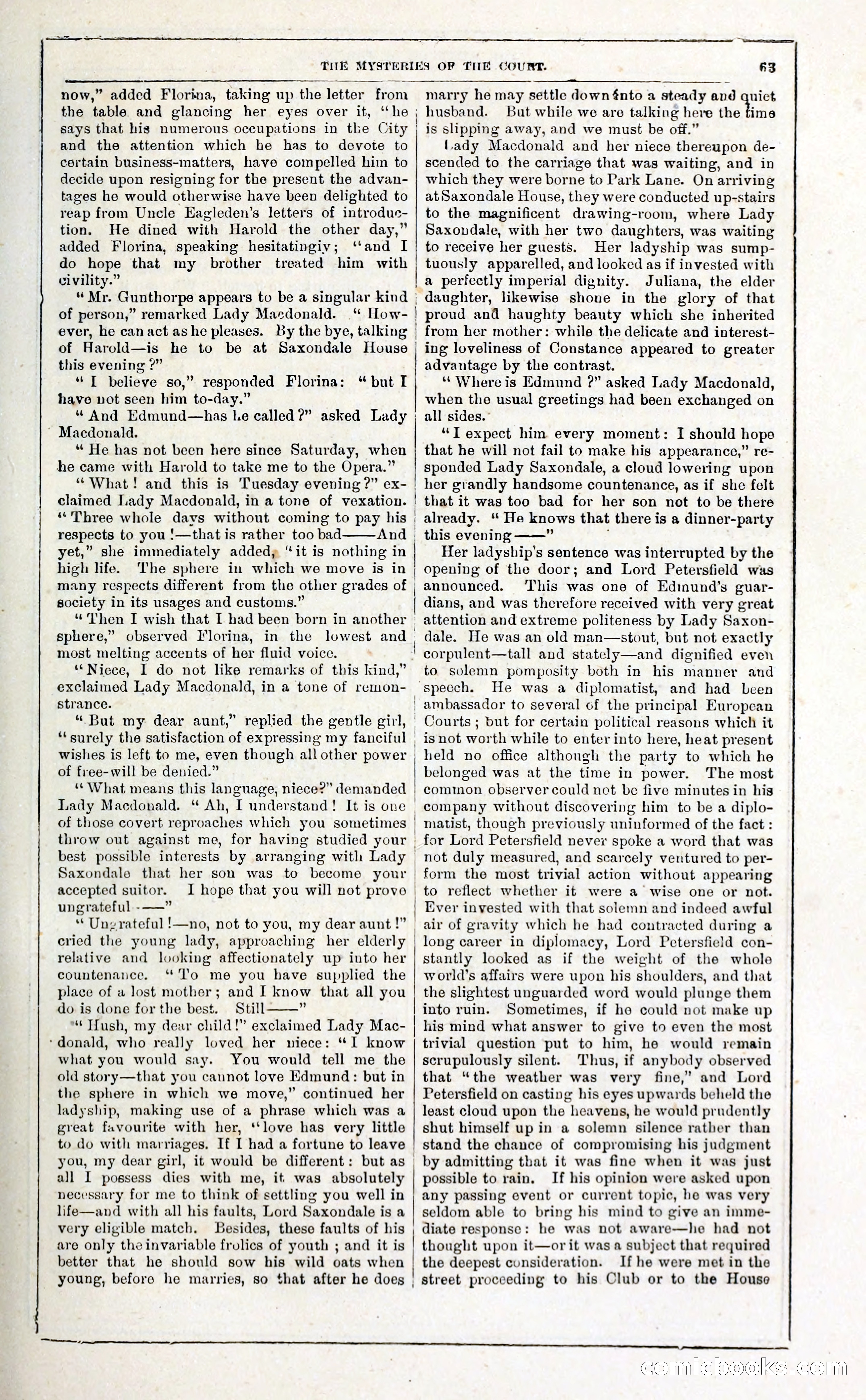
A restored page from Penny Dreadfuls, 1849. Page through the whole issue in the reader above.
📄 Transcribed text from this page (OCR, searchable)
Machine-transcribed from the original scan — historical spelling and the odd misread are preserved.
—_ TITE MYSTERIES OF TITE COURT. now,” added Florina, taking up the letter from the table and glancing her eyes over it, ‘‘he says that his numerous occupations in tle City and the attention which he has to devote to certain business-matters, have compelled him to decide upon resigning for the present the advan- tages he would otherwise have been delighted to reap from Uncle Eagleden’s letters of introduc- tion. He dined with Harold the other day,” added Florina, speaking hesitatingiv; ‘‘and I do hope that my brother treated him with civility.” “ Mr. Gunthorpe appears to be a singular kind of person,” remarked Lady Macdonald. .“ How- ever, he canact ashe pleases. By the bye, talking of Harold—is he to be at Saxondale House this evening 2” ‘IT believe so,” responded Florina: “ but I have not seen him to-day.” *“ And Edmund—has Le called?” asked Lady ~ Macdonald. “ He has not been here since Saturday, when he came with Harold to take me to the Opera.” ‘“ What! and this is Tuesday evening ?” ex- claimed Lady Macdonald, in a tone of vexation. “Three whole davs without coming to pay his respects to you !—thatis rather too bad And yet,” she immediately added, “it is nothing in high life. The sphere in which we move is in many respects different from the other grades of society in its usages and customs.” | | a a ‘“ Then I wish that I had been born in another - sphere,” observed Florina, in the lowest and most melting accents of her fluid voice. ‘“Niece, I do not like remarks of this kind,” exclaimed Lady Macdonald, in a tone of remon- strance. “ But my dear aunt,” replied the gentle girl, “surely the satisfaction of expressing my fanciful wishes is left to me, even though all other power of free-will be denied.” ‘‘What means this language, niece?” demanded Lady Macdonald. “ Ah, I understand! It is one of those covert reproaches which you sometimes throw out against me, for having studied your best possible interests by arranging with Lady Saxondale that her son was to become your accepted suitor. I hope that you will not prove ungrateful.-——” * Une rateful !—no, not to you, my dear aunt !” cried the young lady, approaching her elderly relative and looking affectionately up into her countenance. ‘‘’o me you have supplied the place of wu lost mother; and I know that all you do is done forthe best. Still . “ TWush, my dear child!” exclaimed Lady Mac- ‘donald, who really loved her niece: “I know what you would say. You would tell me the old story—that you cannot love Edmund: but in the sphere in which we move,” continued her ladyship, making use of a phrase which was a great favourite with her, “love has very little to do with marriages. If I had a fortune to leave you, my dear girl, it would be different: but as all I possess dies with me, it was absolutely necessary for me to think of settling you well in life—and with all his faults, Lord Saxondale is a very eligible match. Besides, these faults of his are only theinvariable frolics of youth ; and it is better that he should sow his wild oats when ggelinen Ngan speech. 3 marry he may settle down énto a steady and quiet husband. But while we are talking here the time is slipping away, and we must be off.” lady Macdonald and her niece thereupon de- scended to the carriage that was waiting, and in which they were borne to Park Lane. On arriving at Saxondale House, they were conducted up-stairs to the magnificent drawing-room, where Lady Saxondale, with her two daughters, was waiting to receive her guests. Her ladyship was sump- tuously apparelled, and looked as if invested with a perfectly imperial dignity. Juliana, the elder daughter, likewise shone in the glory of that proud and haughty beauty which she inherited from her mother: while the delicate and interest- ing loveliness of Constance appeared to greater advantage by the contrast. “Whereis Edmund ?” asked Lady Macdonald, when the usual greetings had been exchanged on all sides.” “T expect him every moment: I should hope that he will not fail to make his appearance,” re- sponded Lady Saxondale, a cloud lowering upon her grandly handsome countenance, as if she felt that it was too bad for her son not to be there already. “ He knows that there is a dinner-party this evening “4 Her ladyship’s sentence was interrupted by the opening of the door; and Lord Petersfield was announced. This was one of Edinund’s guar- dians, and was therefore received with very great attention and extreme politeness by Lady Saxon- dale. He was an old man—stout, but not exactly corpulent—tall and stately—and dignified even to solemn pomposity both in his manner and He was a diplomatist, and had Leen ambassador to several of the principal Europcan Courts ; but for certain political reasons whicli it is not worth while to enter into here, heat present held no office although the party to which he belonged was at the time in power. The most common observer could not be five minutes in his company without discovering him to be a diplo- matist, though previously uninformed of the fact : for Lord Petersfield never spoke a word that was not duly measured, and scarcely ventured to per- form the most trivial action without appearing to reflect whether it were a wise one or not. Ever invested with that solemn and indeed awful air of gravity which he had contracted during a long career in diplomacy, Lord Petersfield con- stantly looked as if the weight of the whole world’s affairs were upon his shoulders, and that the slightest unguarded word would plunge them into ruin. Sometimes, if he could not make up his mind what answer to give to even the most trivial question put to him, he would remain scrupulously silent. Thus, if anybody observed that “the weather was very fine,” and Lord Petersfield on casting his eyes upwards beheld the least cloud upon the heavens, he would prudently shut himself up in a solemn silence rather than stand the chance of compromising his judgment by admitting that it was fine when it was just possible to rain. If his opinion were asked upon any passing event or current topic, he was very seldom able to bring his mind to give an imme- diate response: he was not aware—le had not thought upon it—orit was a subject that required the deepest consideration. If he were met in the young, before he marries, so that after he does | street proceeding to his Club or to the House a EO JOO “S (CO)