
Penny Dreadfuls, 1849 · page 44 of 394
The Mysteries of the Court of London — page 44: what you’re looking at
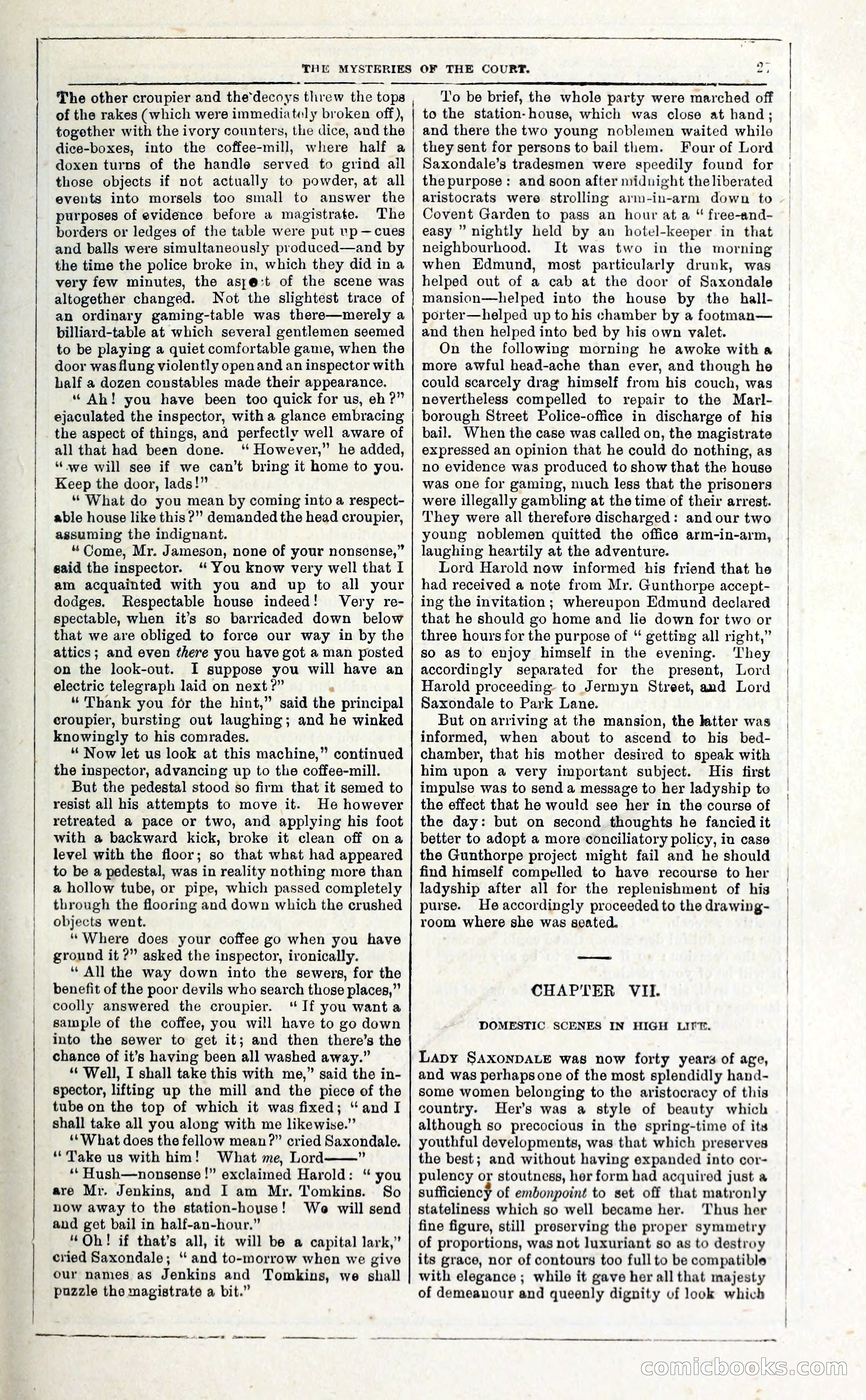
A restored page from Penny Dreadfuls, 1849. Page through the whole issue in the reader above.
📄 Transcribed text from this page (OCR, searchable)
Machine-transcribed from the original scan — historical spelling and the odd misread are preserved.
The other croupier and the'decoys threw the tops , of the rakes (which were immediately broken off), together with the ivory counters, the dice, aud the dice-boxes, into the coffee-mill, where half a doxen turns of the handle served to grind ail those objects if not actually to powder, at all events into morsels too small to answer the purposes of evidence before a magistrate. The borders or ledges of the table were put up—cues and balls were simultaneously produced—and by the time the police broke in, which they did in a very few minutes, the asye:t of the scene was altogether changed. Not the slightest trace of an ordinary gaming-table was there—merely a billiard-table at which several gentlemen seemed to be playing a quiet comfortable game, when the door was flung violently open and an inspector with half a dozen constables made their appearance. “ Ah! you have been too quick for us, eh ?” ejaculated the inspector, with a glance embracing the aspect of things, and perfectly well aware of all that had been done. ‘ However,” he added, “we will see if we can’t bring it home to you. Keep the door, lads!” - “ What do you mean by coming into a respect- able house like this ?” demanded the head croupier, assuming the indignant. “*Come, Mr. Jameson, none of your nonsense,” said the inspector. ‘“ You know very well that I am acquainted with you and up to all your dodges. Respectable house indeed! Very re- spectable, when it’s so barricaded down below that we are obliged to force our way in by the attics; and even there you have got a man posted on the look-out. I suppose you will have an electric telegraph laid on next ?” . “ Thank you for the hint,” said the principal croupier, bursting out laughing; and he winked knowingly to his comrades. “* Now let us look at this machine,” continued the inspector, advancing up to the coffee-mill. But the pedestal stood so firm that it semed to resist all his attempts to move it. He however retreated a pace or two, and applying his foot with a backward kick, broke it clean off ona level with the floor; so that what had appeared to be a pedestal, was in reality nothing more than a hollow tube, or pipe, which passed completely through the flooring and down which the crushed objects went. ‘Where does your coffee go when you have ground it ?” asked the inspector, ironically. ‘All the way down into the sewers, for the benefit of the poor devils who search those places,”’ coolly answered the croupier. “If you want a sample of the coffee, you will have to go down into the sewer to get it; and then there’s the chance of it’s having been all washed away.” “‘ Well, I shall take this with me,” said the in- spector, lifting up the mill and the piece of the tube on the top of which it was fixed; “and I shall take all you along with me likewise.” “What does the fellow mean?” cried Saxondale. “Take us with him! What me, Lord R ‘‘ Hush—nonsense !” exclaimed Harold: “ you are Mr. Jenkins, and I am Mr. Tomkins. So now away to the station-house! We will send and get bail in half-an-hour.” “Oh! if that’s all, it will be a capital lark,” cried Saxondale; ‘and to-morrow whon we give our names as Jenkins and Tomkins, we shall puzzle the magistrate a bit.” ee THE MYSTERIES OF THE COURT. os "> bag ‘l'o be brief, the whole party were marched off to the station- house, which was close at hand; and there the two young noblemen waited while they sent for persons to bail them. Four of Lord Saxondale’s tradesmen were speedily found for the purpose: and soon after midnight the liberated aristocrats were strolling arm-in-arm down to Covent Garden to pass an hour at a “ free-and- easy ’ nightly held by an hotel-keeper in that neighbourhood. It was two in the morning when Edmund, most particularly drunk, was helped out of a cab at the door of Saxondale mansion—helped into the house by the hall- porter—helped up to his chamber by a footman— and then helped into bed by his own valet. On the following morning he awoke witha more awful head-ache than ever, and though he could scarcely drag himself from his couch, was nevertheless compelled to repair to the Marl- borough Street Police-office in discharge of his bail. When the case was called on, the magistrate expressed an opinion that he could do nothing, as no evidence was produced to show that the house was one for gaming, much legs that the prisoners were illegally gambling at the time of their arrest. They were all therefore discharged: and our two young noblemen quitted the office arm-in-arm, laughing heartily at the adventure. Lord Harold now informed his friend that he had received a note from Mr. Gunthorpe accept- ing the invitation ; whereupon Edmund declared that he should go home and lie down for two or three hours for the purpose of “ getting all right,” so as to enjoy himself in the evening. ‘They accordingly separated for the present, Lord - Harold proceeding to Jermyn Street, and Lord Saxondale to Park Lane. But on arriving at the mansion, the hatter was informed, when about to ascend to his bed- chamber, that his mother desired to speak with him upon a very important subject. His first impulse was to send a message to her ladyship to the effect that he would see her in the course of the day: but on second thoughts he fancied it better to adopt a more conciliatory policy, iu case the Gunthorpe project might fail and he should find himself compelled to have recourse to her ladyship after all for the replenishment of his purse. He accordingly proceeded to the drawing- room where she was seated. CHAPTER VII. DOMESTIC SCENES IN HIGH LITT. LaDy SAXONDALE was now forty years of age, and was perhaps one of the most splendidly hand- some women belonging to the aristocracy of this country. Her’s was a style of beauty which although so precocious in the spring-time of its youthful developments, was that which preserves the best; and without having expanded into cor- pulency or stoutness, her form had acquired just a sufficiency of embonpoint to set off that matronly stateliness which so well became her. Thus her fine figure, still preserving the proper symmetry of proportions, was not luxuriant so as to destroy its grace, nor of contours too full to be compatible with elegance ; while it gave her all that majesty of demeanour and queenly dignity of look which Go dO) (CO)