
Penny Dreadfuls, 1849 · page 40 of 394
The Mysteries of the Court of London — page 40: what you’re looking at
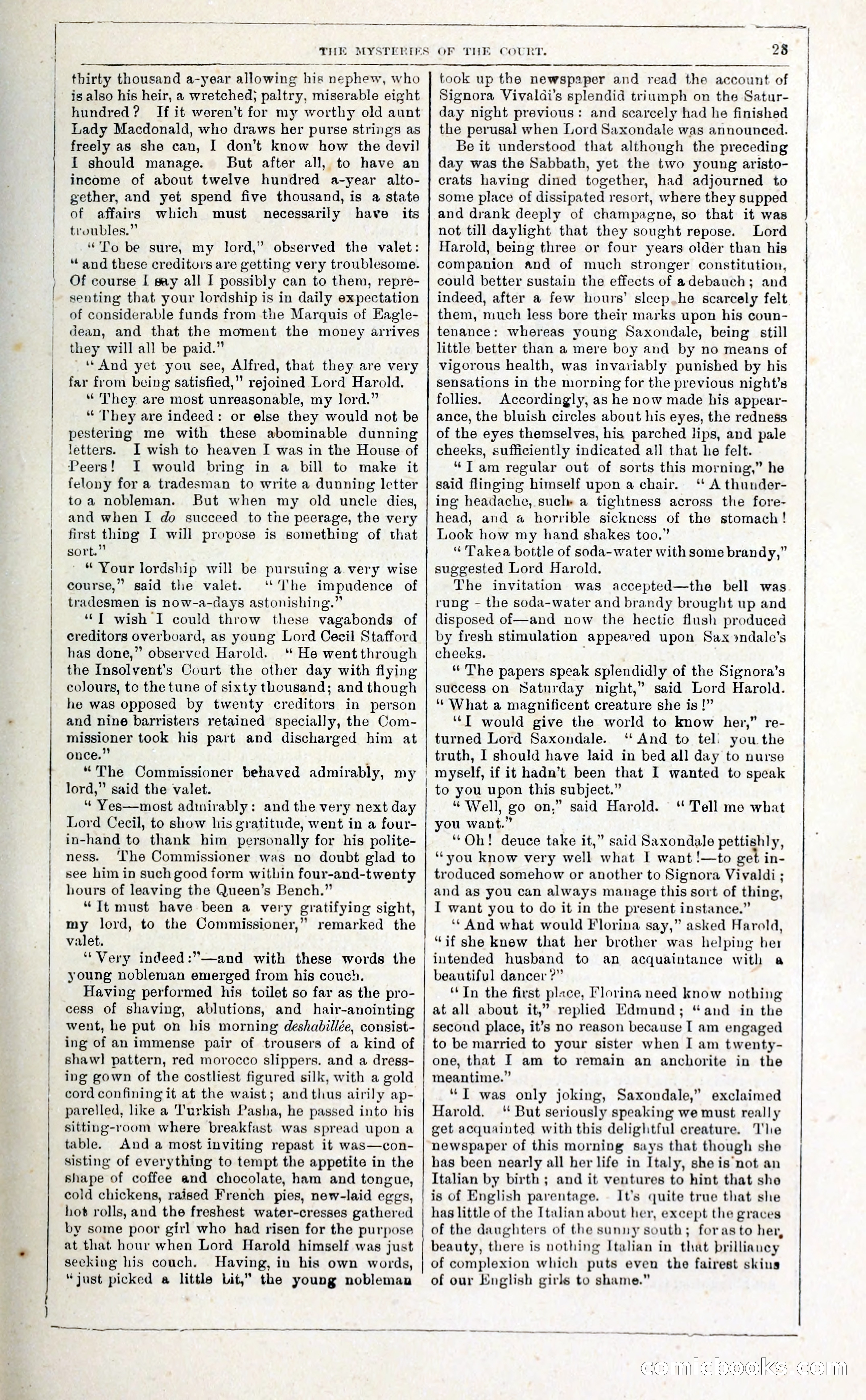
A restored page from Penny Dreadfuls, 1849. Page through the whole issue in the reader above.
📄 Transcribed text from this page (OCR, searchable)
Machine-transcribed from the original scan — historical spelling and the odd misread are preserved.
=, ———— THE MYSTERIES OF THE COURT. 28 rr rr thirty thousand a-year allowing his nephew, who is also his heir, a wretched; paltry, miserable eight hundred? If it weren’t for my worthy old aunt Lady Macdonald, who draws her purse strings as freely as she can, I don’t know how the devil I should manage. SBut after all, to have an income of about twelve hundred a-year alto- gether, and yet spend five thousand, is a state of affairs which must necessarily have its troubles.” “'To be sure, my lord,” observed the valet: “ and these creditors are getting very troublesome. Of course I say all I possibly can to them, repre- senting that your lordship is in daily expectation of considerable funds from the Marquis of Eagle- dean, and that the moment the money arrives they will all be paid.” _‘* And yet you see, Alfred, that they are very far from being satisfied,” rejoined Lord Harold. “ They are most unreasonable, my lord.” “They are indeed: or else they would not be pestering me with these abominable dunning letters. I wish to heaven I was in the House of Peers! I would bring in a bill to make it felony for a tradesman to write a dunning letter toa nobleman. But when my old uncle dies, and when I do succeed to the peerage, the very first thing I will propose is something of that sort.” ~“ Your lordship will be pursuing a very wise course,” said the valet. ‘‘The impudence of tradesmen is now-a-days astonishing.” ‘Tl wish I could throw these vagabonds of creditors overboard, as young Lord Cecil Stafford has done,” observed Harold. “ He went through the Insolvent’s Court the other day with flying colours, to the tune of sixty thousand; and though he was opposed by twenty creditors in person and nine barristers retained specially, the Com- missioner took his part and discharged him at once.” “The Commissioner behaved admirably, my lord,” said the valet. “ Yes—most admirably: and the very next day Lord Cecil, to show his gratitude, went in a four- in-hand to thank him personally for his polite- ness. ‘he Commissioner was no doubt glad to see him in such good form within four-and-twenty hours of leaving the Queen’s Bench.” “It must have been a very gratifying sight, my lord, to the Commissioner,” remarked the valet. ‘‘'Very indeed:”—and with these words the young nobleman emerged from his couch. Having performed his toilet so far as the pro- cess of shaving, ablutions, and hair-anointing went, he put on his morning deshabillée, consist- ing of an immense pair of trousers of a kind of shawl pattern, red morocco slippers. and a dress- ing gown of the costliest figured silk, with a gold cord confining it at the waist; andthus airily ap- parelled, like a ‘Turkish Pasha, he passed into his sitting-room where breakfast was spread upon a table. And a most inviting repast it was—con- sisting of everything to tempt the appetite in the Shape of coffee and chocolate, ham and tongue, cold chickens, raised French pies, new-laid eggs, hot rolls, and the freshest water-cresses gathered by some poor girl who had risen for the purpose at that hour when Lord Harold himself was just secking his couch. Having, in his own words, “just picked a little Lit,” the young nobleman -_— a —_ -—_ took up the newspaper and read the account of Signora Vivalai’s splendid triumph on the Satur- day night previous: and scarcely had he finished the perusal when Lord Saxondale was announced. Be it understood that although the preceding day was the Sabbath, yet the two young aristo- crats having dined together, had adjourned to some place of dissipated resort, where they supped and drank deeply of champagne, so that it was not till daylight that they sought repose. Lord Harold, being three or four years older than his companion and of much stronger constitution, could better sustain the effects of adebauch; and indeed, after a few hours’ sleep.he scarcely felt them, much less bore their marks upon his coun- tenance: whereas young Saxondale, being still little better than a mere boy and by no means of vigorous health, was invariably punished by his sensations in the morning for the previous night’s follies. Accordingly, as he now made his appear- ance, the bluish circles about his eyes, the redness of the eyes themselves, his parched lips, and pale cheeks, sufficiently indicated all that he felt. “Tam regular out of sorts this morning,” he said flinging himself upon a chair. ‘“ A thunder- ing headache, sucl» a tightness across the fore- head, and a horrible sickness of the stomach! Look how my hand shakes too.” “ 'Takea botile of soda-water with some brandy,” suggested Lord Harold. The invitation was accepted—the bell was rung - the soda-water and brandy brought up and disposed of—and now the hectic flush produced by fresh stimulation appeared upon Sax 9ndale’s cheeks. “The papers speak splendidly of the Signora’s success on Saturday night,” said Lord Harold. ‘What a magnificent creature she is!” ‘““T would give the world to know her,” re- turned Lord Saxondale. ‘And to tel: you the truth, I should have laid in bed all day to nurse myself, if it hadn’t been that I wanted to speak to you upon this subject.” “ Well, go on,” said Harold. you want.” ‘“Oh! deuce take it,” said Saxondale pettishly, “you know very well what I want !—to get in- troduced somehow or another to Signora Vivaldi ; and as you can always manage this sort of thing, I want you to do it in the present instance.” ‘* And what would Florina say,” asked Harold, “if she knew that her brother was helping her intended husband to an acquaintance with a beautiful dancer ?” ‘In the first place, Florina need know nothing at all about it,” replied Mdmund; “and in the second place, it’s no reason because I am engaged to be married to your sister when I am twenty- one, that I am to remain an anchorite in the meantime.” “IT was only joking, Saxondale,” exclaimed Harold. ‘“ But seriously speaking we must really get acquainted with this delightful creature. ‘T'le newspaper of this morning says that though she has been nearly all her life in Italy, she is not an Italian by birth ; and it ventures to hint that she is of English parentage. It’s quite true that she has little of the Italian about her, except the graces of the daughters of the sunny south; foras to her, beauty, there is nothing Italian in that brilliauey of complexion which puts even the fairest skius of our English girls to shame.” “Tell me what ttl. ea tilt, COMmMICcbookxs (CO)