
Penny Dreadfuls, 1849 · page 383 of 394
The Mysteries of the Court of London — page 383: what you’re looking at
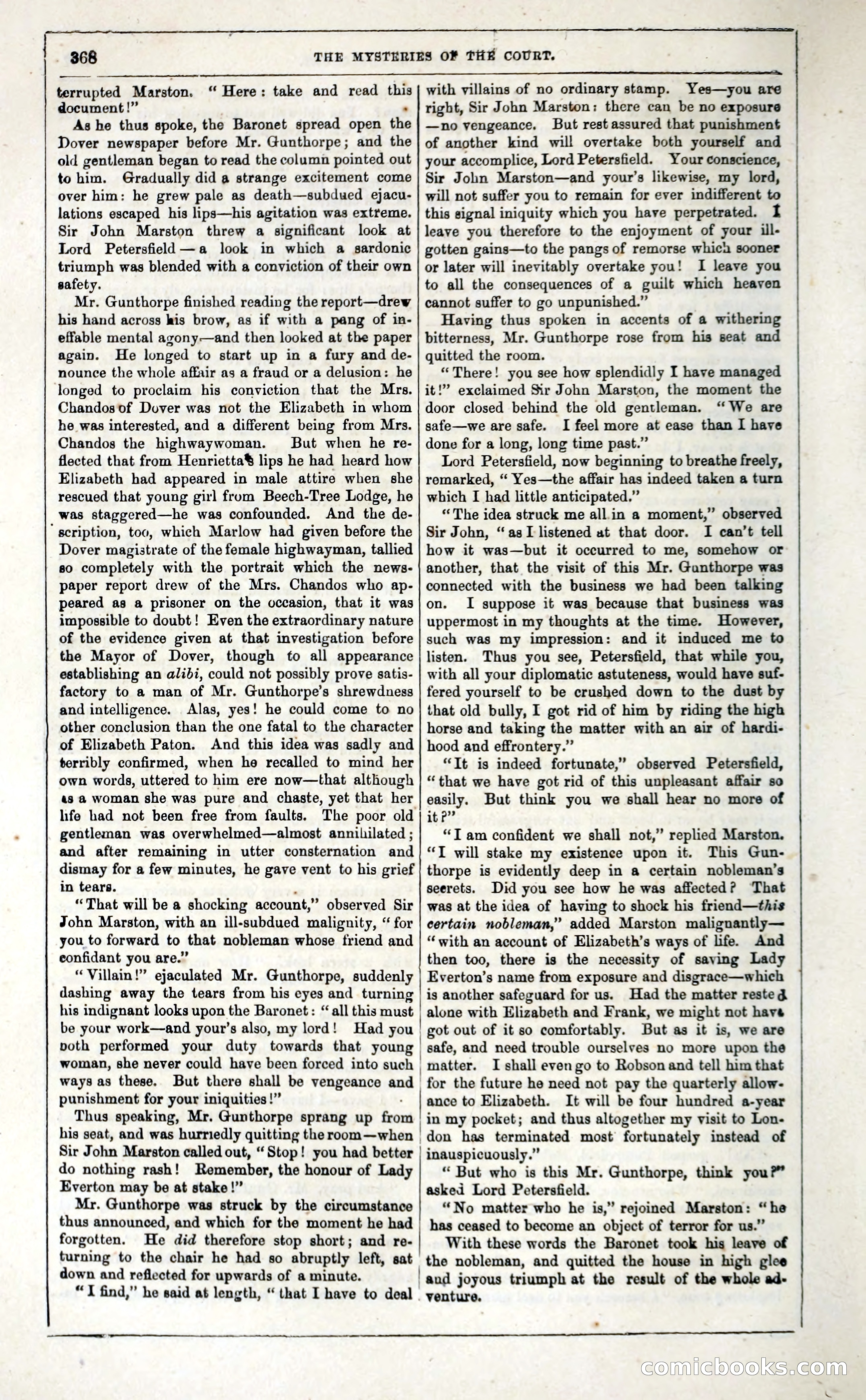
A restored page from Penny Dreadfuls, 1849. Page through the whole issue in the reader above.
📄 Transcribed text from this page (OCR, searchable)
Machine-transcribed from the original scan — historical spelling and the odd misread are preserved.
908 ; terrupted Marston. “ Here: take and read this document!” . As he thus spoke, the Baronet spread open th Dover newspaper before Mr. Gunthorpe; and the old gentleman began to read the column pointed out to him. Gradually did a strange excitement come over him: he grew pale as death—subdued ejacu- lations escaped his lips—his agitation was extreme. Sir John Marston threw a significant look at Lord Petersfield —a look in which a sardonic triumph was blended with a conviction of their own safety. Mr. Gunthorpe finished reading the report—drew his hand across his brow, as if with a pang of in- effable mental azony—and then looked at the paper again. He longed to start up in a fury and de- nounce the whole affair as a fraud or a delusion: he longed to proclaim his conviction that the Mrs. Chandos of Dover was not the Elizabeth in whom he was interested, and a different being from Mrs. Chandos the highwaywoman. SBut when he re- flected that from Henrietta® lips he had heard how Elizabeth had appeared in male attire when she rescued that young girl from Beech-Tree Lodge, he was staggered—he was confounded. And the de- ‘ scription, too, which Marlow had given before the Dover magistrate of the female highwayman, tallied so completely with the portrait which the news- paper report drew of the Mrs. Chandos who ap- peared as a prisoner on the occasion, that it was impossible to doubt! Even the extraordinary nature of the evidence given at that investigation before the Mayor of Dover, though fo all appearance establishing an alibi, could not possibly prove satis- factory to a man of Mr. Gunthorpe’s shrewdness and intelligence. Alas, yes! he could come to no other conclusion than the one fatal to the character of Elizabeth Paton. And this idea was sadly and terribly confirmed, when he recalled to mind her own words, uttered to him ere now—that although as 2 woman she was pure and chaste, yet that her life had not been free from faults. gentleman was overwhelmed—almost annililated ; and after remaining in utter consternation and dismay for a few minutes, he gave vent to his grief in tears. , “That will be a shocking account,” observed Sir John Marston, with an ill-subdued malignity, “ for you to forward to that nobleman whose friend and confidant you are.” “Villain!” ejaculated Mr. Gunthorpe, suddenly dashing away the tears from his eyes and turning his indignant looks upon the Baronet: “all this must be your work—and your’s also, my lord! Had you both performed your duty towards that young The poor old THE MYSTERIES OF THE COURT. nn ee eee enna ynsyn nnn nse with villains of no ordinary stamp. Yes—you are right, Sir John Marston: there can be no exposure —no vengeance. But rest assured that punishment of another kind will overtake both yourself and your accomplice, Lord Petersfield. Your conscience, Sir John Marston—and your’s likewise, my lord, will not suffer you to remain for ever indifferent to this signal iniquity which you have perpetrated. I leave you therefore to the enjoyment of your ill- gotten gains—to the pangs of remorse which sooner or later will inevitably overtake you! I leave you to all the consequences of a guilt which heaven cannot suffer to go unpunished.” Having thus spoken in accents of a withering bitterness, Mr. Gunthorpe rose from his seat and quitted the room. “There! you see how splendidly I have managed it!”’ exclaimed Sir John Marston, the moment the door closed behind the old gentleman. “ We are safe—we are safe. I feel more at ease than I have done for a long, long time past.” Lord Petersfield, now beginning to breathe freely, remarked, “ Yes—the affair has indeed taken a turn which I had little anticipated.” “The idea struck me all.in a moment,” observed Sir John, “as I listened at that door. I can’t tell how it was—but it occurred to me, somehow or another, that the visit of this Mr. Ganthorpe was connected with the business we had been talking on. I suppose it was because that business was uppermost in my thoughts at the time. However, such was my impression: and it induced me to listen. Thus you see, Petersfield, that while you, with all your diplomatic astuteness, would have suf- fered yourself to be crushed down to the dust by that old bully, I got rid of him by riding the high horse and taking the matter with an air of hardi- hood and effrontery.” “Tt is indeed fortunate,” observed Petersfield, “that we have got rid of this unpleasant affair so easily. But think you we shall hear no more of it P” “T am confident we shall not,” replied Marston. “TI will stake my existence upon it. This Gun- thorpe is evidently deep in a certain nobleman’s seerets. Did you see how he was affected? That was at the idea of having to shock his friend—this certain nobleman,” added Marston malignantly— “with an account of Elizabeth’s ways of life. And then too, there is the necessity of saying Lady Everton’s name from exposure and disgrace—which is another safeguard for us. Had the matter rested alone with Elizabeth and Frank, we might not have got out of it so comfortably. But as it is, we are safe, and need trouble ourselves no more upon the woman, she never could have been forced into such | matter. I shall even go to Robson and tell him that ways as these. But there shall be vengeance and punishment for your iniquities !” Thus speaking, Mr. Gunthorpe sprang up from his seat, and was hurriedly quitting the room—when Sir John Marston called out, “Stop! you had better do nothing rash! Remember, the honour of Lady Everton may be at stake !” Mr. Gunthorpe was struck by the circumstance thus announced, and which for the moment he had forgotten. He did therefore stop short; and re- for the future he need not pay the quarterly allow- ance to Elizabeth. It will be four hundred a-year in my pocket; and thus altogether my visit to Lon- don has terminated most fortunately instead of inauspicuously.” “ But who is this Mr. Gunthorpe, think you?” asked Lord Petersfield. “No matter who he is,” rejoined Marston: “he has ceased to become an object of terror for us.” With these words the Baronet took his leave of turning to the chair he had so abruptly left, sat the nobleman, and quitted the house in high glee down and reflected for upwards of a minute. ‘and joyous triumph at the result of the whole ad- “T find,” he said at length, “ that I have to deal. yenture. ECORNICLOOO Ss (€©)