
Penny Dreadfuls, 1849 · page 373 of 394
The Mysteries of the Court of London — page 373: what you’re looking at
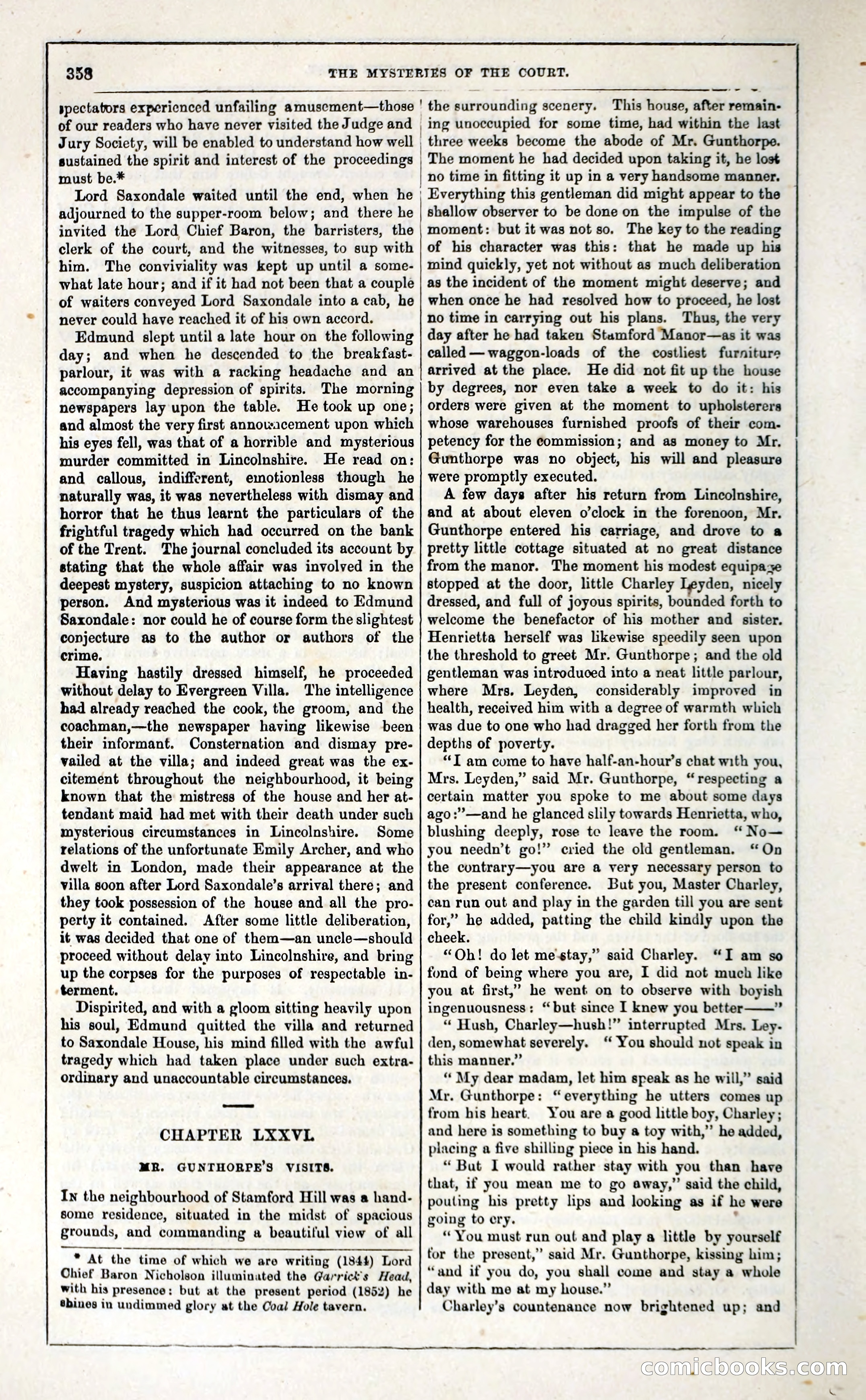
A restored page from Penny Dreadfuls, 1849. Page through the whole issue in the reader above.
📄 Transcribed text from this page (OCR, searchable)
Machine-transcribed from the original scan — historical spelling and the odd misread are preserved.
358 THE MYSTERIES OF THE COURT. se i a spectators experienced unfailing amusement—those ! the surrounding scenery. This house, after remain- of our readers who have never visited the Judge and must be.* Lord Saxondale waited until the end, when he adjourned to the supper-room below; and there he invited the Lord Chief Baron, the barristers, the clerk of the court, and the witnesses, to sup with him. The conviviality was kept up until a some- what late hour; and if it had not been that a couple of waiters conveyed Lord Saxondale into a cab, he never could have reached it of his own accord. Edmund slept until a late hour on the following day; and when he descended to the breakfast- parlour, it was with a racking headache and an accompanying depression of spirits. The morning newspapers lay upon the table. He took up one; and almost the very first annowacement upon which his eyes fell, was that of a horrible and mysterious murder committed in Lincolnshire. He read on: and callous, indifferent, emotionless though he naturally was, it was nevertheless with dismay and horror that he thus learnt the particulars of the frightful tragedy which had occurred on the bank of the Trent. The journal concluded its account by stating that the whole affair was involved in the deepest mystery, suspicion attaching to no known person. And mysterious was it indeed to Edmund Saxondale: nor could he of course form the slightest conjecture as to the author or authors of the crime. Having hastily dressed himself, he proceeded without delay to Evergreen Villa. The intelligence had already reached the cook, the groom, and the coachman,—the newspaper having likewise been their informant. Consternation and dismay pre- vailed at the villa; and indeed great was the ex- citement throughout the neighbourhood, it being known that the mistress of the house and her at- tendant maid had met with their death under such mysterious circumstances in Lincolnshire. Some relations of the unfortunate Emily Archer, and who dwelt in London, made their appearance at the villa soon after Lord Saxondale’s arrival there; and they took possession of the house and all the pro- perty it contained. After some little deliberation, it was decided that one of them—an uncle—should proceed without delay into Lincolnshire, and bring up the corpses for the purposes of respectable in- terment. Dispirited, and with a gloom sitting heavily upon his soul, Edmund quitted the villa and returned to Saxondale House, his mind filled with the awful tragedy which had taken place under such extra- ordinary and unaccountable circumstances. CHAPTER LXXVL MR. GUNTHORPE’S VISITS. In the neighbourhood of Stamford Hill was a hand- some residence, situated in the midst of spacious grounds, and commanding a beautiful view of all * At the time of which we are writing (1844) Lord Chief Baron Nicholson illuminated the Garrick's Head, with his presence; but at the present period (1852) he Shines in undimmed glory at the Coal Hole tavern. ES TT. dente tee — a = om _ = ing unoccupied for some time, had within the last Jury Society, will be enabled to understand how well , three weeks become the abode of Mr. Gunthorpe. sustained the spirit and interest of the proceedings | The moment he had decided upon taking it, he lost no time in fitting it up in a very handsome manner. | Everything this gentleman did might appear to the shallow observer to be done on the impulse of the moment: but it was not so. The key to the reading of his character was this: that he made up his mind quickly, yet not without as much deliberation as the incident of the moment might deserve; and when once he had resolved how to proceed, he lost no time in carrying out his plans. Thus, the very day after he had taken Stamford Manor—as it was called — waggon-loads of the costliest furniture arrived at the place. He did not fit up the house by degrees, nor even take a week to do it: his orders were given at the moment to upholsterers whose warehouses furnished proofs of their com. petency for the commission; and as money to Mr. Gunthorpe was no object, his will and pleasure were promptly executed. A few days after his return from Lincolnshire, and at about eleven o’clock in the forenoon, Mr. Gunthorpe entered his carriage, and drove to a pretty little cottage situated at no great distance from the manor. The moment his modest equipaze stopped at the door, little Charley Leyden, nicely dressed, and full of joyous spirits, bounded forth to welcome the benefactor of his mother and sister. Henrietta herself was Lkewise speedily seen upon the threshold to greet Mr. Gunthorpe; and the old gentleman was introduced into a neat little parlour, where Mrs. Leyden, considerably improved in health, received him with a degree of warmth which was due to one who had dragged her forth from the depths of poverty. “T am come to have half-an-hour’s chat with you, Mrs. Leyden,” said Mr. Gunthorpe, “respecting a certain matter you spoke to me about some days aco:’—and he glanced slily towards Henrietta, who, blushing deeply, rose te leave the room. ‘‘ No— you needn’t go!” cried the old gentleman. “On the contrary—you are a very necessary person to the present conference. But you, Master Charley, can run out and play in the garden till you are sent for,” he added, patting the child kindly upon the cheek. “Oh! do let me'stay,” said Charley. “I am so fond of being where you are, I did not much like you at first,” he went on to observe with boyish ingenuousness: “but since I knew you better-——” “ Hush, Charley—hush!” interrupted Mrs. Ley- den, somewhat severely. “ You should not speak in this manner.” “ My dear madam, let him speak as he will,” said Mr. Gunthorpe: “everything he utters comes up from his heart. You are a good little boy, Charley; and here is something to buy a toy with,” he added, placing a five shilling piece in his hand. “ But I would rather stay with you than have that, if you mean me to go away,” said the child, pouting his pretty lips and looking as if he were going to ery. : “You must run oul and play a little by yourself tor the present,” said Mr. Gunthorpe, kissing him; “and if you do, you shall come and stay a whole day with me at my house.” Charley’s countenance now brightened up; and a me ee ee ee Gomichoo (C <=) (c@)