
Penny Dreadfuls, 1849 · page 289 of 394
The Mysteries of the Court of London — page 289: what you’re looking at
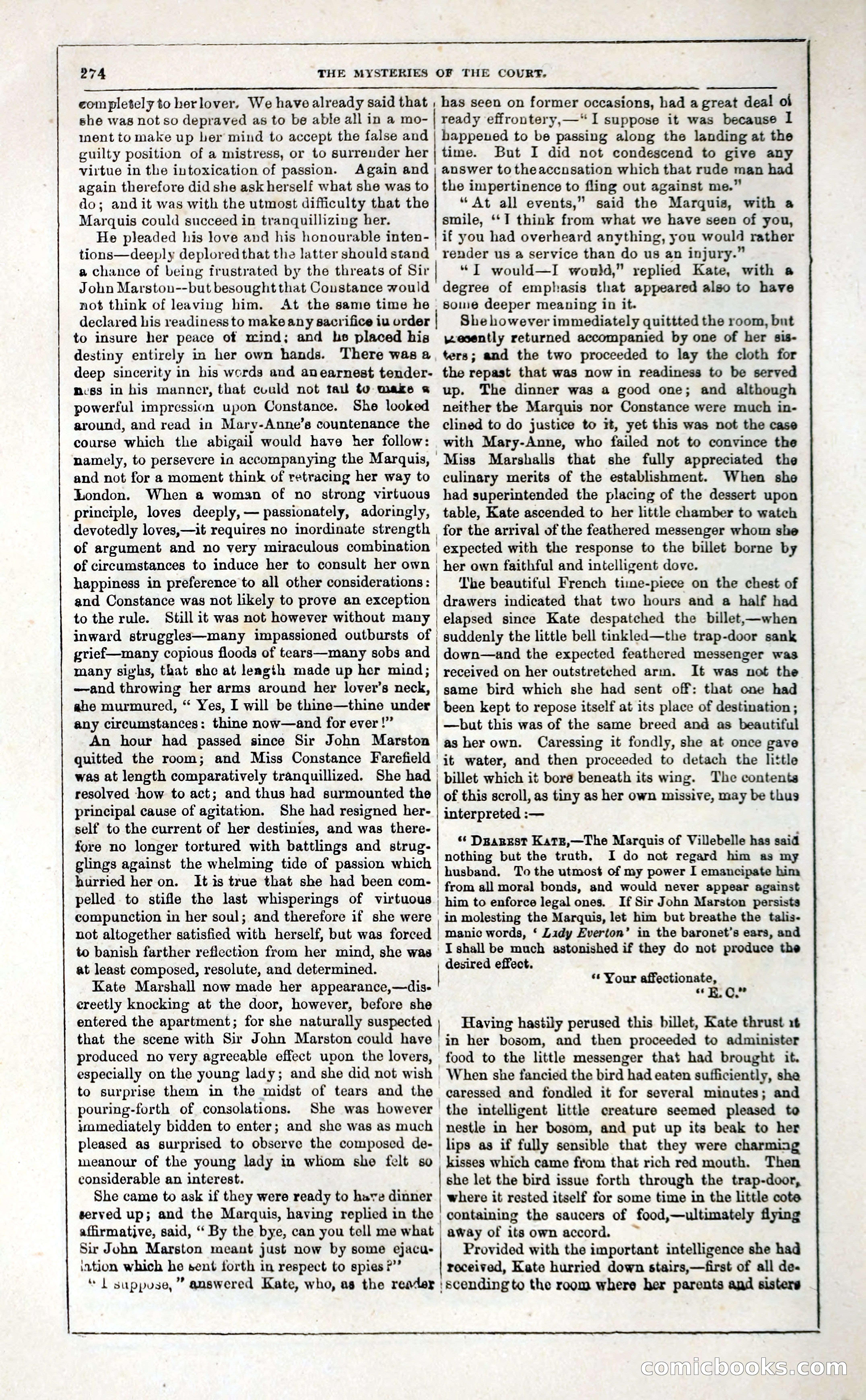
A restored page from Penny Dreadfuls, 1849. Page through the whole issue in the reader above.
📄 Transcribed text from this page (OCR, searchable)
Machine-transcribed from the original scan — historical spelling and the odd misread are preserved.
274 completely to herlover. We have already said that , she was not so depraved as to be able all in a mo- nent to make up her mind to accept the false and guilty position of a mistress, or to surrender her virtue in the intoxication of passion. Again and again therefore did she ask herself what she was to do; and it was with the utmost difficulty that the Marquis could succeed in tranquillizing her. He pleaded his love and his honourable inten- THE MYSTERIES OF THE COURT. has seen on former occasions, had a great deal of ready effrontery,—“ I suppose it was because 1 happeued to be passing along the landing at the time. But I did not condescend to give any answer to theaccusation which that rude man had the impertinence to fling out against me.” “At all events,” said the Marquis, with a smile, ‘I think from what we have seen of you, if you had overheard anything, you would rather tions—deeply deplored that the latter should stand render us a service than do us an injury.” a chance of being frustrated by the threats of Sir John Marstou--but besought that Coustance would not think of leaving him. At the same time he declared his readiness to make any sacrifice iu order to insure her peace of wind; and he placed his destiny entirely in her own hands. There was a deep sincerity in his words and an earnest tender- mess in his manner, that could not fall to make & powerful impression upon Constance. She looked around, and read in Mary-Anne’s countenance the course which the abigail would have her follow: namely, to persevere ia accompanying the Marquis, | and not for a moment think of retracing her way to London. When a woman of no strong virtuous principle, loves deeply, — passionately, adoringly, devotedly loves,—it requires no inordinate strength of circumstances to induce her to consult her own happiness in preference to all other considerations: and Constance was not likely to prove an exception to the rule. Still it was not however without many “JT would—I would,” replied Kate, with a degree of emphasis that appeared also to have some deeper meaning in it. She however immediately quittted the room, but wesently returned accompanied by one of her sis- ters; and the two proceeded to lay the cloth for the repast that was now in readiness to be served up. The dinner was a good one; and although neither the Marquis nor Constance were much in- clined to do justice to rt, yet this was not the case with Mary-Anne, who failed not to convince the Miss Marshalls that she fully appreciated the culinary merits of the establishment. When she had superintended the placing of the dessert upon table, Kate ascended to her little chamber to watch _for the arrival of the feathered messenger whom she of argument and no very miraculous combination | expected with the response to the billet borne by her own faithful and intelligent dove. The beautiful French time-piece on the chest of drawers indicated that two hours and a half had elapsed since Kate despatched the billet,—when inward struggles—many impassioned outbursts of | suddenly the little bell tinkled—the trap-door sank grief—many copious floods of tears—many sobs and many sighs, that she at length made up her mind; —and throwing her arms around her lover’s neck, ahe murmured, “‘ Yes, I will be thine—thine under any circumstances: thine now—and for ever !”’ An hour had passed since Sir John Marston quitted the room; and Miss Constance Farefield resolved ‘how to act; and thus had surmounted the principal cause of agitation. She had resigned her- self to the current of her destinies, and was there- fore no longer tortured with battlings and strug- glings against the whelming tide of passion which hurried her on. It is true that she had been com- down—and the expected feathered messenger was received on her outstretched arm. It was not the same bird which she had sent off: that one had been kept to repose itself at its place of destination ; —but this was of the same breed and as beautiful as her own. Caressing it fondly, she at once gave ‘it water, and then proceeded to detach the little was at length comparatively tranquillized. She had | billet which it bore beneath its wing. The contents of this scroll, as tiny as her own missive, may be thus interpreted :— ‘¢ Dgarxst Katz,—The Marquis of Villebelle has said nothing but the truth. I do not regard him as my husband. To the utmost of my power I emancipate him from all moral bonds, and would never appear against pelled to stifle the last whisperings of virtuous | him to enforce legal ones. If Sir John Marston persists compunction in her soul; and therefore if she were not altogether satisfied with herself, but was forced to banish farther reficction from her mind, she was at least composed, resolute, and determined. Kate Marshall now made her appearance,—dis- creetly knocking at the door, however, before she entered the apartment; for she naturally suspected that the scene with Sir John Marston could have produced no very agreeable effect upon the lovers, especially on the young lady; and she did not wish > to surprise them in the midst of tears and the pouring-forth of consolations. | desired effect. She was however. in molesting the Marquis, let him but breathe the talis- manic words, ‘ Lady Everton’ in the baronet’s ears, and I shall be much astonished if they do not produce the ‘* Your affectionate, cng Having hastily perused this billet, Kate thrust at in her bosom, and then proceeded to administer food to the little messenger that had brought it. When she fancied the bird had eaten sufficiently, sha caressed and fondled it for several minutes; and the intelligent little creature seemed pleased to immediately bidden to enter; and she was as much | nestle in her bosom, and put up its beak to her pleased as surprised to observe the composed de- | lips as if fully sensible that they were charming meanour of the young lady in whom she felt so kisses which came from that rich red mouth. Then considerable an interest. | she let the bird issue forth through the trap-door, She came to ask if they were ready to have dinner | where it rested itself for some time in the little cote served up; and the Marquis, having replied in the | containing the saucers of food,—ultimately flying affirmative, said, “ By the bye, can you tell me what away of its own accord. —~ Sir John Marston meant just now by some ejacu-| Provided with the important intelligence she had iution which he sent forth in respect to spies?” roceived, Kate hurried down stairs,—first of all de- * | suppose,” answered Kate, who, as the reader :scendingto the room where her parents and sisters ECOMMICOOOKS (EC)