
Penny Dreadfuls, 1849 · page 276 of 394
The Mysteries of the Court of London — page 276: what you’re looking at
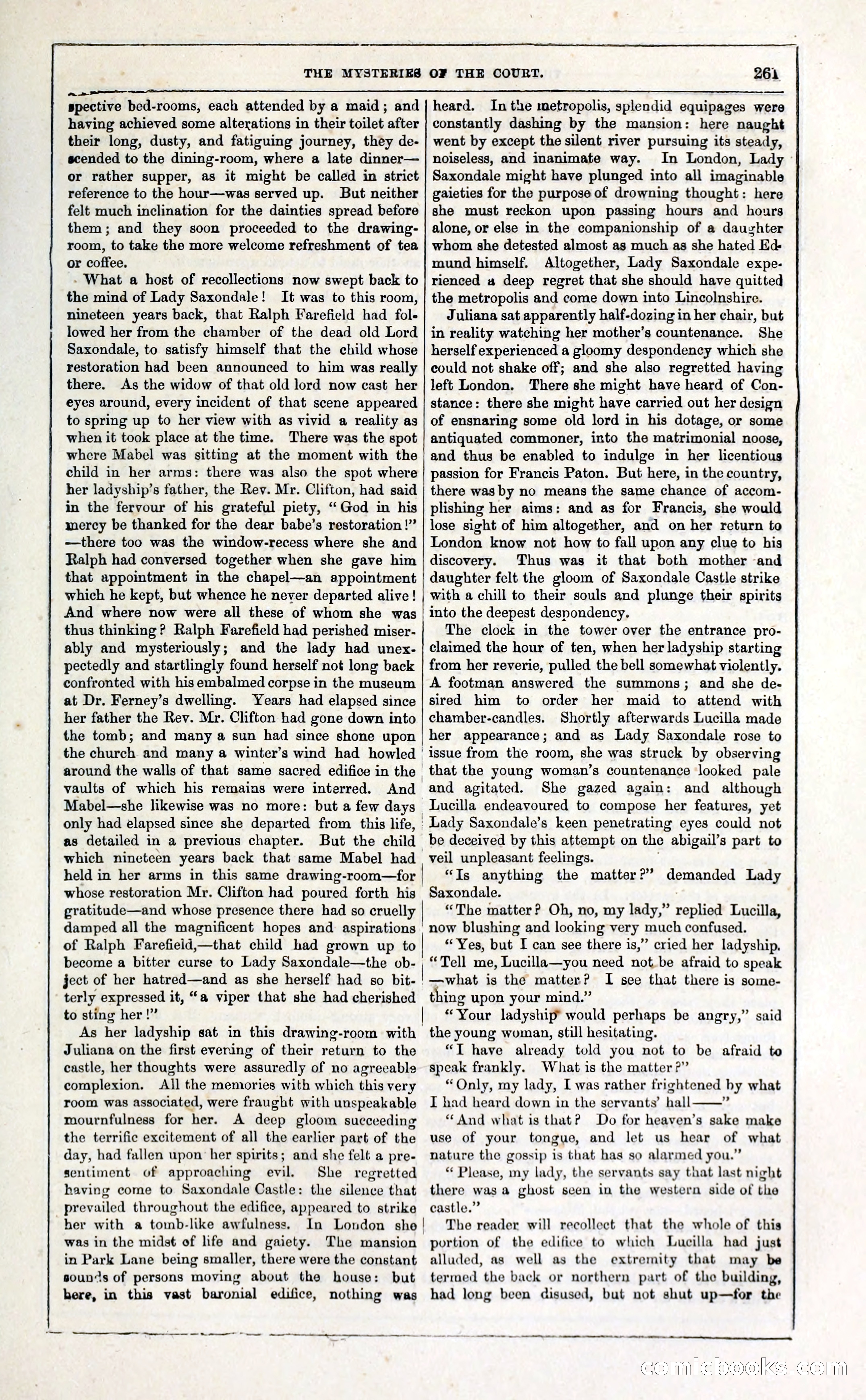
A restored page from Penny Dreadfuls, 1849. Page through the whole issue in the reader above.
📄 Transcribed text from this page (OCR, searchable)
Machine-transcribed from the original scan — historical spelling and the odd misread are preserved.
THE MYSTERIES OF THE COURT. 261 spective bed-rooms, each attended by a maid; and having achieved some alterations in their toilet after their long, dusty, and fatiguing journey, they de- scended to the dining-room, where a late dinner— or rather supper, as it might be called in strict reference to the hour—was served up. But neither felt much inclination for the dainties spread before them; and they soon proceeded to the drawing- room, to take the more welcome refreshment of tea or coffee. - What a host of recollections now swept back to the mind of Lady Saxondale! It was to this room, nineteen years back, that Ralph Farefield had fol lowed her from the chamber of the dead old Lord Saxondale, to satisfy himself that the child whose restoration had been announced to him was really there. As the widow of that old lord now cast her eyes around, every incident of that scene appeared to spring up to her view with as vivid a reality as when it took place at the time. There was the spot where Mabel was sitting at the moment with the child in her arms: there was also the spot where her ladyship’s father, the Rev. Mr. Clifton, had said in the fervour of his grateful piety, “God in his mercy be thanked for the dear babe’s restoration!” —there too was the window-recess where she and Ralph had conversed together when she gave him that appointment in the chapel—an appointment which he kept, but whence he never departed alive! And where now were all these of whom she was thus thinking? Ralph Farefield had perished miser- ably and mysteriously; and the lady had unex- pectedly and startlingly found herself not long back confronted with his embalmed corpse in the museum at Dr. Ferney’s dwelling. Years had elapsed since her father the Rev. Mr. Clifton had gone down into the tomb; and many a sun had since shone upon the church and many a winter’s wind had howled around the walls of that same sacred edifice in the vaults of which his remains were interred. And Mabel—she likewise was no more: but a few days only had elapsed since she departed from this life, as detailed in a previous chapter. But the child which nineteen years back that same Mabel had held in her arms in this same drawing-room—for whose restoration Mr. Clifton had poured forth his gratitude—and whose presence there had so cruelly damped all the magnificent hopes and aspirations of Ralph Farefield,—that child had grown up to become a bitter curse to Lady Saxondale—the ob- ject of her hatred—and as she herself had so bit- terly expressed it, “a viper that she had cherished to sting her!” As her ladyship sat in this drawing-room with Juliana on the first evering of their return to the castle, her thoughts were assuredly of no agreeable complexion. All the memories with which this very room was associated, were fraught with unspeakable mournfulness for her. A deep gloom succeeding the terrific excitement of all the earlier part of the day, had fallen upon her spirits; and she felt a pre- sentiment of approaching evil. She regretted having come to Saxondale Castle: the silence that prevailed throughout the edifice, appeared to strike her with a tomb-like awfulness, In London she was in the midst of life and gaiety. The mansion in Park Lane being smaller, there were the constant sounds of persons moving about the house: but here, in this vast baronial edifice, nothing was —_—_— et, a ~ ee ee ee ee - heard. Inthe metropolis, splendid equipages were constantly dashing by the mansion: here naught went by except the silent river pursuing its steady, noiseless, and inanimate way. In London, Lady © Saxondale might have plunged into all imaginable gaieties for the purpose of drowning thought: here she must reckon upon passing hours and hours alone, or else in the companionship of a dauvhter whom she detested almost as much as she hated Ed. mund himself. Altogether, Lady Saxondale expe- rienced a deep regret that she should have quitted the metropolis and come down into Lincolnshire. Juliana sat apparently half-dozing in her chair, but in reality watching her mother’s countenance. She herself experienced a gloomy despondency which she could not shake off; and she also regretted having left London. There she might have heard of Con- stance: there she might have carried out her design of ensnaring some old lord in his dotage, or some antiquated commoner, into the matrimonial noose, and thus be enabled to indulge in her licentious passion for Francis Paton. But here, in the country, there was by no means the same chance of accom- plishing her aims: and as for Francis, she would lose sight of him altogether, and on her return to London know not how to fall upon any clue to his discovery. Thus was it that both mother and daughter felt the gloom of Saxondale Castle strike with a chill to their souls and plunge their spirits into the deepest despondency. The clock in the tower over the entrance pro- claimed the hour of ten, when her ladyship starting from her reverie, pulled the bell somewhat violently. A footman answered the summons; and she de- sired him to order her maid to attend with chamber-candles. Shortly afterwards Lucilla made her appearance; and as Lady Saxondale rose to issue from the room, she was struck by observing that the young woman’s countenance looked pale and agitated. She gazed again: and although Lucilla endeavoured to compose her features, yet ' Lady Saxondale’s keen penetrating eyes could not be deceived by this attempt on the abigail’s part to veil unpleasant feelings. “Ts anything the matter?’ demanded Lady Saxondale. . “The matter? Oh, no, my lady,” replied Lucilla, ‘now blushing and looking very much confused. “Yes, but I can see there is,” cried her ladyship. “Tell me, Lucilla—you need not.be afraid to speak | ——what is the matter? I see that there is some- thing upon your mind.” “Your ladyship’ would perhaps be angry,’ the young woman, still hesitating. “T have already told you not to be afraid to speak frankly. What is the matter?” “Only, my lady, I was rather frightened by what I had heard down in the servants’ hall ne “And what is that? Do for heaven’s sake make use of your tongue, and let us hear of what nature the gossip is that has so alarmed you.” “ Please, my lady, the servants say that last night there was a ghost seen in the western side of the castle.” | The reader will recollect that the whole of this portion of the edifice to which Lucilla had just alluded, as well as the extremity that may be termed the back or northern part of the building, had long been disused, but not shut up—for the said —* 2 --e o wm eee ee ECOMmMIiclboooks (CO)