
Penny Dreadfuls, 1849 · page 27 of 394
The Mysteries of the Court of London — page 27: what you’re looking at
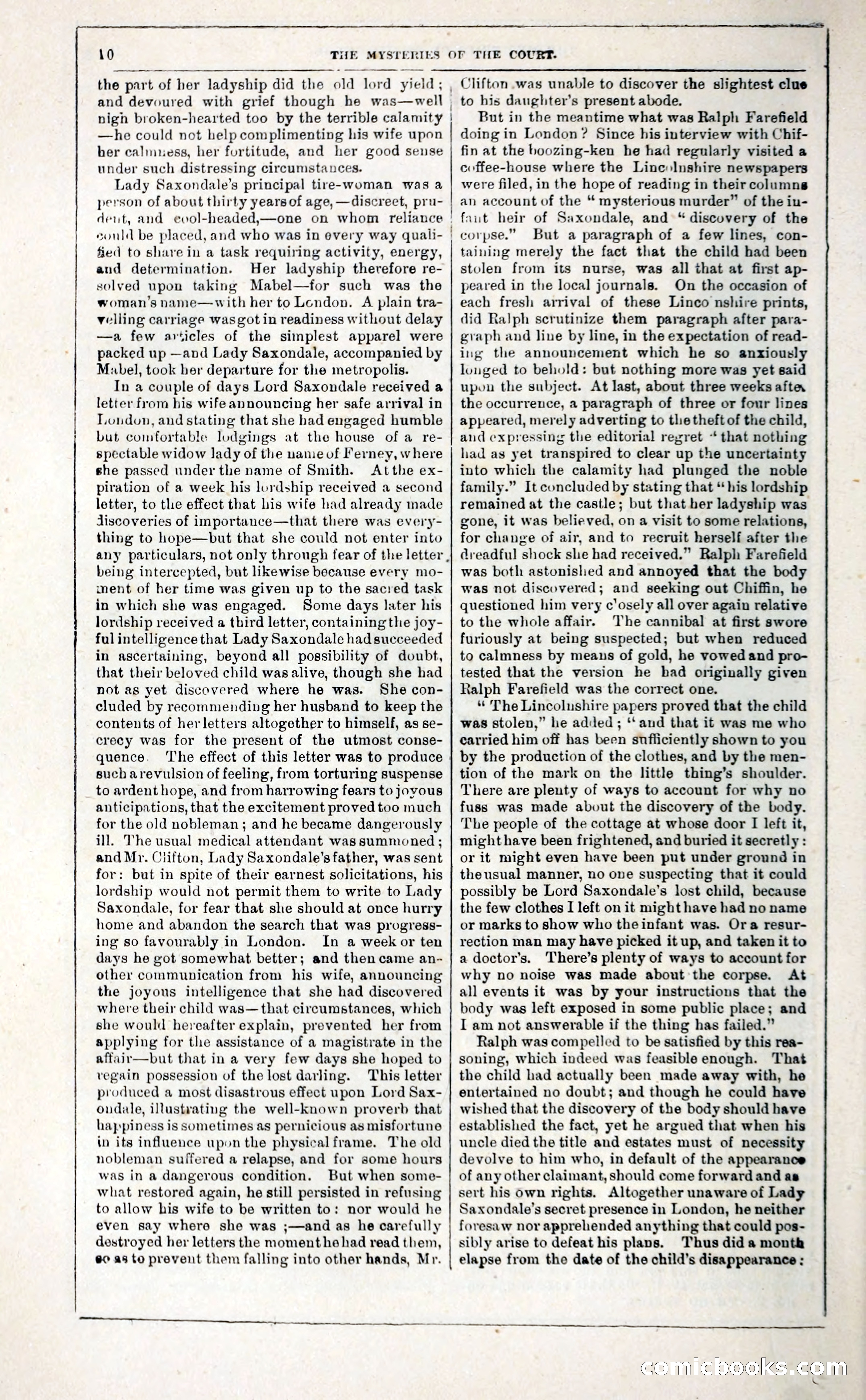
A restored page from Penny Dreadfuls, 1849. Page through the whole issue in the reader above.
📄 Transcribed text from this page (OCR, searchable)
Machine-transcribed from the original scan — historical spelling and the odd misread are preserved.
10 THE MYSTERIES OF THE COURT. the part of her ladyship did the old lord yield; , Clifton was unable to discover the slightest clue and devoured with grief though he was—well | to his daughter's present abode. nigh broken-hearted too by the terrible calamity —he could not helpcomplimenting his wife upon her calmuess, her fortitude, and her good sense under such distressing circumstances. Lady Saxondale’s principal tire-woman was a person of about thirty years of age, —discreet, pru- | deut, and evol-headed,—one on whom reliance could be placed, and who was in every way quali- fied to share in a task requiring activity, energy, aud determination. Her ladyship therefore re- solved upon taking Mabel—for such was the woman’s bame—with her to Lendon. A plain tra- velling carriage was got in readiness without delay —a few articles of the simplest apparel were packed up —and Lady Saxondale, accompanied by Mabel, took ber departure for the metropolis. In a couple of days Lord Saxondale received a letter from his wife announcing her safe arrival in Loudon, and stating that she had engaged humble but comfortable lodgings at the house of a re- spectable widow lady of the uanie of Ferney, where she passed under the name of Smith. Atthe ex- piration of a week his lordship received a second letter, to the effect that his wife had already made dJiscoveries of importance—that there was every- thing to hope—but that she could not enter into any particulars, not only through fear of the letter being intercepted, but likewise because every mo- nent of her time was given up to the sacred task in which she was engaged. Some days later his lordship received a third letter, containing the joy- ful intelligencethat Lady Saxondale had succeeded in ascertaining, beyond all possibility of doubt, that their beloved child was alive, though she had not as yet discovered where he was. She con- cluded by recommending her husband to keep the contents of her letters altogether to himself, as se- crecy was for the present of the utmost conse- quence. The effect of this letter was to produce such arevulsion of feeling, from torturing suspense to ardent hope, and from harrowing fears to joyous anticipations, that the excitement proved too much for the old nobleman; and he became dangerously ill. The usual medical attendant was summoned ; and Mr. Clifton, Lady Saxondale’s father, was sent for: but in spite of their earnest solicitations, his lordship would not permit them to write to Lady Saxondale, for fear that she should at once hurry home and abandon the search that was progress- ing so favourably in London. In a week or ten days he got somewhat better; and then came an- other communication from his wife, announcing the joyous intelligence that she had discovered where their child was—that circumstances, which she would hereafter explain, prevented her from applying for the assistance of a magistrate in the affair—but that in a very few days she hoped to vegain possession of the lost darling. This letter produced a most disastrous effect upon Lord Sax- ondale, illustvating the well-known proverb that happiness is sometimes as pernicious as misfortune in its influence upon the physical frame. The old nobleman suffered a relapse, and for some hours was in a dangerous condition. But when some- what restored again, he still persisted in refusing to allow his wife to be written to: nor would he even say where she was ;—and as he carefully destroyed her letters the moment he had read them, ec as to prevent them falling into other hands, Mr. | t-te —— oe But in the meantime what was Ralph Farefield doing in London ? Since his interview with Chif- fin at the boozing-ken he had regularly visited a coffee-house where the Linc lnshire newspapers were filed, in the hope of reading in their columns an account of the “ mysterious murder” of the iu- faut heir of Saxondale, and “ discovery of the corpse.” But a paragraph of a few lines, con- taining merely the fact that the child had been stolen from its nurse, was all that at first ap- peared in the local journals. On the occasion of each fresh arrival of these Linco nshire prints, did Ralph scrutinize them paragraph after para- graph and line by line, in the expectation of read- ing the announcement which he so anxiously longed to behold: but nothing more was yet said upon the subject. At last, about three weeks afta the occurrence, a paragraph of three or four lines appeared, merely adverting to the theft of the child, aud expressing the editorial regret “ that nothing liad as yet transpired to clear up the uncertainty into which the calamity had planged the noble family.” It concluded by stating that “ his lordship remained at the castle; but that her ladyship was gone, it was believed, on a visit to some relations, for change of air, and to recruit herself after the dreadful shock she had received.” Ralph Farefield was both astonislied and annoyed that the body was not discovered; and seeking out Chiffin, he questioned him very c’osely all over again relative to the whole affair. The cannibal at first swore furiously at being suspected; but when reduced to calmness by meaus of gold, he vowed and pro- tested that the version he had originally given Ralph Farefield was the correct one. ‘‘ The Lincolnshire papers proved that the child was stolen,” he added; “and that it was me who carried him off has been snfliciently shown to you by the production of the clothes, and by the men- tion of the mark on the little thing’s shoulder. There are plenty of ways to account for why no fuss was made about the discovery of the body. The people of the cottage at whose door I left it, might have been frightened, and buried it secretly : or it might even have been put under ground in theusual manner, no ove suspecting that it could possibly be Lord Saxondale’s lost child, because the few clothes I left on it might have had no name or marks to show who theinfant was. Ora resur- rection man may have picked it up, and taken it to a doctor's. There’s plenty of ways to account for why no noise was made about the corpse. At all events it was by your instructions that the body was left exposed in some public place; and I am not answerable if the thing has failed.” Ralph was compelled to be satisfied by this rea- soning, which indeed was feasible enough. That the child had actually been made away with, he entertained no doubt; and though he could have wished that the discovery of the body should have established the fact, yet he argued that when his uncle died the title and estates must of necessity devolve to him who, in default of the appearance of any other claimant, should come forward and as sert his own rights. Altogether unaware of Lady Saxondale’s secret presence in London, he neither foresaw nor apprehended anything that could pos- sibly arise to defeat his plans. Thus did a month elapse from the date of the child’s disappearance : mn S) EO) 0)(0)(0) co