
Penny Dreadfuls, 1849 · page 266 of 394
The Mysteries of the Court of London — page 266: what you’re looking at
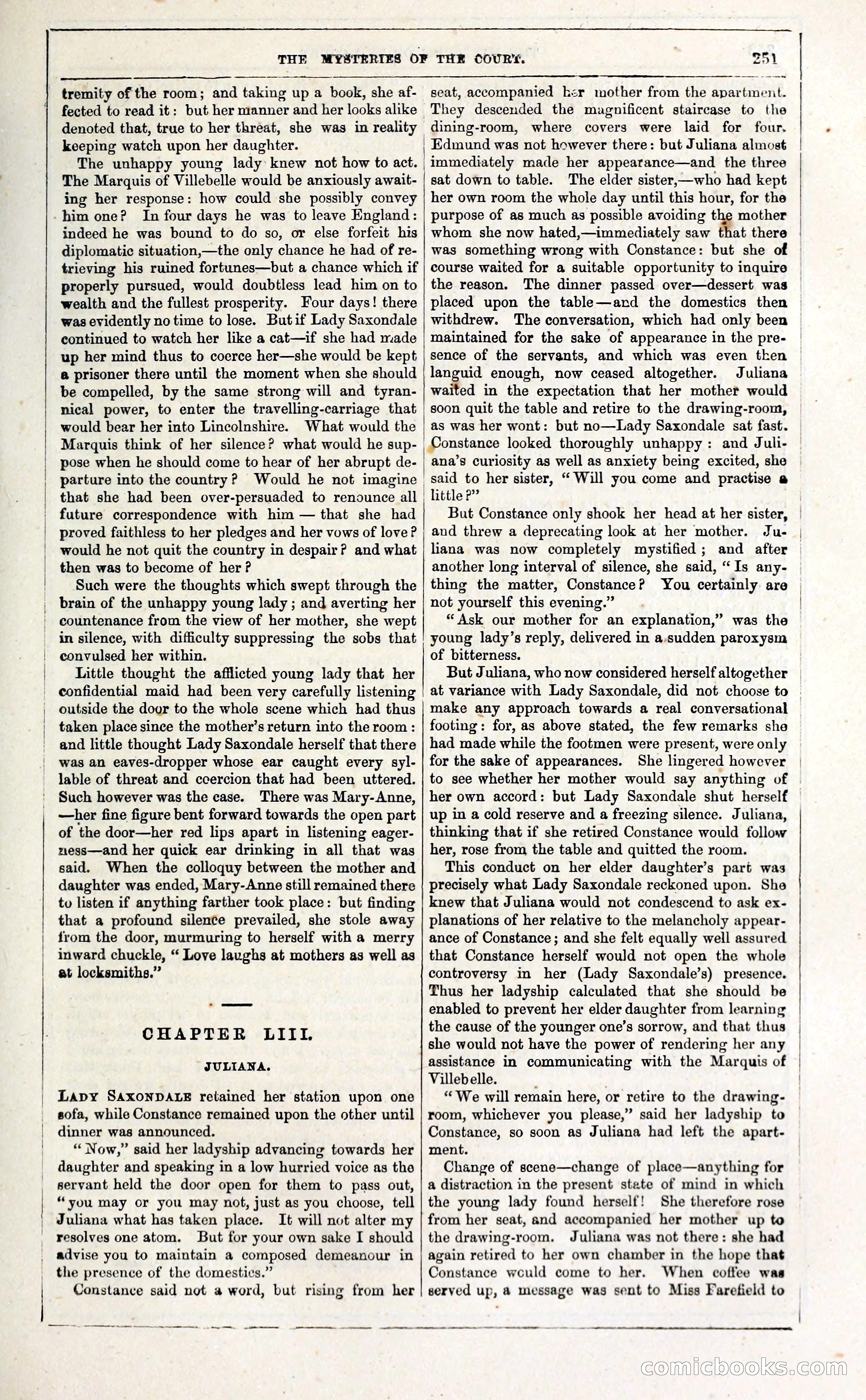
A restored page from Penny Dreadfuls, 1849. Page through the whole issue in the reader above.
📄 Transcribed text from this page (OCR, searchable)
Machine-transcribed from the original scan — historical spelling and the odd misread are preserved.
THE MYSTRRIES OF THE COUR‘. tremity of the room; and taking up a book, she af- 251 seat, accompanied ker mother from the apartment. fected to read it: but her nianner and her looks alike They descended the magnificent staircase to the denoted that, true to her threat, she was in reality keeping watch upon her daughter. The unhappy young lady knew not how to act. The Marquis of Villebelle would be anxiously await- ing her response: how could she possibly convey -him one? In four days he was to leave England: indeed he was bound to do so, or else forfeit his diplomatic situation,—the only chance he had of re- trieving his ruined fortunes—but a chance which if properly pursued, would doubtless lead him on to wealth and the fullest prosperity. Four days! there was evidently no time to lose. Butif Lady Saxondale continued to watch her like a cat—if she had made up her mind thus to coerce her—she would be kept @ prisoner there until the moment when she should be compelled, by the same strong will and tyran- nical power, to enter the travelling-carriage that would bear her into Lincolnshire. What would the Marquis think of her silence? what would he sup- | dining-room, where covers were laid for four. Edmund was not however there: but Juliana almost immediately made her appearance—and the three sat down to table. The elder sister,—who had kept her own room the whole day until this hour, for the purpose of as much as possible avoiding the mother whom she now hated,—immediately saw that there was something wrong with Constance: but she of course waited for a suitable opportunity to inquire the reason. The dinner passed over—dessert was a ee placed upon the table—and the domestics then | withdrew. maintained for the sake of appearance in the pre- sence of the servants, and which was even tken languid enough, now ceased altogether. Juliana waited in the expectation that her mother would soon quit the table and retire to the drawing-room, as was her wont: but no—Lady Saxondale sat fast. Constance looked thoroughly unhappy: and Juli- pose when he should come to hear of her abrupt de- | ana’s curiosity as well as anxiety being excited, she parture into the country? Would he not imagine | said to her sister, “ Will you come and practise @ that she had been over-persuaded to renounce all future correspondence with him — that she had proved faithless to her pledges and her vows of love? would he not quit the country in despair? and what then was to become of her? Such were the thoughts which swept through the brain of the unhappy young lady ; and averting her countenance from the view of her mother, she wept in silence, with difficulty suppressing the sobs that convulsed her within. Little thought the afflicted young lady that her confidential maid had been very carefully listening outside the door to the whole scene which had thus taken place since the mother’s return into the room : and little thought Lady Saxondale herself that there was an eaves-dropper whose ear caught every syl- lable of threat and ccercion that had been uttered. Such however was the case. There was Mary-Anne, —her fine figure bent forward towards the open part of the door—her red lips apart in listening eager- ness—and her quick ear drinking in all that was said. When the colloquy between the mother and daughter was ended, Mary-Anne still remained there tu listen if anything farther took place: but finding that a profound silence prevailed, she stole away from the door, murmuring to herself with a merry inward chuckle, “ Love laughs at mothers as well as at locksmiths.” CHAPTER LIIIL JULIANA. Lapy SAXONDALE retained her station upon one sofa, while Constance remained upon the other until dinner was announced. “Now,” said her ladyship advancing towards her daughter and speaking in a low hurried voice as the servant held the door open for them to pass out, “you may or you may not, just as you choose, tell Juliana what has taken place. It will not alter my resolves one atom. But for your own sake I should advise you to maintain a composed demeanour in the presence of the domestics.” Constance said not a word, but rising from her —— —_ Ci ——————— —_— ee ee ee ++ eee little ?” The conversation, which had only been | But Constance only shook her head at her sister, | and threw a deprecating look at her mother. Ju- liana was now completely mystified; and after another long interval of silence, she said, “Is any- thing the matter, Constance? You certainly are not yourself this evening.” __. “Ask our mother for an explanation,” was the young lady’s reply, delivered in a.,sudden paroxysm of bitterness. But Juliana, who now considered herself altogether | at variance with Lady Saxondale, did not choose to | make any approach towards a real conversational footing: for, as above stated, the few remarks she had made while the footmen were present, were only for the sake of appearances. She lingered however to see whether her mother would say anything of her own accord: but Lady Saxondale shut herself up in a cold reserve and a freezing silence. Juliana, thinking that if she retired Constance would follow her, rose from the table and quitted the room. This conduct on her elder daughter’s part was precisely what Lady Saxondale reckoned upon. She knew that Juliana would not condescend to ask ex- planations of her relative to the melancholy appear- ance of Constance; and she felt equally well assured that Constance herself would not open the whole controversy in her (Lady Saxondale’s) presence. Thus her ladyship calculated that she should be enabled to prevent her elder daughter from learning the cause of the younger one’s sorrow, and that thus she would not have the power of rendering her any assistance in communicating with the Marquis of Villebelle. “We will remain here, or retire to the drawing- room, whichever you please,” said her ladyship to Constance, so soon as Juliana had left the apart- ment. Change of scene—change of place—anything for a distraction in the present state of mind in which the young lady found herself! She therefore rose from her seat, and accompanied her mother up to the drawing-room. Juliana was not there: she had again retired to her own chamber in the hope that Constance weuld come to her. When coffee was served up, & message was sent to Miss Farefield to ————— S Go JOO (CO)