
Penny Dreadfuls, 1849 · page 253 of 394
The Mysteries of the Court of London — page 253: what you’re looking at
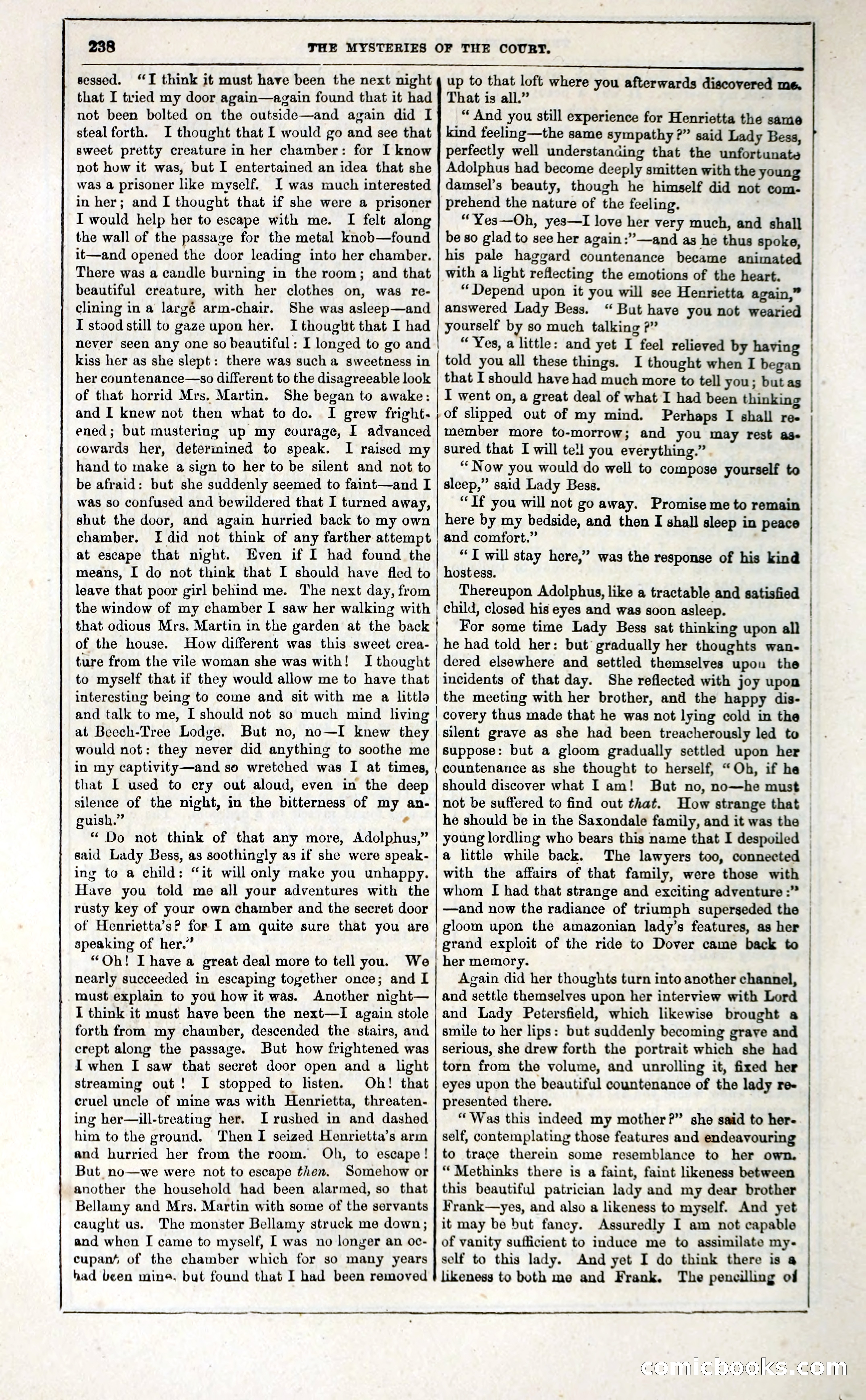
A restored page from Penny Dreadfuls, 1849. Page through the whole issue in the reader above.
📄 Transcribed text from this page (OCR, searchable)
Machine-transcribed from the original scan — historical spelling and the odd misread are preserved.
eee 238 sessed. “TI think it must have been the next night that I tried my door again—again found that it had not been bolted on the outside—and again did I steal forth. I thought that I would go and see that sweet pretty creature in her chamber: for I know not how it was, but I entertained an idea that she was a prisoner like myself. I was much interested in her; and I thought that if she were a prisoner I would help her to escape with me. I felt along the wall of the passage for the metal knob—found it—and opened the door leading into her chamber. There was a candle burning in the room; and that beautiful creature, with her clothes on, was re- clining in a largé arm-chair. She was asleep—and I stood still to gaze upon her. I thought that I had never seen any one so beautiful : I longed to go and kiss her as she slept: there was such a sweetness in her countenance—so different to the disagreeable look of that horrid Mrs. Martin. She began to awake: and I knew not then what to do. I grew fright- ened; but mustering up my courage, I advanced cowards her, deterinined to speak. I raised my hand to make a sign to her to be silent and not to be afraid: but she suddenly seemed to faint—and I was so confused and bewildered that I turned away, shut the door, and again hurried back to my own chamber. I did not think of any farther attempt at escape that night. Even if I had found the means, I do not think that I should have fled to leave that poor girl behind me. The next day, from the window of my chamber I saw her walking with that odious Mrs. Martin in the garden at the back of the house. How different was this sweet crea- ture from the vile woman she was with! I thought to myself that if they would allow me to have that interesting being to come and sit with me a little and talk to me, I should not so much mind living at Beech-Tree Lodge. But no, no—I knew they would not: they never did anything to soothe me in my captivity—and so wretched was I at times, that I used to cry out aloud, even in the deep silence of the night, in the bitterness of my an- guish.” : , “ Do not think of that any more, Adolphus,” said Lady Bess, as soothingly as if she were speak- ing to a child: “it will only make you unhappy. Have you told me all your adventures with the rusty key of your own chamber and the secret door of Henrietta’s? for I am quite sure that you are speaking of her.” “Oh! I have a great deal more to tell you. We nearly succeeded in escaping together once; and I must explain to you how it was. Another night— I think it must have been the next—I again stole forth from my chamber, descended the stairs, and crept along the passage. But how frightened was I when I saw that secret door open and a light streaming out! I stopped to listen. Oh! that cruel uncle of mine was with Henrietta, threaten- ing her—ill-treating her. I rushed in and dashed him to the ground. Then I seized Henrietta’s arm and burried her from the room. Oh, to escape! But no—we were not to escape then. Somehow or another the household had been alarmed, so that Bellamy and Mrs. Martin with some of the servants caught us. The monster Bellamy struck me down; and when I came to myself, [ was no longer an oc- cupans of the chamber which for so many years had been mine, but found that I had been removed THE MYSTERIES OF THE COURT. up to that loft where you afterwards discovered That is all.” | “And you still experience for Henrietta the same kind feeling—the same sympathy ?” said Lady Bess, perfectly well understanding that the unfortunate Adolphus had become deeply smitten with the young damsel’s beauty, though he himself did not com- prehend the nature of the feeling. “Yes—Oh, yes—I love her very much, and shall be so glad to see her again :”—and as he thus spoke, his pale haggard countenance became animated with a light reflecting the emotions of the heart. “Depend upon it you will see Henrietta again,” answered Lady Bess. “ But have you not wearied yourself by so much talking ?” “ Yes, a little: and yet I feel relieved by having told you all these things. I thought when I began that I should have had much more to tell you; but as I went on, a great deal of what I had been thinking of slipped out of my mind. Perhaps I shall ree member more to-morrow; and you may rest ase sured that I will tetl you everything.” “Now you would do well to compose yourself to sleep,” said Lady Bess. “Tf you will not go away. Promise me to remain here by my bedside, and then I shall sleep in peace and comfort.” , “I will stay here,” was the response of his kind hostess. Thereupon Adolphus, like a tractable and satisfied child, closed his eyes and was soon asleep. For some time Lady Bess sat thinking upon all he had told her: but’ gradually her thoughts wan- dered elsewhere and settled themselves upou the incidents of that day. She reflected with joy upon the meeting with her brother, and the happy dis- | covery thus made that he was not lying cold in the ee -~ ———— silent grave as she had been treacherously led to — suppose: but a gloom gradually settled upon her — countenance as she thought to herself, “Ob, if he should discover what Iam! But no, no—he must not be suffered to find out that. How strange that he should be in the Saxondale family, and it was the young lordling who bears this name that I despoiled — a little while back. with the affairs of that family, were those with whom I had that strange and exciting adventure :” —and now the radiance of triumph superseded the gloom upon the amazonian lady’s features, as her grand exploit of the ride to Dover came back to her memory. Again did her thoughts turn into another channel, and settle themselves upon her interview with Lord and Lady Petersfield, which likewise brought a smile tu her lips: but suddenly becoming graye and serious, she drew forth the portrait which she had torn from the volume, and unrolling it, fixed her eyes upon the beautiful countenance of the lady re- presented there. “Was this indeed my mother?” she said to her- self, contemplating those features and endeavouring to trace therein some resemblance to her own. “ Methinks there is a faint, faint likeness between this beautiful patrician lady and my dear brother Frank—yes, and also a likeness to myself. And yet it may be but fancy. Assuredly I am not capable of vanity sufficient to induce me to assimilate my- self to this lady. And yet I do think there is a likeness to both me and Frank. The pencilling of The lawyers too, connected | Ec — ECOMMICcOoolxs (EO)