
Penny Dreadfuls, 1849 · page 221 of 394
The Mysteries of the Court of London — page 221: what you’re looking at
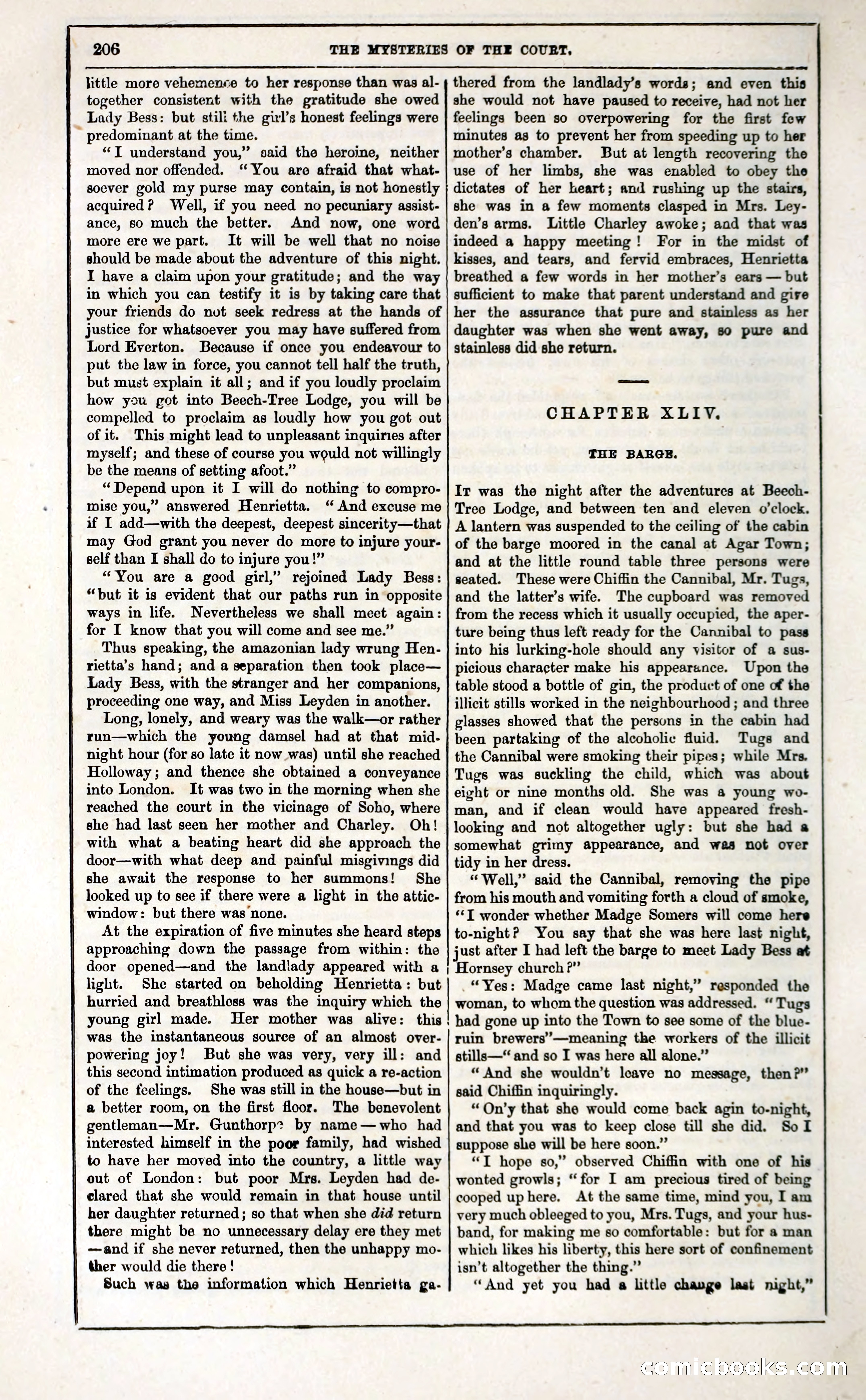
A restored page from Penny Dreadfuls, 1849. Page through the whole issue in the reader above.
📄 Transcribed text from this page (OCR, searchable)
Machine-transcribed from the original scan — historical spelling and the odd misread are preserved.
206 little more vehemence to her response than was al- together consistent with the gratitude she owed Lady Bess: but stili the girl’s honest feelings were ~ predominant at the time. “T understand you,” said the heroine, neither moved nor offended. ‘You are afraid that what- soever gold my purse may contain, is not honestly acquired? Well, if you need no pecuniary assist- ance, so much the better. And now, one word more ere we part. It will be well that no noise should be made about the adventure of this night. I have a claim upon your gratitude; and the way in which you can testify it is by taking care that your friends do not seek redress at the hands of justice for whatsoever you may have suffered from Lord Everton. Because if once you endeavour to put the law in force, you cannot tell half the truth, but must explain it all; and if you loudly proclaim how you got into Beech-Tree Lodge, you will be compelled to proclaim as loudly how you got out of it. This might lead to unpleasant inquiries after myself; and these of course you would not willingly be the means of setting afoot.” “Depend upon it I will do nothing to compro- mise you,” answered Henrietta. ‘‘ And excuse me if I add—with the deepest, deepest sincerity—that may God grant you never do more to injure your- self than I shall do to injure you!” “You are a good girl,’ rejoined Lady Bess: “but it is evident that our paths run in opposite ways in life. Nevertheless we shall meet again: for I know that you will come and see me.” Thus speaking, the amazonian lady wrung Hen- rietta’s hand; and a separation then took place— Lady Bess, with the stranger and her companions, proceeding one way, and Miss Leyden in another. Long, lonely, and weary was the walk—or rather run—which the young damsel had at that mid- night hour (for so late it now was) until she reached Holloway; and thence she obtained a conveyance into London. It was two in the morning when she reached the court in the vicinage of Soho, where she had last seen her mother and Charley. Oh! with what a beating heart did she approach the door—with what deep and painful misgivings did she await the response to her summons! She looked up to see if there were a light in the attic- window: but there was none. At the expiration of five minutes she heard steps approaching down the passage from within: the door opened—and the landlady appeared with a | light. She started on beholding Henrietta: but hurried and breathless was the inquiry which the young girl made. Her mother was alive: this was the instantaneous source of an almost over- powering joy! But she was very, very ill: and this second intimation produced as quick a re-action of the feelings. She was still in the house—but in a better room, on the first floor. The benevolent gentleman—Mr. Gunthorp? by name— who had interested himself in the poor family, had wished to have her moved into the country, a little way out of London: but poor Mrs. Leyden had de- clared that she would remain in that house until her daughter returned; so that when she did return | there might be no unnecessary delay ere they met ~—and if she never returned, then the unhappy mo- ther would die there! Such was the information which Henrietta ga- THE MYSTERIES OF THE COURT, thered from the landlady’s words; and even this she would not have paused to receive, had not her feelings been so overpowering for the first few minutes as to prevent her from speeding up to her mother’s chamber. But at length recovering the use of her limbs, she was enabled to obey the dictates of her heart; and rushing up the stairs, she was in a few moments clasped in Mrs. Ley- den’s arms. Little Charley awoke; and that was indeed a happy meeting! For in the midst of kisses, and tears, and fervid embraces, Henrietta breathed a few words in her mother’s ears — but sufficient to make that parent understand and gire her the assurance that pure and stainless as her daughter was when she went away, so pure and stainless did she return. CHAPTER XLIV. THE BARGE. It was the night after the adventures at Beech- Tree Lodge, and between ten and eleven o'clock. A lantern was suspended to the ceiling of the cabin of the barge moored in the canal at Agar Town; and at the little round table three persons were seated. These were Chiffin the Cannibal, Mr. Tugs, and the latter’s wife. The cupboard was removed from the recess which it usually occupied, the aper- ture being thus left ready for the Cannibal to pass into his lurking-hole should any visitor of a sus- picious character make his appearance. Upon the table stood a bottle of gin, the product of one of the illicit stills worked in the neighbourhood ; and three glasses showed that the persons in the cabin had been partaking of the alcoholic fluid. Tugs and the Cannibal were smoking their pipes; while Mrs. Tugs was suckling the child, which was about eight or nine months old. She was a young wo- man, and if clean would have appeared fresh- looking and not altogether ugly: but she had a somewhat grimy appearance, and was not over tidy in her dress. “Well,” said the Cannibal, removing the pipe from his mouth and vomiting forth a cloud of smoke, ‘‘T wonder whether Madge Somers will come here to-night? You say that she was here last night, just after I had left the barge to meet Lady Bess at Hornsey church ?” . . “Yes: Madge came last night,” responded the woman, to whom the question was addressed. “Tugs had gone up into the Town to see some of the blue- ruin brewers’—meaning the workers of the illicit stills—‘ and so I was here all alone.” “And she wouldn’t leave no message, then?” said Chiffin inquiringly. “On’y that she would come back agin to-night, and that you was to keep close till she did. Sol suppose she will be here soon.” “T hope so,” observed Chiffin with one of his wonted growls; “for I am precious tired of being cooped up here. At the same time, mind you, I am very much obleeged to you, Mrs. Tugs, and your hus- band, for making me so comfortable: but for a man which likes his liberty, this here sort of confinement isn’t altogether the thing.” “And yet you had a little change last night,” fi A CC ET LL LLL LLL LLL LLL LLL A COMMICEOO® Ss (E()