
Penny Dreadfuls, 1849 · page 212 of 394
The Mysteries of the Court of London — page 212: what you’re looking at
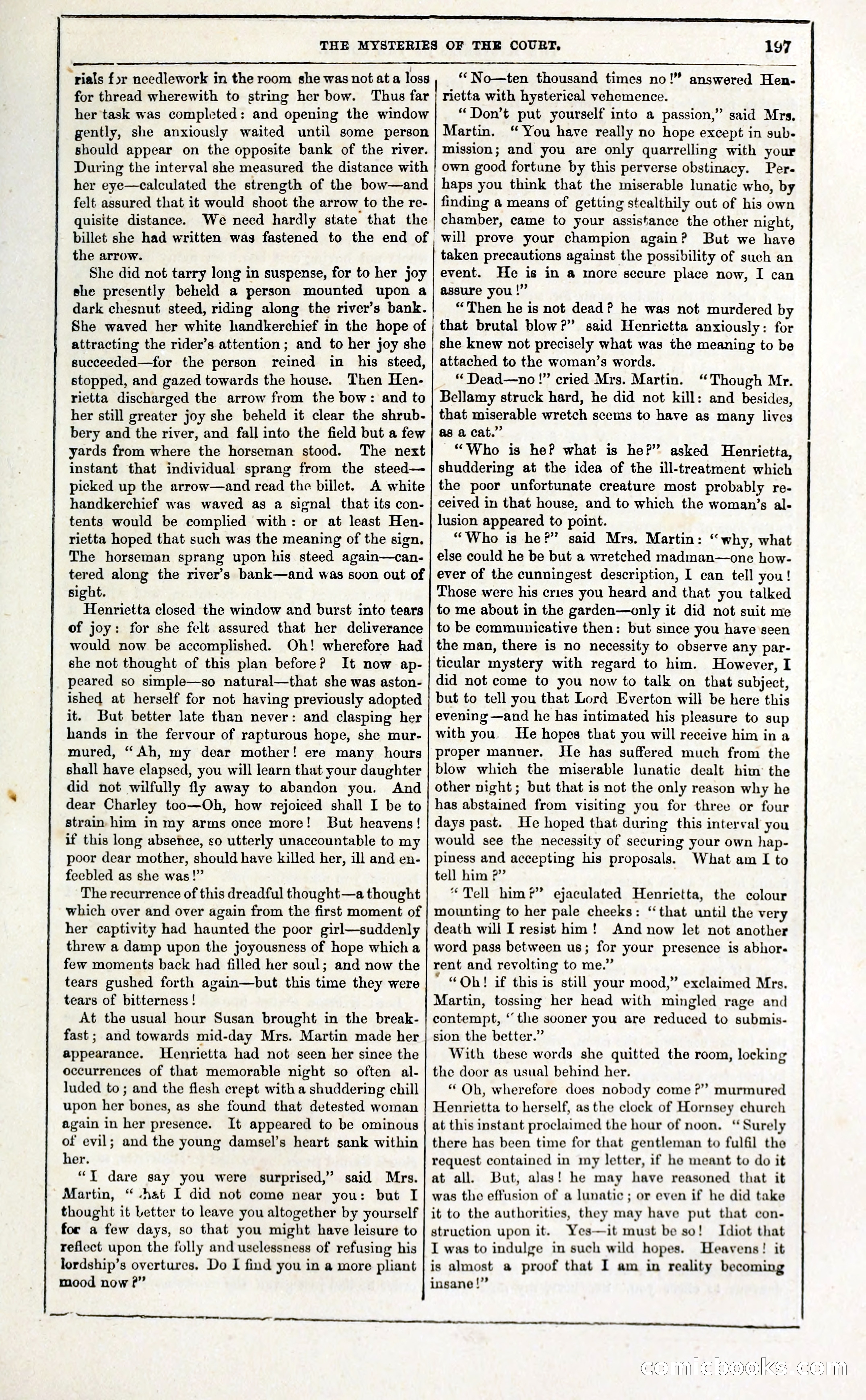
A restored page from Penny Dreadfuls, 1849. Page through the whole issue in the reader above.
📄 Transcribed text from this page (OCR, searchable)
Machine-transcribed from the original scan — historical spelling and the odd misread are preserved.
——*~ nee RE Ee THE MYSTERIES OF THE COURT, “rials fr needlework in the room she was not ata loss for thread wherewith to string her bow. Thus far her task was completed: and opening the window gently, she anxiously waited until some person should appear on the opposite bank of the river. During the interval she measured the distance with her eye—calculated the strength of the bow—and felt assured that it would shoot the arrow to the re- quisite distance. We need hardly state that the billet she had written was fastened to the end of the arrow. She did not tarry long in suspense, for to her joy she presently beheld a person mounted upon a dark chesnut steed, riding along the river’s bank. She waved her white handkerchief in the hope of attracting the rider’s attention; and to her joy she succeeded—for the person reined in his steed, stopped, and gazed towards the house. Then Hen- rietta discharged the arrow from the bow: and to her still greater joy she beheld it clear the shrub- bery and the river, and fall into the field but a few yards from where the horseman stood. The next instant that individual sprang from the steed— picked up the arrow—and read the billet. A white handkerchief was waved as a signal that its con- tents would be complied with: or at least Hen- rietta hoped that such was the meaning of the sign. The horseman sprang upon his steed again—can- tered along the river’s bank—and was soon out of sight. Henrietta closed the window and burst into tears of joy: for she felt assured that her deliverance would now be accomplished. Oh! wherefore had she not thought of this plan before? It now ap- peared so simple—so natural—that she was aston- ished at herself for not having previously adopted it. But better late than never: and clasping her hands in the fervour of rapturous hope, she mur- mured, “Ah, my dear mother! ere many hours shall have elapsed, you will learn that your daughter did not wilfully fly away to abandon you. And dear Charley too—Oh, how rejoiced shall I be to strain him in my arms once more! But heavens! if this long absence, so utterly unaccountable to my poor dear mother, should have killed her, ill and en- fecbled as she was!” The recurrence of this dreadful thought—a thought which over and over again from the first moment of her captivity had haunted the poor girl—suddenly threw a damp upon the joyousness of hope which a few moments back had filled her soul; and now the tears gushed forth again—but this time they were tears of bitterness ! At the usual hour Susan brought in the break- fast; and towards mid-day Mrs. Martin made her appearance. Henrietta had not seen her since the occurrences of that memorable night so often al- luded to; and the flesh crept with a shuddering chill upon her bones, as she found that detested woman again in her presence. It appeared to be ominous of evil; and the young damsel’s heart sank within her. “YT dare say you were surprised,” said Mrs. Martin, “ hat I did not come near you: but I thought it better to leave you altogether by yourself for a few days, so that you might have leisure to reflect upon the folly and uselessness of refusing his lordship’s overtures. Do I find you in a more pliant mood now ?” piness and accepting his proposals. 197 “‘No—ten thousand times no!” answered Hen- rietta with hysterical vehemence. “Don’t put yourself into a passion,” said Mrs, Martin. ‘You have really no hope except in sub- mission; and you are only quarrelling with your own good fortune by this perverse obstinacy. Per. haps you think that the miserable lunatic who, by finding a means of getting stealthily out of his own chamber, came to your assistance the other night, will prove your champion again? But we have taken precautions against the possibility of such an event. He is in a more secure place now, I can assure you !” “Then he is not dead? he was not murdered by that brutal blow?” said Henrietta anxiously: for she knew not precisely what was the meaning to be attached to the woman’s words. “ Dead—no!” cried Mrs. Martin. “Though Mr. Bellamy struck hard, he did not kill: and besides, that miserable wretch seems to have as many lives as a cat.” “Who is he? what is he?” asked Henrietta, shuddering at the idea of the ill-treatment which the poor unfortunate creature most probably re- ceived in that house, and to which the woman’s al- lusion appeared to point. “Who is he?” said Mrs. Martin: “why, what else could he be but a wretched madman—one how- ever of the cunningest description, I can tell you! Those were his cries you heard and that you talked to me about in the garden—only it did not suit me to be communicative then: but since you have seen the man, there is no necessity to observe any par- ticular mystery with regard to him. However, I did not come to you now to talk on that subject, but to tell you that Lord Everton will be here this evening —and he has intimated his pleasure to sup with you. proper manner. He hopes that you will receive him in a He has suffered much from the blow which the miserable lunatic dealt him the other night; but that is not the only reason why he has abstained from visiting you for three or four days past. He hoped that during this interval you would see the necessity of securing your own hap- What am I to tell him ?” “Tell him?” ejaculated Henrictta, the colour mounting to her pale cheeks: ‘that until the very death will I resist him! And now let not another word pass between us; for your presence is abhor- rent and revolting to me.” " “Oh! if this is still your mood,” exclaimed Mrs. Martin, tossing her head with mingled rage and contempt, ‘the sooner you are reduced to submis- sion the better.” With these words she quitted the room, locking the door as usual behind her. “ Oh, wherefore does nobody come ?” murmured Henrietta to herself, as the clock of Hornsey church at this instant proclaimed the hour of noon. “Surely there has been time for that gentleman to fulfil the request contained in my letter, if he meant to do it at all. But, alas! he may have reasoned that it was the effusion of a lunatic; or even if he did take it to the authorities, they may have put that con- struction upon it. Yes—it must be so! Idiot that I was to indulge in such wild hopes. Heavens! it is almost a proof that I am in reality becoming insane!” DOOKS (CO) (CO)