
Penny Dreadfuls, 1849 · page 210 of 394
The Mysteries of the Court of London — page 210: what you’re looking at
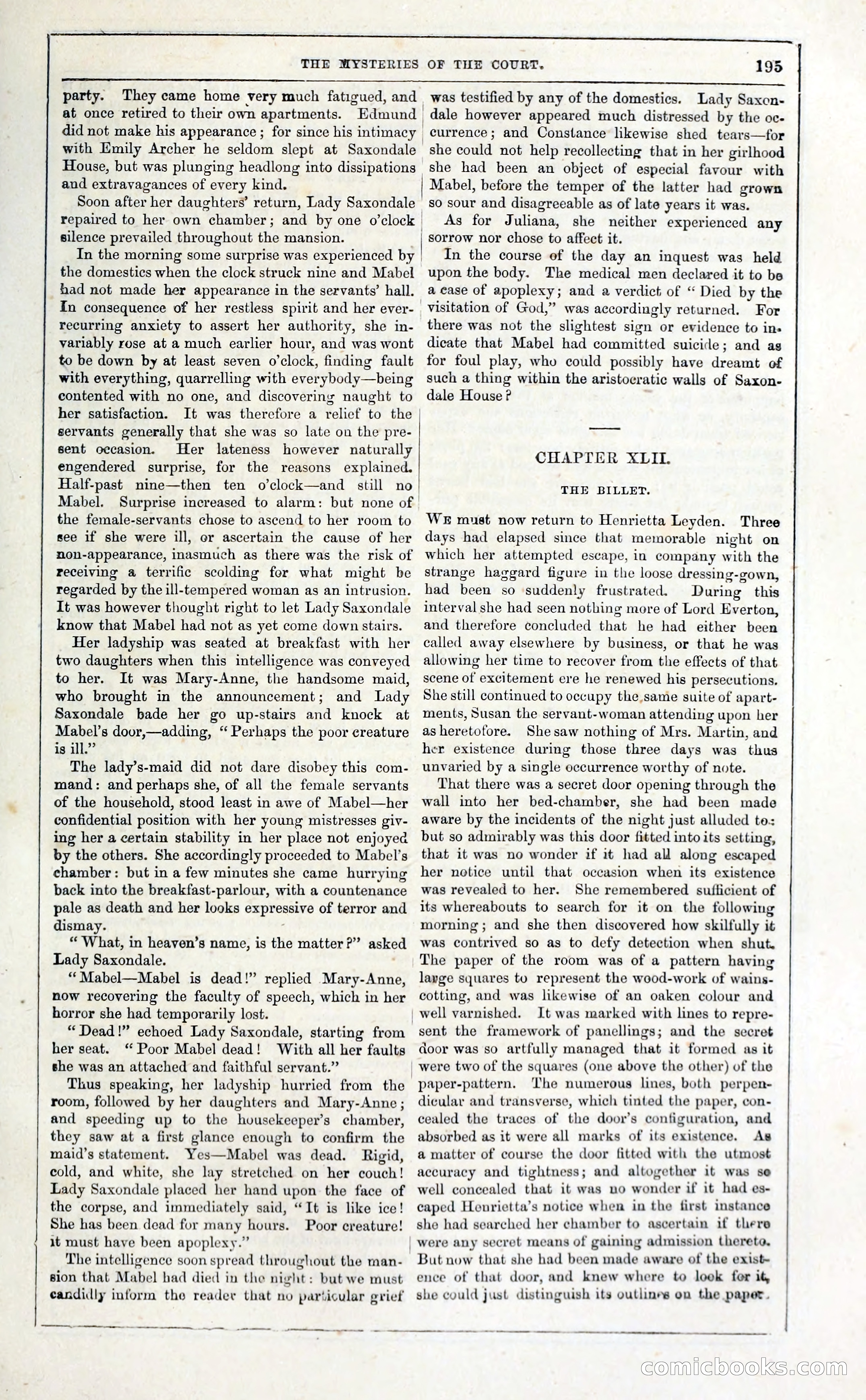
A restored page from Penny Dreadfuls, 1849. Page through the whole issue in the reader above.
📄 Transcribed text from this page (OCR, searchable)
Machine-transcribed from the original scan — historical spelling and the odd misread are preserved.
rc tee sn fatal | THE MYSTERIES OF THE COURT. party. They came home very much fatigued, and at once retired to their own apartments. Edmund | did not make his appearance ; for since his intimacy | with Emily Archer he seldom slept at Saxondale House, but was plunging headlong into dissipations and extravagances of every kind. Soon after her dauchters’ return, Lady Saxondale repaired to her own chamber; and by one o’clock silence prevailed throughout the mansion. | In the morning some surprise was experienced by | the domestics when the clock struck nine and Mabel had not made her appearance in the servants’ hall. In consequence of her restless spirit and her ever- recurring anxiety to assert her authority, she in- variably rose at a much earlier hour, and was wont to be down by at least seven o'clock, finding fault with everything, quarrelling with everybody—hbeing contented with no one, and discovering naught to her satisfaction. It was therefore a relief to the servants generally that she was so late on the pre- sent occasion. Her lateness however naturally engendered surprise, for the reasons explained. Half-past nine—then ten o’clock—and still no Mabel. Surprise increased to alarm: but none of the female-servants chose to ascend to her room to see if she were ill, or ascertain the cause of her non-appearance, inasmuch as there was the risk of receiving a terrific scolding fer what might be regarded by the ill-tempered woman as an intrusion. It was however thought right to let Lady Saxondale know that Mabel had not as yet come down stairs. Her ladyship was seated at breakfast with her two daughters when this intelligence was conveyed to her. It was Mary-Anne, the handsome maid, who brought in the announcement; and Lady Saxondale bade her go up-stairs and knock at Mabel’s door,—adding, ‘ Perhaps the poor creature is ill.” The lady’s-maid did not dare disobey this com- mand: and perhaps she, of all the female servants of the household, stood least in awe of Mabel—her confidential position with her young mistresses giv- ing her a certain stability in her place not enjoyed by the others. She accordingly proceeded to Mabel’s chamber: but in a few minutes she came hurrying back into the breakfast-parlour, with a countenance pale as death and her looks expressive of terror and dismay. “ What, in heaven’s name, is the matter?” asked Lady Saxondale. “ Mabel—Mabel is dead!” replied Mary-Anne, now recovering the faculty of speech, which in her horror she had temporarily lost. “Dead!” echoed Lady Saxondale, starting from her seat. “ Poor Mabel dead! With all her faults she was an attached and faithful servant.” Thus speaking, her ladyship hurried from the room, followed by her daughters and Mary-Anne ; and speeding up to the housekeeper’s chamber, they saw at a first glance enough to confirm the maid’s statement. Yes—Mabel was dead. Rigid, cold, and white, she lay stretched on her couch! Lady Saxondale placed her hand upon the face of the corpse, and immediately said, “It is like ice! She has been dead for many hours. Poor creature! it must have been apoplexy.” The intelligence soon spread throughout the man- sion that Mabel had died in the night: but we must candidly inform the reader that no particular grief _-——- + oe — oo = o = ee - —_ | well varnished. | paper-pattern. 195 was testified by any of the domestics. Lady Saxen- dale however appeared much distressed by the oc- currence; and Constance likewise shed tears—for she could not help recollecting that in her girlhood she had been an object of especial favour with Mabel, before the temper of the latter had grown so sour and disagreeable as of late years it was. As for Juliana, she neither experienced any sorrow nor chose to affect it. In the course of the day an inquest was held upon the body. The medical men declared it to be a ease of apoplexy; and a verdict of “ Died by the visitation of God,” was accordingly returned. For there was not the slightest sign or evidence to ins dicate that Mabel had committed suicide; and ag for foul play, who could possibly have dreamt of such a thing within the aristocratic walls of Saxon- dale House? ee CHAPTER XLII. THE BILLET. WE must now return to Henrietta Leyden. Three days had elapsed since that memorable night on which her attempted escape, in company with the strange haggard figure in the loose dressing-gown, had been so suddenly frustrated. During this interval she had seen nothing more of Lord Everton, and therefore concluded that he had either been called away elsewhere by business, or that he was allowing her time to recover from the effects of that scene of excitement ere he renewed his persecutions. She still continued to occupy the same suite of apart- ments, Susan the servant-woman attending upon her as heretofore. Shesaw nothing of Mrs. Martin, and her existence during those three days was thus unvaried by a single occurrence worthy of note. That there was a secret door opening through the wall into her bed-chamber, she had been made aware by the incidents of the night just alluded te: but so admirably was this door fitted into its setting, that it was no wonder if it had all along escaped her notice until that occasion when its existence was revealed to her. She remembered sufficient of its whereabouts to search for it on the following morning ; and she then discovered how skilfully it was contrived so as to defy detection when shut. The paper of the room was of a pattern having layge squares to represent the wood-work of wains- cotting, and was likewise of an oaken colour and It was marked with lines to repre- sent the framework of panellings; and the secret door was so artfully managed that it formed as it were two of the squares (one above the other) of the The numerous lines, both perpen- dicular and transverse, which tinted the paper, con- cealed the traces of the door’s configuration, and absorbed as it were all marks of its existence. As a matter of course the door fitted with the utmost accuracy and tightness; and altogether it was se well concealed that it was no wonder if it had es- caped Henrietta’s notice when in the first instance she had searched her chamber to ascertain if there | were any secret means of gaining admission thereto, But now that she had been made aware of the exist- ence of that door, and knew where to loek for it, she could just distinguish its outlines on the paper. ee - eee ee COMIC OOO© (CO)