
Penny Dreadfuls, 1849 · page 191 of 394
The Mysteries of the Court of London — page 191: what you’re looking at
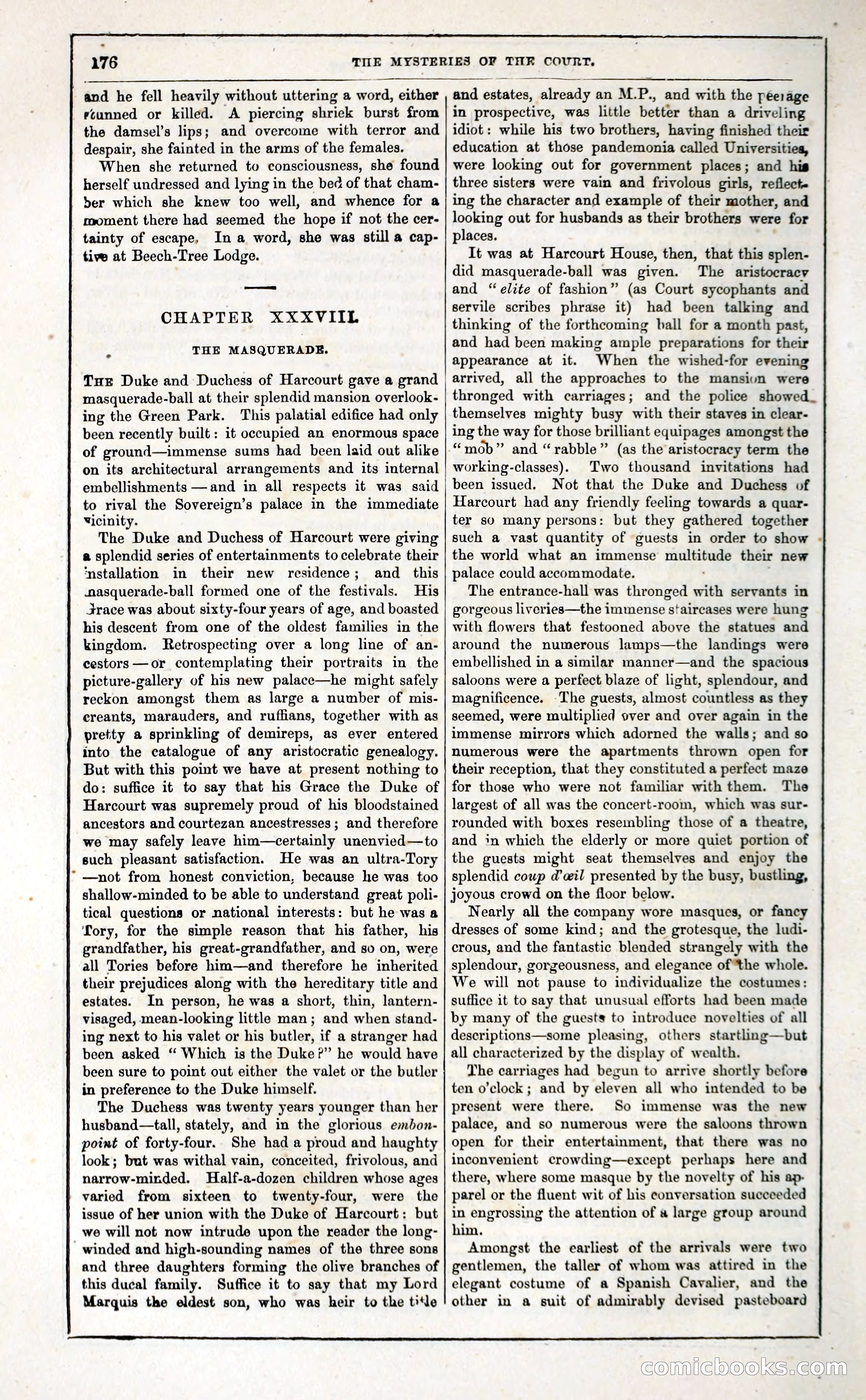
A restored page from Penny Dreadfuls, 1849. Page through the whole issue in the reader above.
📄 Transcribed text from this page (OCR, searchable)
Machine-transcribed from the original scan — historical spelling and the odd misread are preserved.
176 and he fell heavily without uttering a word, either ecunned or killed. A piercing shriek burst from the damsel’s lips; and overcome with terror and despair, she fainted in the arms of the females. When she returned to consciousness, she found herself undressed and lying in the bed of that cham- ber which she knew too well, and whence for a moment there had seemed the hope if not the cer- tainty of escape, Ina word, she was still a cap- tive at Beech-Tree Lodge. See) CHAPTER XXXVIIL THE MASQUERADE. ° THE Duke and Duchess of Harcourt gave a grand masquerade-ball at their splendid mansion overlook- ing the Green Park. This palatial edifice had only been recently built: it occupied an enormous space of ground—immense sums had been laid out alike on its architectural arrangements and its internal embellishments —and in all respects it was said to rival the Sovereign’s palace in the immediate ‘icinity. The Duke and Duchess of Harcourt were giving a splendid series of entertainments to celebrate their ‘nstallation in their new residence; and this nasquerade-ball formed one of the festivals. His Frace was about sixty-four years of age, and boasted his descent from one of the oldest families in the kingdom. Retrospecting over a long line of an- cestors —or contemplating their portraits in the picture-gallery of his new palace—he might safely reckon amongst them as large a number of mis- creants, marauders, and ruffians, together with as pretty a sprinkling of demireps, as ever entered into the catalogue of any aristocratic genealogy. But with this point we have at present nothing to do: suffice it to say that his Grace the Duke of Harcourt was supremely proud of his bloodstained ancestors and courtezan ancestresses ; and therefore we may safely leave him—certainly unenvied—to such pleasant satisfaction. He was an ultra-Tory *—not from honest conviction, because he was too shallow-minded to be able to understand great poli- tical questions or national interests: but he was a Tory, for the simple reason that his father, his grandfather, his great-grandfather, and so on, were all Tories before him—and therefore he inherited their prejudices along with the hereditary title and estates. In person, he was a short, thin, lantern- visaged, mean-looking little man; and when stand- ing next to his valet or his butler, if a stranger had been asked “ Which is the Duke?” he would have been sure to point out either the valet or the butler in preference to the Duke himself. The Duchess was twenty years younger than her husband—tall, stately, and in the glorious embon- point of forty-four. She had a proud and haughty look; but was withal vain, conceited, frivolous, and narrow-minded. Half-a-dozen children whose ages varied from sixteen to twenty-four, were the issue of her union with the Duke of Harcourt: but we will not now intrude upon the reader the long- winded and high-sounding names of the three sons and three daughters forming the olive branches of this ducal family. Suffice it to say that my Lord Marquis the eldest son, who was heir to the title TIE MYSTERIES OF THE COURT, and estates, already an M.P., and with the pée:age in prospective, was little better than a driveling idiot: while his two brothers, having finished their education at those pandemonia called Universities, were looking out for government places; and his three sisters were vain and frivolous girls, reflect. ing the character and example of their mother, and looking out for husbands as their brothers were for places. It was at Harcourt House, then, that this splen- did masquerade-ball was given. The aristocracy and “elite of fashion” (as Court sycophants and servile scribes phrase it) had been talking and thinking of the forthcoming ball for a month past, and had been making ample preparations for their appearance at it. When the wished-for evening arrived, all the approaches to the mansion were thronged with carriages; and the police showed. themselves mighty busy with their staves in clear- ing the way for those brilliant equipages amongst the “mob” and “rabble” (as the aristocracy term the working-classes). Two thousand invitations had been issued. Not that the Duke and Duchess of Harcourt had any friendly feeling towards a quar- ter so many persons: but they gathered together such a vast quantity of guests in order to show the world what an immense multitude their new palace could accommodate. | The entrance-hall was thronged with servants in gorgeous liveries—the immense staircases were hung with flowers that festooned above the statues and around the numerous lamps—the landings were embellished in a similar manner—and the spacious saloons were a perfect blaze of light, splendour, and magnificence. The guests, almost countless as they seemed, were multiplied over and over again in the immense mirrors which adorned the walls; and so numerous were the apartments thrown open for their reception, that they constituted a perfect maze for those who were not familiar with them. The largest of all was the concert-room, which was sur- rounded with boxes resembling those of a theatre, and in which the elderly or more quiet portion of the guests might seat themselves and enjoy the splendid coup d’@il presented by the busy, bustling, joyous crowd on the floor below. Nearly all the company wore masques, or fancy dresses of some kind; and the grotesque, the ludi- crous, and the fantastic blended strangely with the splendour, gorzeousness, and elegance ofthe whole. We will not pause to individualize the costumes: suffice it to say that unusual efforts had been made by many of the guests to introduce novelties of all descriptions—some pleasing, others startling—but all characterized by the display of wealth. The carriages had begun to arrive shortly before ten o'clock ; and by eleven all who intended to be present were there. So immense was the new palace, and so numerous were the saloons thrown open for their entertainment, that there was no inconvenient crowding—except perhaps here and there, where some masque by the novelty of his ap- parel or the fluent wit of his conversation succeeded in engrossing the attention of a large group around him. Amongst the earliest of the arrivals were two gentlemen, the taller of whom was attired in the elegant costume of a Spanish Cavalier, and the other in a suit of admirably devised pasteboard EO) 0)(0)(0) Ss (EO)