
Penny Dreadfuls, 1849 · page 183 of 394
The Mysteries of the Court of London — page 183: what you’re looking at
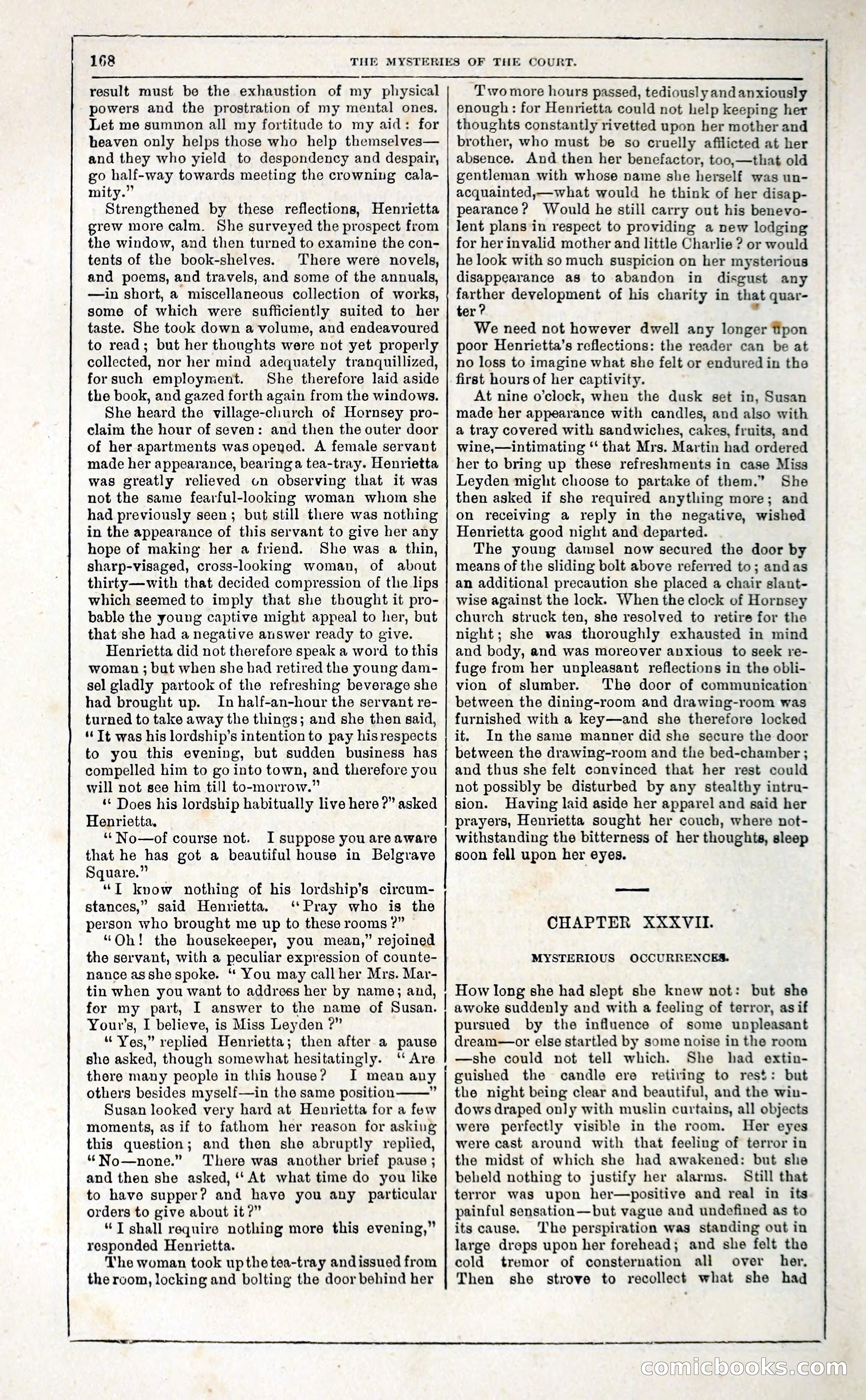
A restored page from Penny Dreadfuls, 1849. Page through the whole issue in the reader above.
📄 Transcribed text from this page (OCR, searchable)
Machine-transcribed from the original scan — historical spelling and the odd misread are preserved.
a, | EEE 168 THE MYSTERIES OF THE COURT. result must be the exhaustion of my physical powers and the prostration of my mental ones, Let me summon all my fortitude to my aid: for heaven only helps those who help themselves— and they who yield to despondency and despair, go half-way towards meeting the crowning cala- mity.”’ Strengthened by these reflections, Henrietta grew more calm. She surveyed the prospect from the window, and then turned to examine the con- tents of the book-shelves. There were novels, and poems, and travels, and some of the annuals, —in short, a miscellaneous collection of works, some of which were sufficiently suited to her taste. She took down a volume, and eadeavoured to read; but her thoughts were not yet properly collected, nor her mind adequately tranquillized, forsuch employment. She therefore laid aside the book, and gazed forth again from the windows. She heard the village-church of Hornsey pro- claim the hour of seven: and then the outer door of her apartments was opened. A female servant made her appearance, bearing a tea-tray. Henrietta was greatly relieved on observing that it was not the same fearful-looking woman whom she had previously seen; but still there was nothing in the appearance of this servant to give her any hope of making her a friend. She was a thin, sharp-visaged, cross-looking woman, of about thirty—with that decided compression of the lips which seemed to imply that she thought it pro- bable the young captive might appeal to her, but that she had a negative answer ready to give. Henrietta did not therefore speak a word to this woman ; but when she had retired the young dam- sel gladly partook of the refreshing beverage she had brought up. In half-an-hour the servant re- turned to take away the things; and she then said, “Tt was his lordship’s intention to pay hisrespects to you this evening, but sudden business has compelled him to go into town, and therefore you will not see him till to-morrow.” ** Does his lordship habitually live here ?” asked Henrietta. ‘‘ No—of course not. I suppose you are aware that he has got a beautiful house in Belgrave Square.” “T kvow nothing of his lordship’s circum- stances,” said Henrietta. ‘Pray who is the person who brought me up to these rooms ?” “Oh! the housekeeper, you mean,” rejoined the servant, with a peculiar expression of counte- nance asshe spoke. “‘ You may call her Mrs. Mar- tin when you want to addross her by name; and, for my part, I answer to the name of Susan. Your's, I believe, is Miss Leyden ?” Yes,” replied Henrietta; then after a pause she asked, though somewhat hesitatingly. ‘ Are there many people in this house? I mean any others besides myself—in the same position “ Susan looked very hard at Henrietta for a few moments, as if to fathom her reason for asking this question; and then she abruptly replied, ‘No—none.” There was another brief pause ; and then she asked, ‘‘At what time do you like to have supper? and have you any particular orders to give about it ?” “T shall require nothing more this evening,” responded Henrietta. The woman took upthe tea-tray andissued from the room, locking and bolting the door behind her Two more hours passed, tediousl y andanxiously enough : for Henrietta could not help keeping her thoughts constantly rivetted upon her mother and brother, who must be so cruelly afflicted at her absence. And then her benefactor, too,—that old gentleman with whose name she herself was un- acquainted,—what would he think of her disap- pearance? Would he still carry out his benevo- lent plans in respect to providing a new lodging for her invalid mother and little Charlie ? or would he look with so much suspicion on her mysterious disappearance as to abandon in disgust any farther development of his charity in that quar- ter? . We need not however dwell any longer fipon poor Henrietta’s reflections: the reader can be at no loss to imagine what she felt or endured in the first hours of her captivity. At nine o’clock, when the dusk set in, Susan made her appearance with candles, and also with a tray covered with sandwiches, cakes, fruits, and wine,—intimating ‘‘ that Mrs. Martin had ordered her to bring up these refreshments in case Miss Leyden might choose to partake of them.” She then asked if she required anything more; and on receiving a reply in the negative, wished Henrietta good night and departed. The young damsel now secured the door by means of the sliding bolt above referred to; andas an additional precaution she placed a chair slant- wise against the lock. When the clock of Hornsey church struck ten, she resolved to retire for the night; she was thoroughly exhausted in mind and body, and was moreover anxious to seek re- fuge from her unpleasant reflections in the obli- vion of slumber. ‘The door of communication between the dining-room and drawing-room was furnished with a key—and she therefore locked it. In the same manner did she secure the door between the drawing-room and the bed-chamber ; and thus she felt convinced that her rest could not possibly be disturbed by any stealthy intru- sion. Having laid aside her apparel and said her prayers, Henrietta sought her couch, where not- withstanding the bitterness of her thoughts, sleep soon fell upon her eyes. o_o CHAPTER XXXVII. MYSTERIOUS OCCURRENCES. How long she had slept she knew not: but she awoke suddenly and with a feeling of terror, asif pursued by the influence of some unpleasant dream—or else startled by some noise in the room —she could not tell which. She had extin- guished the candle ere retiring to rest: but the night being clear and beautiful, and the winu- dows draped only with muslin curtains, all objects were perfectly visible in the room. Her eyes were cast around with that feeling of terror in the midst of which she had awakened: but she beheld nothing to justify her alarms. Still that terror was upon her—positive and real in its painful sensation—but vague and undefined as to its cause. ‘The perspiration was standing out in large drops upon her forehead; and she felt the cold tremor of consternation all over her, Then she strove to recollect what she had ease ECOMMICLOOOKS (€@)