
Penny Dreadfuls, 1849 · page 113 of 394
The Mysteries of the Court of London — page 113: what you’re looking at
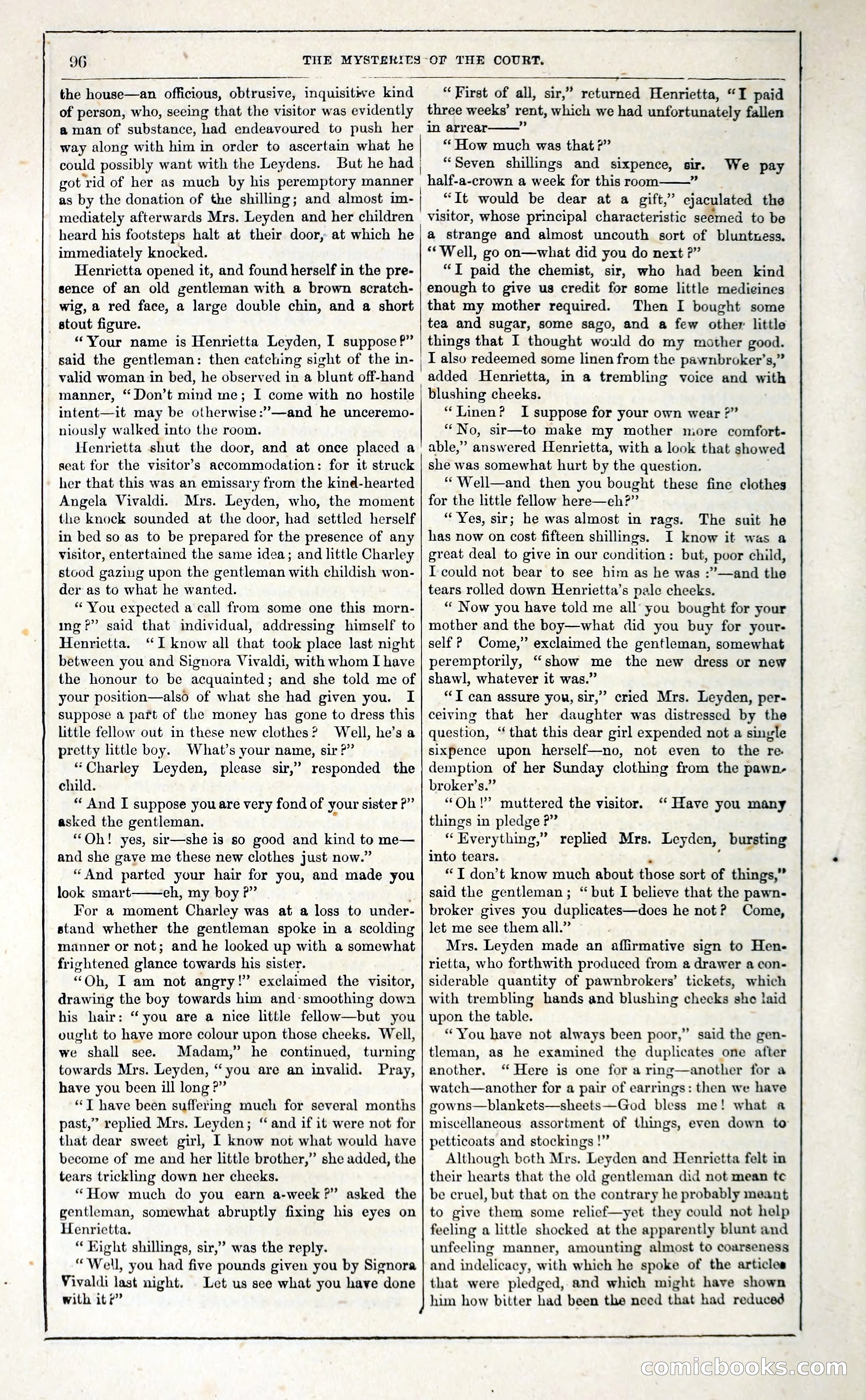
A restored page from Penny Dreadfuls, 1849. Page through the whole issue in the reader above.
📄 Transcribed text from this page (OCR, searchable)
Machine-transcribed from the original scan — historical spelling and the odd misread are preserved.
96 the house—an officious, obtrusive, inquisitkve kind THE MYSTERIES OF THE COURT. a “First of all, sir,” returned Henrietta, “I paid of person, who, seeing that the visitor was evidently three weeks’ rent, which we had unfortunately fallen aman of substance, had endeavoured to push her in arrear way along with him in order to ascertain what he could possibly want with the Leydens. But he had got rid of her as much by his peremptory manner as by the donation of the shilling; and almost im- mediately afterwards Mrs. Leyden and her children heard his footsteps halt at their door, at which he immediately knocked. Henrietta opened it, and found herself in the pre- sence of an old gentleman with a brown scratch- wig, a red face, a large double chin, and a short stout figure. “Your name is Henrietta Leyden, I suppose?” said the gentleman: then catching sight of the in- valid woman in bed, he observed in a blunt off-hand manner, “Don’t mind me; I come with no hostile intent—it may be otherwise :’—and he unceremo- niously walked into the room. Henrietta shut the door, and at once placed a seat for the visitor’s accommodation: for it struck her that this was an emissary from the kind-hearted Angela Vivaldi. Mrs. Leyden, who, the moment the knock sounded at the door, had settled herself in bed so as to be prepared for the presence of any visitor, entertained the same idea; and little Charley stood gazing upon the gentleman with childish won- der as to what he wanted. “You expected a call from some one this morn- ing?” said that individual, addressing himself to Henrietta. ‘I know all that took place last night between you and Signora Vivaldi, with whom I have the honour to be acquainted; and she told me of your position—also of what she had given you. I suppose a paft of the money has gone to dress this little fellow out in these new clothes? Well, he’s a pretty little boy. What’s your name, sir?” “Charley Leyden, please sir,” responded the child. “And I suppose you are very fond of your sister ?” asked the gentleman. “Qh! yes, sir—she is so good and kind to me— and she gaye me these new clothes just now.” “And parted your hair for you, and made you look smart——~eh, my boy ?” For a moment Charley was at a loss to under- stand whether the gentleman spoke in a scolding manner or not; and he looked up with a somewhat frightened glance towards his sister. “Oh, I am not angry!” exclaimed the visitor, drawing the boy towards him and-smoothing down his hair: “you are a nice little fellow—but you ought to have more colour upon those cheeks. Well, we shall see. Madam,” he continued, turning towards Mrs. Leyden, ‘you are an invalid. Pray, have you been ill long ?” “T have been suffering much for several months past,” replied Mrs. Leyden; “ and if it were not for that dear sweet girl, I know not what would have become of me and her little brother,” she added, the tears trickling down her cheeks. “How much do you earn a-week?” asked the gentleman, somewhat abruptly fixing his eyes on Henrietta. “ Kight shillings, sir,” was the reply. “Well, you had five pounds given you by Signora Vivaldi last night. Let us see what you have done with it?” “* How much was that ?” “Seven shillings and sixpence, sir. We pay half-a-crown a week for this room * “It would be dear at a gift,” cjaculated the visitor, whose principal characteristic seemed to be a strange and almost uncouth sort of bluntness. “Well, go on—what did you do next ?” “T paid the chemist, sir, who had been kind enough to give us credit for some little medieines that my mother required. Then I bought some tea and sugar, some sago, and a few other little things that I thought would do my mother good. I also redeemed some linen from the pawnbroker’s, * added Henrietta, in a trembling voice and with blushing cheeks. “Linen? I suppose for your own wear ?” “No, sir—to make my mother more comfort. able,” answered Henrietta, with a look that showed she was somewhat hurt by the question. ‘Well—and then you bought these fine clothes for the little fellow here—ch?” “Yes, sir; he was almost in rags. The suit he has now on cost fifteen shillings. I know it was a great deal to give in our condition : but, poor child, I could not bear to see him as he was :’—and the tears rolled down Henrietta’s pale cheeks. ““ Now you have told me all you bought for your mother and the boy—what did you buy for your- self ? Come,” exclaimed the gentleman, somewhat peremptorily, “show me the new dress or new shawl, whatever it was.” “‘T can assure you, sir,” cried Mrs. Leyden, per- ceiving that her daughter was distressed by the question, ‘“ that this dear girl expended not a single sixpence upon herself—no, not even to the re. demption of her Sunday clothing from the pawn- broker’s.” “Oh!” muttered the visitor. things in pledge P” “ Everything,” into tears. “T don’t know much about those sort of things,” said the gentleman; “but I believe that the pawn- broker gives you duplicates—does he not? Come, let me see them all.” Mrs. Leyden made an affirmative sign to Hen- rietta, who forthwith produced from a drawer a con- siderable quantity of pawnbrokers’ tickets, which with trembling hands and blushing checks she laid upon the table. “You have not always been poor,” said the gen- tleman, as he examined the duplicates one after enother. “ Here is one for a ring—another for a watch—another for a pair of earrings: then we have gowns—blankets—sheets—God bless me! what a miscellaneous assortment of things, even down to petticoats and stockings !” Although both Mrs. Leyden and Henrietta felt in their hearts that the old gentleman did not mean te be cruel, but that on the contrary he probably meant to give them some relief—yet they could not help feeling a little shocked at the apparently blunt and unfeeling manner, amounting almost to coarseness and indelicacy, with which he spoke of the articles that were pledged, and which might have shown him how bitter had been the need that had reduced “Have you many replied Mrs. Leyden, bursting ee EORNICLOO (Cc Ss (E©)