
Penny Dreadfuls, 1860 · page 215 of 394
The Mysteries of the Court of London — page 215: what you’re looking at
A restored page from Penny Dreadfuls, 1860. Page through the whole issue in the reader above.
📄 Transcribed text from this page (OCR, searchable)
Machine-transcribed from the original scan — historical spelling and the odd misread are preserved.
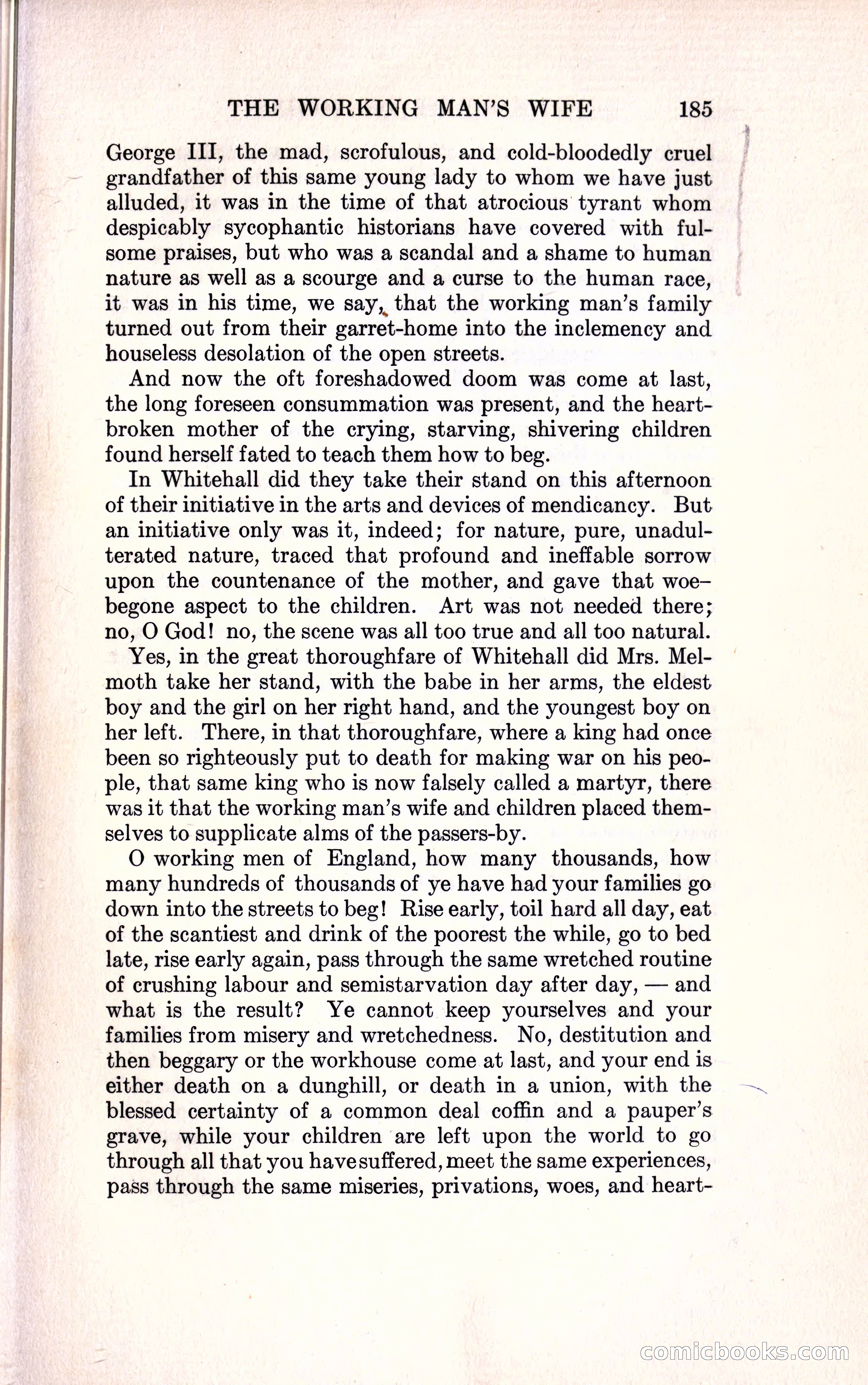
THE WORKING MAN’S WIFE 185 George III, the mad, scrofulous, and cold-bloodedly cruel grandfather of this same young lady to whom we have just alluded, it was in the time of that atrocious tyrant whom despicably sycophantic historians have covered with ful- some praises, but who was a scandal and a shame to human nature as well as a scourge and a curse to the human race, it was in his time, we say, that the working man’s family turned out from their garret-home into the inclemency and houseless desolation of the open streets. And now the oft foreshadowed doom was come at last, the long foreseen consummation was present, and the heart- broken mother of the crying, starving, shivering children found herself fated to teach them how to beg. In Whitehall did they take their stand on this afternoon of their initiative in the arts and devices of mendicancy. But an initiative only was it, indeed; for nature, pure, unadul- terated nature, traced that profound and ineffable sorrow upon the countenance of the mother, and gave that woe- begone aspect to the children. Art was not needed there; no, O God! no, the scene was all too true and all too natural. Yes, in the great thoroughfare of Whitehall did Mrs. Mel- moth take her stand, with the babe in her arms, the eldest boy and the girl on her right hand, and the youngest boy on her left. There, in that thoroughfare, where a king had once been so righteously put to death for making war on his peo- ple, that same king who is now falsely called a martyr, there was it that the working man’s wife and children placed them- selves to supplicate alms of the passers-by. O working men of England, how many thousands, how many hundreds of thousands of ye have had your families go down into the streets to beg! Rise early, toil hard all day, eat of the scantiest and drink of the poorest the while, go to bed late, rise early again, pass through the same wretched routine of crushing labour and semistarvation day after day, — and what is the result? Ye cannot keep yourselves and your families from misery and wretchedness. No, destitution and then beggary or the workhouse come at last, and your end is either death on a dunghill, or death in a union, with the blessed certainty of a common deal coffin and a pauper’s grave, while your children are left upon the world to go through all that you havesuffered, meet the same experiences, pass through the same miseries, privations, woes, and heart- (Gi ®) MG