
Penny Dreadfuls, 1860 · page 122 of 391
The Mysteries of the Court of London — page 122: what you’re looking at
A restored page from Penny Dreadfuls, 1860. Page through the whole issue in the reader above.
📄 Transcribed text from this page (OCR, searchable)
Machine-transcribed from the original scan — historical spelling and the odd misread are preserved.
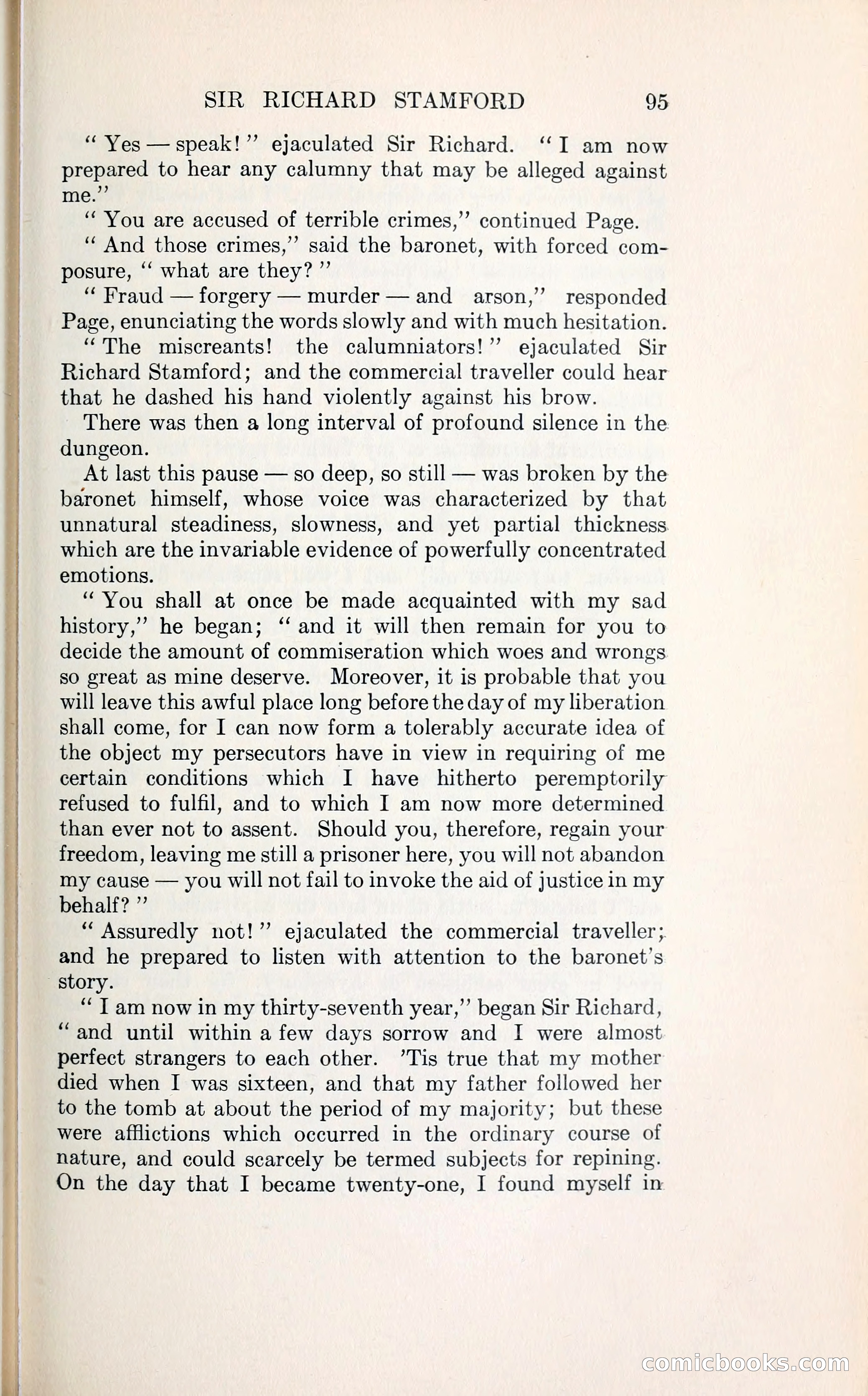
| | | SIR RICHARD STAMFORD 95 “ Yes — speak!’”’ ejaculated Sir Richard. ‘I am now prepared to hear any calumny that may be alleged against me.” “You are accused of terrible crimes,’”’ continued Page. ‘‘ And those crimes,” said the baronet, with forced com- posure, “‘ what are they? ”’ ‘“ Fraud — forgery — murder — and arson,’ responded Page, enunciating the words slowly and with much hesitation. “The miscreants! the calumniators!” ejaculated Sir Richard Stamford; and the commercial traveller could hear that he dashed his hand violently against his brow. There was then a long interval of profound silence in the dungeon. At last this pause — so deep, so still — was broken by the baronet himself, whose voice was characterized by that unnatural steadiness, slowness, and yet partial thickness which are the invariable evidence of powerfully concentrated emotions. “You shall at once be made acquainted with my sad history,’ he began; ‘‘ and it will then remain for you to decide the amount of commiseration which woes and wrongs so great as mine deserve. Moreover, it is probable that you will leave this awful place long before the day of my liberation shall come, for I can now form a tolerably accurate idea of the object my persecutors have in view in requiring of me certain conditions which I have hitherto peremptorily refused to fulfil, and to which I am now more determined than ever not to assent. Should you, therefore, regain your freedom, leaving me still a prisoner here, you will not abandon my cause — you will not fail to invoke the aid of justice in my behalf? ”’ ““ Assuredly not!” ejaculated the commercial traveller; and he prepared to listen with attention to the baronet’s story. “ T am now in my thirty-seventh year,’”’ began Sir Richard, “and until within a few days sorrow and I were almost perfect strangers to each other. ’Tis true that my mother died when I was sixteen, and that my father followed her to the tomb at about the period of my majority; but these were afflictions which occurred in the ordinary course of nature, and could scarcely be termed subjects for repining. On the day that I became twenty-one, I found myself in (CO) i 0) Oy 0) (CO)