
Penny Dreadfuls, 1849 · page 67 of 394
The Mysteries of the Court of London — page 67: what you’re looking at
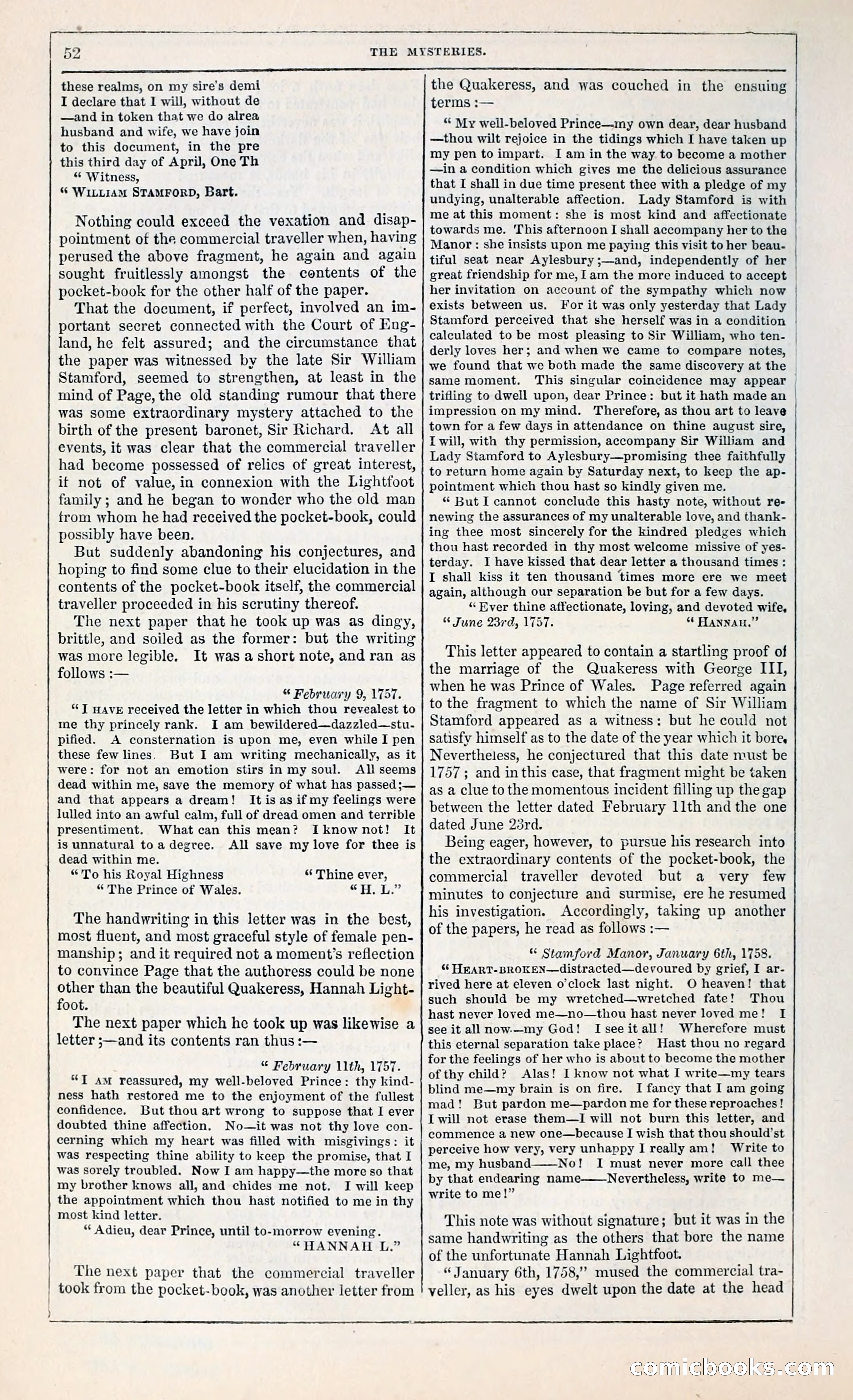
A restored page from Penny Dreadfuls, 1849. Page through the whole issue in the reader above.
📄 Transcribed text from this page (OCR, searchable)
Machine-transcribed from the original scan — historical spelling and the odd misread are preserved.
| 52 THE these realms, on my sire’s demi I declare that I will, without de —and in token that we do alrea husband and wife, we have join to this document, in the pre this third day of April, One Th “ Witness, “ WILLIAM STAMFORD, Bart. Nothing could exceed the vexation and disap- pointment of the commercial traveller when, having perused the above fragment, he again and again sought fruitlessly amongst the contents of the pocket-book for the other half of the paper. That the document, if perfect, involved an im- portant secret connected with the Court of Eng- land, he felt assured; and the circumstance that the paper was witnessed by the late Sir William Stamford, seemed to strengthen, at least in the mind of Page, the old standing rumour that there was some extraordinary mystery attached to the birth of the present baronet, Sir Richard. At all events, it was clear that the commercial traveller had become possessed of relics of great interest, it not of value, in connexion with the Lightfoot family ; and he began to wonder who the old man from whom he had received the pocket-book, could possibly have been. But suddenly abandoning his conjectures, and hoping to find some clue to their elucidation in the contents of the pocket-book itself, the commercial traveller proceeded in his scrutiny thereof. The next paper that he took up was as dingy, brittle, and soiled as the former: but the writing was more legible. It was a short note, and ran as follows :-— “ February 9, 1757. “JT HAVE received the letter in which thou revealest to me thy princely rank. I am bewildered—dazzled—stu- pified. A consternation is upon me, even while I pen these few lines. But I am writing mechanically, as it were: for not an emotion stirs in my soul. All seems dead within me, save the memory of what has passed ;— and that appears a dream! It is as if my feelings were lulled into an awful calm, full of dread omen and terrible presentiment. Whatcan this mean? Iknownot! It is unnatural toa degree. All save my love for thee is dead within me. “To his Royal Highness “The Prince of Wales. “ Thine ever, “Hob.” The handwriting in this letter was in the best, most fluent, and most graceful style of female pen- manship; and it required not a moment’s reflection to convince Page that the authoress could be none meg than the beautiful Quakeress, Hannah Light- oot. The next paper which he took up was likewise a letter ;—and its contents ran thus :— “© February 11th, 1757. “T am reassured, my well-beloved Prince: thy kind- ness hath restored me to the enjoyment of the fullest confidence. But thou art wrong to suppose that I ever doubted thine affection. No—it was not thy love con- cerning which my heart was filled with misgivings: it was respecting thine ability to keep the promise, that I was sorely troubled. Now I am happy—the more so that my brother knows all, and chides me not. I will keep the appointment which thou hast notified to me in thy most kind letter. “‘ Adieu, dear Prince, until to-morrow evening. “HANNAH L.” The next paper that the commercial traveller took from the pocket-book, was another letter from MYSTERIES. Sennen Ae aaa aaa teen the Quakeress, and was couched in the ensuing terms :— “ My weill-beloved Prince—my own dear, dear husband —thou wilt rejoice in the tidings which I have taken up my pen to impart. Iam in the way to become a mother —in a condition which gives me the delicious assurance that I shall in due time present thee with a pledge of my undying, unalterable affection. Lady Stamford is with me at this moment: she is most kind and affectionate towards me. This afternoon I shall accompany her to the Manor: she insists upon me paying this visit to her beau- tiful seat near Aylesbury ;—and, independently of her great friendship for me, [am the more induced to accept her invitation on account of the sympathy which now exists between us. For it was only yesterday that Lady Stamford perceived that she herself was in a condition calculated to be most pleasing to Sir William, who ten- derly loves her; and when we came to compare notes, we found that we both made the same discovery at the | same moment. This singular coincidence may appear trifling to dwell upon, dear Prince: but it hath made an impression on my mind. Therefore, as thou art to leave town for a few days in attendance on thine august sire, I will, with thy permission, accompany Sir William and Lady Stamford to Aylesbury—promising thee faithfully to return home again by Saturday next, to keep the ap- pointment which thou hast so kindly given me. “ But I cannot conclude this hasty note, without re- newing the assurances of my unalterable love, and thank- ing thee most sincerely for the kindred pledges which thou hast recorded in thy most welcome missive of yes- terday. I have kissed that dear letter a thousand times: I shall kiss it ten thousand times more ere we meet again, although our separation be but for a few days. “Ever thine affectionate, loving, and devoted wife, June 237d, 1757. ‘6 FIANNAH,” This letter appeared to contain a startling proof of the marriage of the Quakeress with George III, when he was Prince of Wales. Page referred again to the fragment to which the name of Sir William Stamford appeared as a witness: but he could not satisfy himself as to the date of the year which it bore. Nevertheless, he conjectured that this date must be 1757 ; and in this case, that fragment might be taken as a clue tothe momentous incident filling up the gap between the letter dated February 11th and the one dated June 25rd. Being eager, however, to pursue his research into the extraordinary contents of the pocket-book, the commercial traveller devoted but a very few minutes to conjecture and surmise, ere he resumed his investigation. Accordingly, taking up another of the papers, he read as follows :— “ Stamford Manor, January 6th, 1758. “ TRART-BROKEN—distracted—devoured by grief, I ar- rived here at eleven o'clock last night. O heaven! that such should be my wretched—wretched fate! Thou hast never loved me—no—thou hast never loved me! I see it allnow.-—my God! Iseeitall! Wherefore must this eternal separation take place? Hast thou no regard for the feelings of her who is about to become the mother of thy child? Alas! I know not what I write—my tears blind me—my brain is on fire. I fancy that I am going mad! But pardon me—pardon me for these reproaches! I will not erase them—I will not burn this letter, and commence a new one—because I wish that thou should’st perceive how very, very unhappy I really am! Write to me, my husband——No! I must never more call thee by that endearing name——Nevertheless, write to me— write to me!” This note was without signature; but it was in the same handwriting as the others that bore the name of the unfortunate Hannah Lightfoot. “ January 6th, 1758,’ mused the commercial tra- veller, as his eyes dwelt upon the date at the head COLMA (ElNOO_ KS. EOK