
Penny Dreadfuls, 1849 · page 58 of 394
The Mysteries of the Court of London — page 58: what you’re looking at
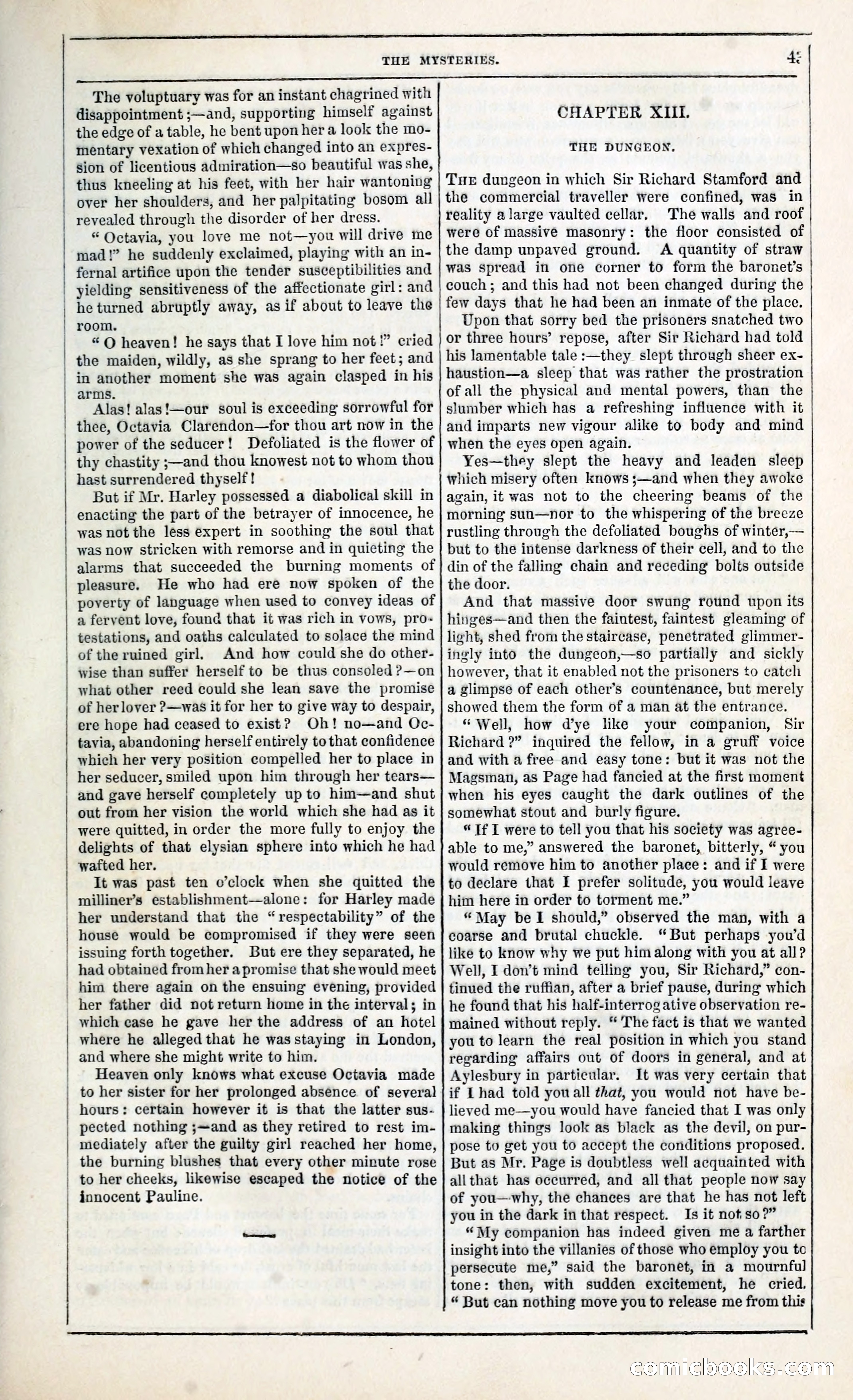
A restored page from Penny Dreadfuls, 1849. Page through the whole issue in the reader above.
📄 Transcribed text from this page (OCR, searchable)
Machine-transcribed from the original scan — historical spelling and the odd misread are preserved.
2 el a rrp > THE MYSTERIES. Cee a EE EEE _— ee The voluptuary was for an instant chagrined with disappointment ;—and, supporting himself against the edge of a table, he bent upon her a look the mo- mentary vexation of which changed into an expres- sion of licentious admiration—so beautiful was she, thus kneeling at his feet, with her hair wantoning over her shoulders, and her palpitating bosom all revealed through the disorder of her dress. “ Octavia, you love me not—you will drive me mad!” he suddenly exclaimed, playing with an in- fernal artifice upon the tender susceptibilities and yielding sensitiveness of the affectionate girl: and he turned abruptly away, as if about to leave the room. “ © heaven! he says that I love him not!” cried the maiden, wildly, as she sprang to her feet; and in another moment she was again clasped in his arms. Alas! alas!—our soul is exceeding sorrowful for thee, Octavia Clarendon—for thou art now in the power of the seducer! Defoliated is the flower of thy chastity ;—and thou knowest not to whom thou hast surrendered thyself! But if Mr. Harley possessed a diabolical skill in enacting the part of the betrayer of innocence, he was not the less expert in soothing the soul that was now stricken with remorse and in quieting the alarms that succeeded the burning moments of pleasure. He who had ere now spoken of the poverty of language when used to convey ideas of a feryent love, found that it was rich in vows, pro- testations, and oaths calculated to solace the mind of the ruined girl. And how could she do other- wise than suffer herself to be thus consoled ?—on what other reed could she lean save the promise of her lover ?—was it for her to give way to despair, ere hope had ceased to exist? Oh! no—and Qc- tavia, abandoning herself entirely to that confidence which her very position compelled her to place in her seducer, smiled upon him through her tears— and gave herself completely up to him—and shut out from her vision the world which she had as it were quitted, in order the more fully to enjoy the delights of that elysian sphere into which he had wafted her. It was past ten o’clock when she quitted the milliner’s establishment—alone: for Harley made her understand that the “respectability” of the house would be compromised if they were seen issuing forth together. But ere they separated, he had obtained from her a promise that she would meet him there again on the ensuing evening, provided her father did not return home in the interval; in which ease he gave her the address of an hotel where he alleged that he wasstaying in London, and where she might write to him. Heaven only knows what excuse Octavia made to her sister for her prolonged absence of several hours: certain however it is that the latter sus- pected nothing ;—and as they retired to rest im- mediately after the guilty girl reached her home, the burning blushes that every other minute rose to her cheeks, likewise escaped the notice of the innocent Pauline. CHAPTER XIII. THE DUNGEON. THE dungeon in which Sir Richard Stamford and the commercial traveller were confined, was in reality a large vaulted cellar. The walls and roof were of massive masonry: the floor consisted of the damp unpaved ground. A quantity of straw was spread in one corner to form the baronet’s couch; and this had not been changed during the few days that he had been an inmate of the place. Upon that sorry bed the prisoners snatched two or three hours’ repose, after Sir Richard had told his lamentable tale :—they slept through sheer ex- haustion—a sleep that was rather the prostration of all the physical and mental powers, than the slumber which has a refreshing influence with it and imparts new vigour alike to body and mind when the eyes open again. Yes—they slept the heavy and leaden sleep which misery often knows ;—and when they awoke again, it was not to the cheering beams of the morning sun—nor to the whispering of the breeze rustling through the defoliated boughs of winter,— but to the intense darkness of their cell, and to the din of the falling chain and receding bolts outside the door. And that massive door swung round upon its hinges—and then the faintest, faintest gleaming of light, shed from the staircase, penetrated glimmer- ingly into the dungeon,—so partially and sickly however, that it enabled not the prisoners to catch a glimpse of each other’s countenance, but merely showed them the form of a man at the entrance. “Well, how d’ye like your companion, Sir Richard ?” inquired the fellow, in a gruff voice and with a free and easy tone: but it was not the Magsman, as Page had fancied at the first moment when his eyes caught the dark outlines of the somewhat stout and burly figure. “Tf I were to tell you that his society was agree- able to me,” answered the baronet, bitterly, “ you would remove him to another place: and if I were to declare that I prefer solitude, you would leave him here in order to torment me.” “May be I should,” observed the man, with a coarse and brutal chuckle. “But perhaps you'd like to know why we put him along with you at all? Well, I don’t mind telling you, Sir Richard,” con- tinued the ruffian, after a brief pause, during which he found that his half-interrog ative observation re- mained without reply. “ The fact is that we wanted you to learn the real position in which you stand regarding affairs out of doors in general, and at Aylesbury in particular. It was very certain that if L had told you all that, you would not have be- lieved me—you would have fancied that I was only making things look as black as the devil, on pur- pose to get you to accept the conditions proposed. But as Mr. Page is doubtless well acquainted with allthat has occurred, and all that people now say of you—why, the chances are that he has not left you in the dark in that respect. Is it nof.so?” “My companion has indeed given me a farther insight into the villanies of those who employ you to persecute me,” said the baronet, in a mournful tone: then, with sudden excitement, he cried. “ But can nothing move you to release me from this Com Clooolks.conn