
Penny Dreadfuls, 1849 · page 50 of 394
The Mysteries of the Court of London — page 50: what you’re looking at
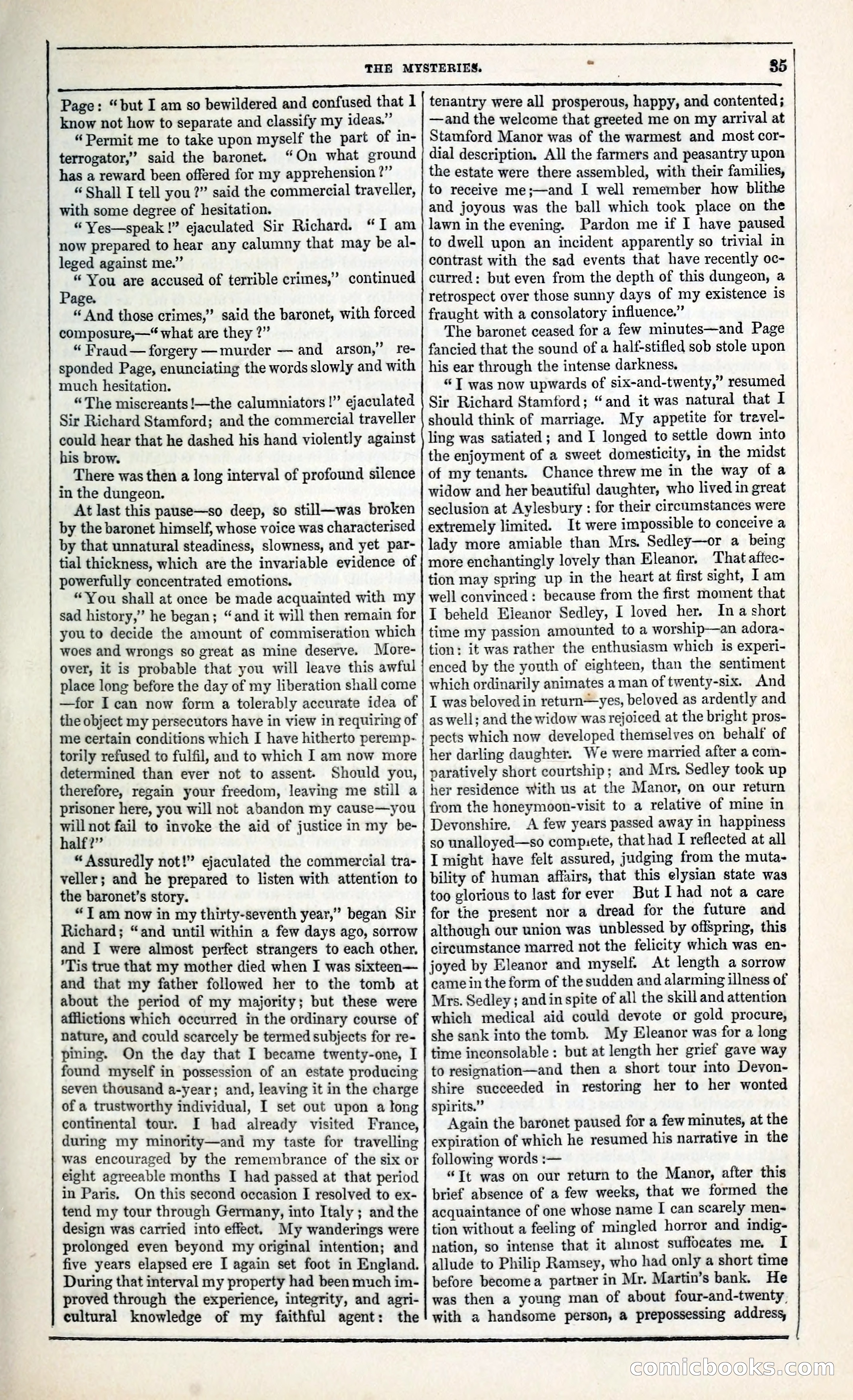
A restored page from Penny Dreadfuls, 1849. Page through the whole issue in the reader above.
📄 Transcribed text from this page (OCR, searchable)
Machine-transcribed from the original scan — historical spelling and the odd misread are preserved.
a a a a a a A a a THE MYSTERIES. Page: “but I am so bewildered and confused that 1 know not how to separate and classify my ideas.” “Permit me to take upon myself the part of in- terrogator,” said the baronet. “On what eround has a reward been offered for my apprehension ?” “ Shall I tell you?” said the commercial traveller, with some degree of hesitation. “ Yes—speak !” ejaculated Sir Richard. “I am now prepared to hear any calumny that may be al- leged against me.” “ You are accused of terrible crimes,” continued Page. “ And those crimes,” said the baronet, with forced composure,—* what are they 2?” “ Fraud — forgery —murder — and arson,” re- sponded Page, enunciating the words slowly and with much hesitation. “The miscreants !—the calumniators !” ejaculated Sir Richard Stamford; and the commercial traveller could hear that he dashed his hand violently against his brow. There was then a long interval of profound silence in the dungeon. At last this pause—so deep, so still—was broken by the baronet himself, whose voice was characterised by that unnatural steadiness, slowness, and yet par- tial thickness, which are the invariable evidence of powerfully concentrated emotions. “You shall at once be made acquainted with my sad history,” he began; “and it will then remain for you to decide the amount of commiseration which woes and wrongs so great as mine deserve. More- over, it is probable that you will leave this awful place long before the day of my liberation shall come —for I can now form a tolerably accurate idea of the object my persecutors have in view in requiring of me certain conditions which I have hitherto peremp- torily refused to fulfil, and to which I am now more determined than ever not to assent. Should you, therefore, regain your freedom, leaving me still a prisoner here, you will not abandon my cause—you will not fail to invoke the aid of justice in my be- half?” “ Assuredly not!” ejaculated the commercial tra- veller; and he prepared to listen with attention to the baronet’s story. “T am now in my thirty-seventh year,” began Sir Richard; “and until within a few days ago, sorrow and I were almost perfect strangers to each other, ’Tis true that my mother died when I was sixteen— and that my father followed her to the tomb at about the period of my majority; but these were afflictions which occurred in the ordinary course of nature, and could scarcely be termed subjects for re- pining. On the day that I became twenty-one, I found myself in possession of an estate producing seven thousand a-year; and, leaving it in the charge of a trustworthy individual, I set out upon a tong continental tour. I had already visited France, during my minority—and my taste for travelling was encouraged by the remembrance of the six or eight agreeable months I had passed at that period in Paris, On this second occasion I resolved to ex- tend my tour through Germany, into Italy; and the design was carried into effect. My wanderings were prolonged even beyond my original intention; and five years elapsed ere I again set foot in England. During that interval my property had been much im- proved through the experience, integrity, and agri- |} cultural knowledge of my faithful agent: the sci 85 tenantry were all prosperous, happy, and contented; —and the welcome that greeted me on my arrival at Stamford Manor was of the warmest and most cor- dial description. All the farmers and peasantry upon the estate were there assembled, with their families, to receive me;—and I well remember how blithe and joyous was the ball which took place on the lawn in the evening. Pardon me if I have paused to dwell upon an incident apparently so trivial in contrast with the sad events that have recently oc- curred: but even from the depth of this dungeon, a retrospect over those sunny days of my existence 1s fraught with a consolatory influence.” The baronet ceased for a few minutes—and Page fancied that the sound of a half-stifled sob stole upon his ear through the intense darkness. “J was now upwards of six-and-twenty,” resumed Sir Richard Stamford; “and it was natural that I should think of marriage. My appetite for trevel- ling was satiated; and I longed to settle down into the enjoyment of a sweet domesticity, in the midst of my tenants. Chance threw me in the way of a widow and her beautiful daughter, who lived in great seclusion at Aylesbury : for their circumstances were extremely limited. It were impossible to conceive a lady more amiable than Mrs. Sedley—or a being more enchantingly lovely than Eleanor. That attec- tion may spring up in the heart at first sight, I am well convinced: because from the first moment that I beheld Ejeanor Sedley, I loved her. Ina short time my passion amounted to a worship—an adora- tion: it was rather the enthusiasm which is experi- enced by the youth of eighteen, than the sentiment which ordinarily animates a man of twenty-six. And I was beloved in return—yes, beloved as ardently and as well; and the widow was rejoiced at the bright pros- pects which now developed themselves on behalf of her darling daughter. We were married after a com- paratively short courtship; and Mrs. Sedley took up her residence with us at the Manor, on our return from the honeymoon-visit to a relative of mine in Devonshire. A few years passed away in happiness so unalloyed—so compiete, that had I reflected at all I might have felt assured, judging from the muta- bility of human affairs, that this elysian state was too glorious to last forever But I had not a care for the present nor a dread for the future and although our union was unblessed by offspring, this circumstance marred not the felicity which was en- joyed by Eleanor and myself. At length a sorrow came in the form of the sudden and alarming illness of Mrs. Sedley ; and in spite of all the skill and attention which medical aid could devote or gold procure, she sank into the tomb. My Eleanor was for a long time inconsolable: but at length her grief gave way to resienation—and then a short tour into Devon- shire succeeded in restoring her to her wonted spirits.” Again the baronet paused for a few minutes, at the expiration of which he resumed his narrative in the following words :— “Tt was on our return to the Manor, after this brief absence of a few weeks, that we formed the acquaintance of one whose name | can scarely men- tion without a feeling of mingled horror and indig- nation, so intense that it almost suffocates me. I allude to Philip Ramsey, who had only a short time before becomea partner in Mr. Martin’s bank. He was then a young man of about four-and-twenty, with a handsome person, a prepossessing address, SS SR SS a Com Clooolks.conn