
Penny Dreadfuls, 1849 · page 357 of 394
The Mysteries of the Court of London — page 357: what you’re looking at
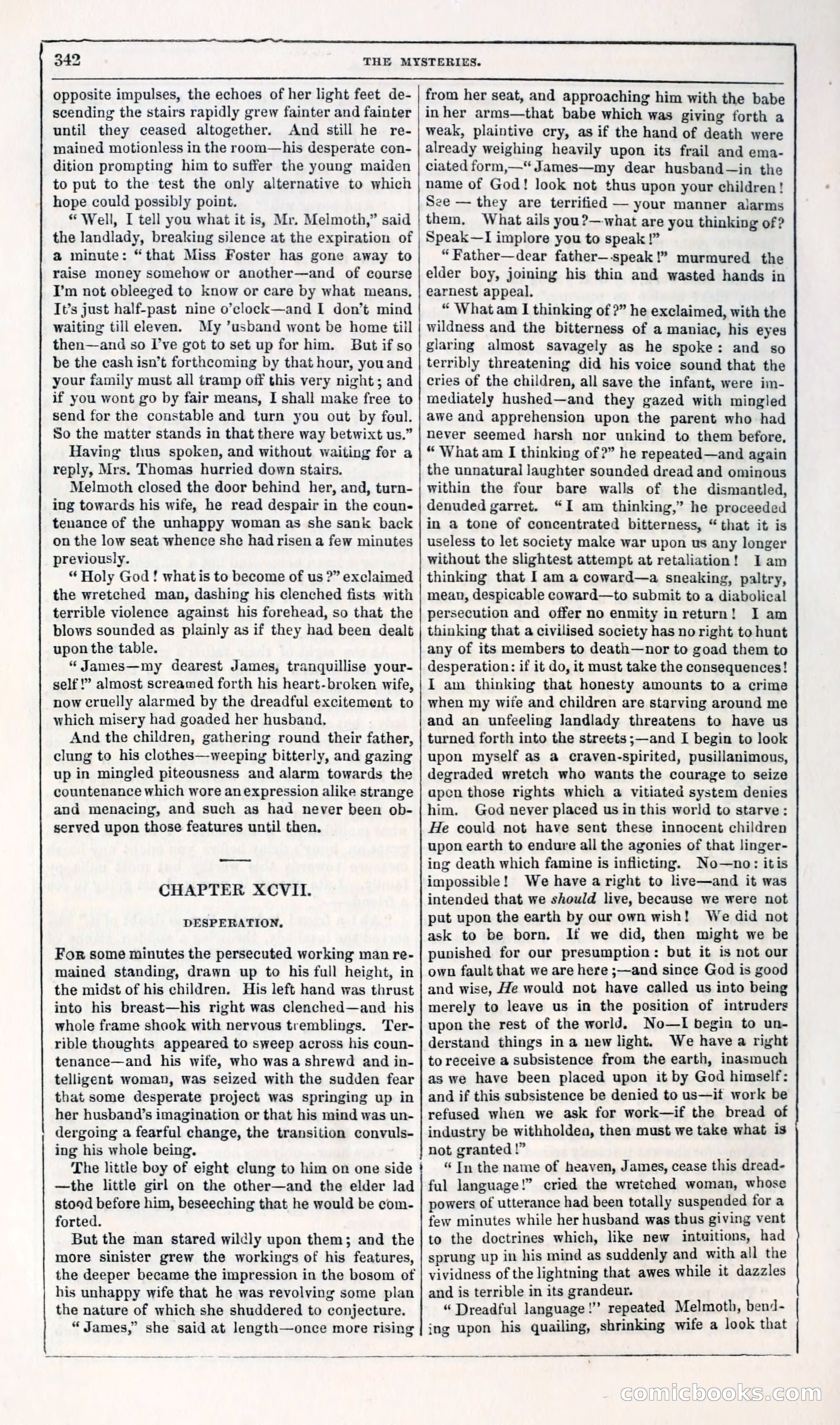
A restored page from Penny Dreadfuls, 1849. Page through the whole issue in the reader above.
📄 Transcribed text from this page (OCR, searchable)
Machine-transcribed from the original scan — historical spelling and the odd misread are preserved.
342 THE MYSTERIES. Se no tee re Pre re re ee eh ne ee eae ae ane inte Rance aa aids nee aaa eee EE opposite impulses, the echoes of her light feet de- scending the stairs rapidly grew fainter and fainter until they ceased altogether. And still he re- mained motionless in the room—his desperate con- dition prompting him to suffer the young maiden to put to the test the only alternative to which hope could possibly point. * Well, [ tell you what it is, Mr. Melmoth,” said the landlady, breaking silence at the expiration of a minute: “that Miss Foster has gone away to raise money scmehow or another—and of course I’m not obleeged to know or care by what means, It’s just half-past nine o’clock—and I don’t mind waiting till eleven. My ’usband wont be home tiil then—and so I’ve got to set up for him. But if so be the cash isn’t forthcoming by that hour, youand your family must all tramp off this very night; and if you wont go by fair means, I shall make free to send for the constable and turn you out by foul. So the matter stands in that there way betwixt us.” Having thus spoken, and without waiting for a reply, Mrs. Thomas hurried down stairs. Melmoth closed the door behind her, and, turn- ing towards his wife, he read despair in the coun- tenance of the unhappy woman as she sank back on the low seat whence she had risen a few minutes previously. “ Holy God ! what is to become of us ?” exclaimed the wretched man, dashing his clenched fists with terrible violence against his forehead, so that the blows sounded as plainly as if they had been dealt upon the table. “ James—my dearest James, tranquillise your- self!” almost screamed forth his heart-broken wife, now cruelly alarmed by the dreadful excitement to which misery had goaded her husband, And the children, gathering round their father, clung to his clothes—weeping bitterly, and gazing up in mingled piteousness and alarm towards the countenance which wore anexpression alike strange and menacing, and such as had never been ob- served upon those features until then. oe - CHAPTER XCVII. DESPERATION. For some minutes the persecuted working man re- mained standing, drawn up to his full height, in the midst of his children. His left hand was thrust into his breast—his right was clenched—and his whole frame shook with nervous tremblings. Ter- rible thoughts appeared to sweep across his coun- tenance—and his wife, who was a shrewd and in- telligent woman, was seized with the sudden fear that some desperate project was springing up in her husband’s imagination or that his mind was un- dergoing a fearful change, the transition convuls- ing his whole being. The little boy of eight clung to him on one side —the little girl on the other—and the elder lad stood before him, beseeching that he would be com- forted. But the man stared wildly upon them; and the more sinister grew the workings of his features, the deeper became the impression in the bosom of his unhappy wife that he was revolving some plan the nature of which she shuddered to conjecture. “James,” she said at length—once more rising ee “ — Se from her seat, and approaching him with the babe inher arms—that babe which was giving forth a weak, plaintive cry, as if the hand of death were already weighing heavily upon its frail and ema- ciated form,— James—my dear husband—in the name of God! look not thus upon your children! ee — they are terrified — your manner alarms them. What ails you?—what are you thinking of? Speak—I implore you to speak !” “Father—dear father—.speak!” murmured the elder boy, joining his thin and wasted hands in earnest appeal. “ What am I thinking of ?” he exclaimed, with the wildness and the bitterness of a maniac, his eyes glaring almost savagely as he spoke: and so terribly threatening did his voice sound that the cries of the children, all save the infant, were im- mediately hushed—and they gazed with mingled awe and apprehension upon the parent who had never seemed harsh nor unkind to them before, “ What am I thinking of?” he repeated—and again the unnatural laughter sounded dread and ominous within the four bare walls of the dismantled, denuded garret. “I am thinking,’ he proceeded in a tone of concentrated bitterness, “that it is useless to let society make war upon us any longer without the slightest attempt at retaliation! Iam thinking that I am a coward—a sneaking, paltry, mean, despicable coward—to submit to a diabolical persecution and offer no enmity inreturn! I am thinking that a civilised society has no right to hunt any of its members to death—nor to goad them to desperation: if it do, it must take the consequences! I am thinking that honesty amounts to a crime when my wiie and children are starving around me and an unfeeling landlady threatens to have us turned forth into the streets ;—and I begin to look upon myself as a craven-spirited, pusillanimous, degraded wretch who wants the courage to seize apen those rights which a vitiated system denies him. God never placed us in this world to starve: He could not have sent these innocent children upon earth to endure all the agonies of that linger- ing death which famine is inflicting. No—no: itis impossible! We have aright to live—and it was intended that we should live, because we were not put upon the earth by our own wish! We did not ask to be born. It we did, then might we be punished for our presumption: but it is not our own fault that we are here ;—and since God is good and wise, He would not have called us into being merely to leave us in the position of intruders upon the rest of the world. No—TI begin to un- derstand things in a new light. We havea right to receive a subsistence from the earth, inasmuch as we have been placed upon it by God himself: and if this subsistence be denied to us—if work be refused when we ask for work—if the bread of industry be withholdea, then must we take what is not granted!” “ In the name of heaven, James, cease this dread- ful language!” cried the wretched woman, whose powers of utterance had been totally suspended fora few minutes while her husband was thus giving vent to the doctrines which, like new intuitions, had sprung up in his mind as suddenly and with all the vividness of the lightning that awes while it dazzles and is terrible in its grandeur. “ Dreadful language!’ repeated Melmoth, bend- ing upon his quailing, shrinking wife a look that (C(O) nn) (@ 6)(0)(©) CSE (C(O)