
Penny Dreadfuls, 1849 · page 33 of 394
The Mysteries of the Court of London — page 33: what you’re looking at
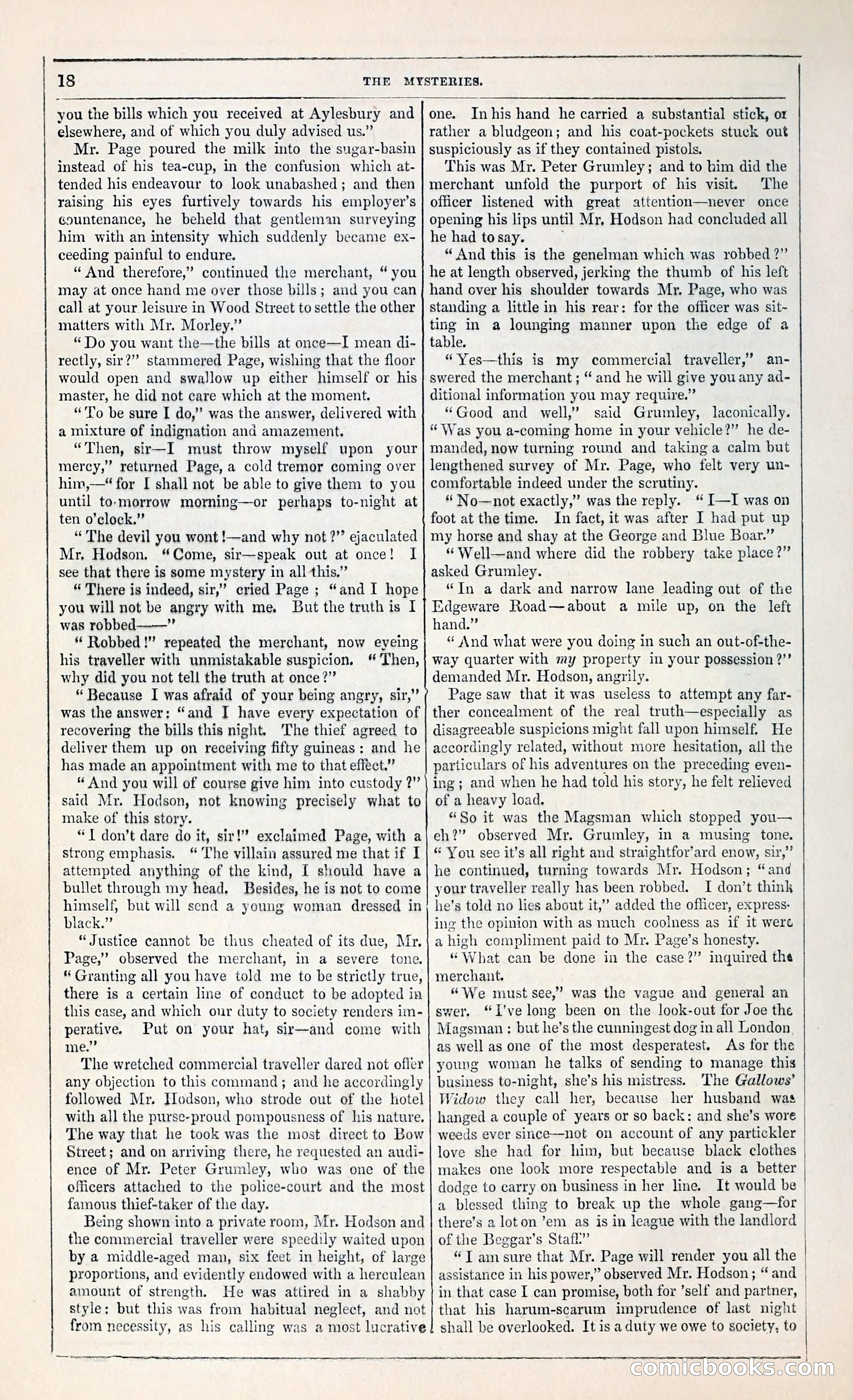
A restored page from Penny Dreadfuls, 1849. Page through the whole issue in the reader above.
📄 Transcribed text from this page (OCR, searchable)
Machine-transcribed from the original scan — historical spelling and the odd misread are preserved.
a 18 THE MYSTERIES. you the bills which you received at Aylesbury and elsewhere, and of which you duly advised us.” Mr. Page poured the milk into the sugar-basin instead of his tea-cup, in the confusion which at- tended his endeavour to look unabashed; and then raising his eyes furtively towards his employer's Gountenance, he beheld that gentleman surveying him with an intensity which suddenly became ex- ceeding painful to endure. “And therefore,” continued the merchant, “ you may at once hand me over those bills; and you can call at your leisure in Wood Street to settle the other matters with Mr. Morley.” “Do you want the—the bills at once—I mean di- rectly, sir?” stammered Page, wishing that the floor would open and swaJlow up either himself or his master, he did not care which at the moment. “To be sure I do,’ was the answer, delivered with a mixture of indignation and amazement. “Then, sir—I must throw myself upon your mercy,” returned Page, a cold tremor coming over hin,—* for I shall not be able to give them to you until to-morrow morning—or perhaps to-night at ten o’clock.” “The devil you wont !—and why not ?”’ ejaculated Mr. Hodson, Come, sir—speak out at once! I see that there is some mystery in all this.” “ There is indeed, sir,” cried Page ; “and I hope you will not be angry with me, But the truthis I was robbed——” “ Robbed!” repeated the merchant, now eyeing his traveller with unmistakable suspicion. Then, why did you not tell the truth at once?” “ Because I was afraid of your being angry, sir,” was the answer: “and I have every expectation of recovering the bills this night. The thief agreed to deliver them up on receiving fifty guineas: and he has made an appointment with me to that effect.” “ And you will of course give him into custody ?” said Mr. Hodson, not knowing precisely what to make of this story. “YT don’t dare do it, sir!’ exclaimed Page, with a strong emphasis. “ ‘The villain assured me that if I attempted anything of the kind, I should have a bullet through my head. Besides, he is not to come himself, but will send a young woman dressed in black.” “Justice cannot be thus cheated of its due, Mr. Page,’ observed the merchant, in a severe tone, * Granting all you have told me to be strictly true, there is a certain line of conduct to be adopted in this case, and which our duty to society renders im- perative. Put on your hat, sir—and come with me.” The wretched commercial traveller dared not offer any objection to this command; and he accordingly followed Mr. Hodson, who strode out of the hotel with all the purse-proud pompousness of his nature. The way that he took was the most direct to Bow Street; and on arriving there, he requested an audi- ence of Mr. Peter Grumley, who was one of the officers attached to the police-court and the most famous thief-taker of the day. Being shown into a private room, Mr. Hodson and the commercial traveller were speedily waited upon by a middle-aged man, six feet in height, of large proportions, and evidently endowed with a herculean amount of strength. He was attired in a shabby style: but this was from habitual neglect, and not from necessity, as his calling was a most lucrative itt _— a one. Inhis hand he carried a substantial stick, or rather a bludgeon; and his coat-pockets stuck out suspiciously as if they contained pistols. This was Mr. Peter Grumley; and to him did the merchant unfold the purport of his visit. The officer listened with great attention—never once opening his lips until Mr, Hodson had concluded all he had to say. | “ And this is the genelman which was robbed 2?” he at length observed, jerking the thumb of his left hand over his shoulder towards Mr. Page, who was standing a little in his rear: for the officer was sit- ting in a lounging manner upon tlie edge of a table. “Yes—this is my commercial traveller,” an- swered the merchant ; “ and he will give you any ad- ditional information you may require.” “Good and well,’ said Grumley, laconically. “Was you a-coming home in your vehicle?” he de- manded, now turning round and taking a calm but lengthened survey of Mr. Page, who felt very un- comfortable indeed under the scrutiny. “ No—not exactly,” was the reply. “ I—I was on foot at the time. In fact, it was after I had put up my horse and shay at the George and Blue Boar.” “Well—and where did the robbery take place?” asked Grumley. “Tn a dark and narrow lane leading out of the Exdgeware Road—about a mile up, on the left hand.” “ And what were you doing in such an out-of-the- way quarter with my property in your possession ?’’ demanded Mr. Hodson, angrily. Page saw that it was useless to attempt any far- ther concealment of the real truth—especially as disagreeable suspicions might fall upon himself. He accordingly related, without more hesitation, all the particulars of his adventures on the preceding even- ing; and when he had told his story, he felt relieved of a heavy load. “So it was the Magsman which stopped you— eh?” observed Mr. Grumley, in a musing tone. “ You see it’s all right and straightfor’ard enow, sir,” he continued, turning towards Mr. Hodson; “and your traveller really has been robbed. I don’t think he’s told no lies about it,” added the officer, express- ing the opinion with as much coolness as if it weré a high compliment paid to Mr. Page’s honesty. “What can be done in the case?” inquired the merchant. “We must see,” was the vague and general an swer. “I've long been on the look-out for Joe the Magsman : but he’s the cunningest dog in all London, as well as one of the most desperatest. As for the young woman he talks of sending to manage this business to-night, she’s his mistress. The Gallows’ Widow they call her, because her husband was hanged a couple of years or so back: and she’s wore weeds ever since—not on account of any partickler love she had for him, but because black clothes makes one look more respectable and is a better dodge to carry on business in her line. It would be a blessed thing to break up the whole gang—for there’s a loton ’em as is in league with the landlord of the Beggar’s Stafl”’ “T amsure that Mr. Page will render you all the assistance in his power,” observed Mr. Hodson; “ and in that case I can promise, both for ’self and partner, that his harum-scarum imprudence of last night shall be overlooked. It is a duty we owe to society, to | | | Connicoooks.coln