
Penny Dreadfuls, 1849 · page 310 of 394
The Mysteries of the Court of London — page 310: what you’re looking at
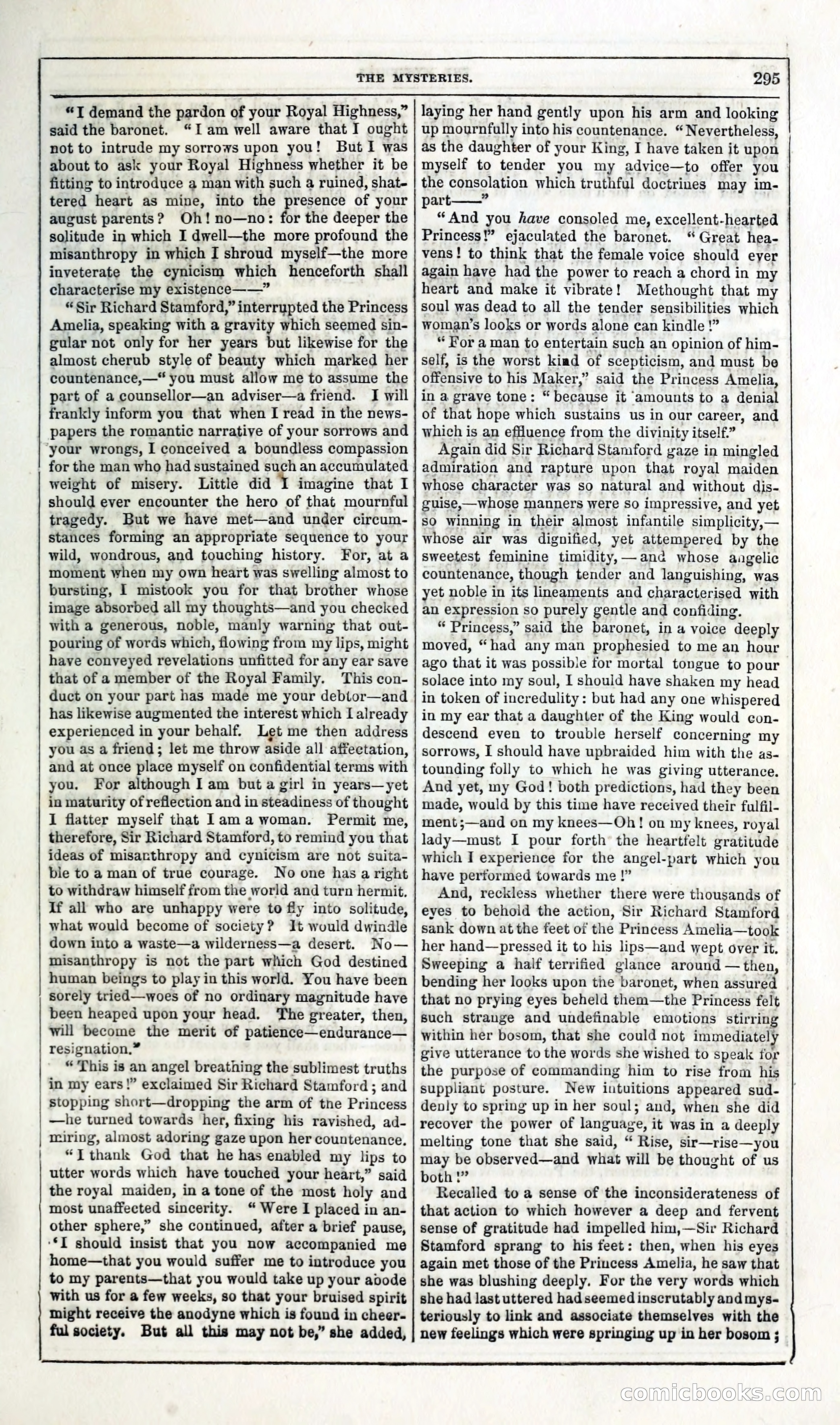
A restored page from Penny Dreadfuls, 1849. Page through the whole issue in the reader above.
📄 Transcribed text from this page (OCR, searchable)
Machine-transcribed from the original scan — historical spelling and the odd misread are preserved.
THE MYSTERIES. 295 “TJ demand the pardon of your Royal Highness,” said the baronet. “Iam well aware that I ought not to intrude my sorrows upon you! ButI was about to ask your Royal Highness whether it be fitting to introduce a man with such a ruined, shat- tered heart as mine, into the peer. of your august parents? Oh! no—no: for the deeper the solitude in which I dwell—the more profound the misanthropy in which I shroud myself—the more inveterate the cynicism which henceforth shall characterise my existence——” “Sir Richard Stamford,” interrupted the Princess Amelia, speaking with a gravity which seemed sin- gular not only for her years but likewise for the almost cherub style of beauty which marked her countenance,—* you must allow me to assume the part of a counsellor—an adviser—a friend. [| will frankly inform you that when I read in the news- papers the romantic narrative of your sorrows and ‘your wrongs, I conceived a boundless compassion ' for the man who had sustained such an accumulated weight of misery. Little did 1 imagine that I should ever encounter the hero of that mournful tragedy. But we have met—and under circum- stances forming an appropriate sequence to your wild, wondrous, and touching history. For, at a moment when my own heart was swelling almost to bursting, I mistook you for that brother whose image absorbed all my thoughts—and you checked with a generous, noble, manly warning that out- pouring of words which, flowing from my lips, might have conveyed revelations unfitted for any ear save that of a member of the Royal Family. This con- duct on your part has made me your debtor—and has likewise augmented the interest which I already experienced in your behalf. Let me then address you as a friend; let me throw aside all affectation, and at once place myself on confidential terms with you. For although I am but a girl in years—yet in maturity of reflection and in steadiness of thought I flatter myself that Lam awoman. Permit me, therefore, Sir Richard Stamford, to remind you that ideas of misarthropy and cynicism are not suita- ble to a man of true courage. No one has aright to withdraw himself from the world and turn hermit. If all who are unhappy were to fly into solitude, what would become of society? It would dwindle down into a waste—a wilderness—a desert. No— misanthropy is not the part which God destined human beings to play in this world. You have been sorely tried—woes of no ordinary magnitude have been heaped upon your head. The greater, then, will become the merit of patience—endurance— resignation.” “This is an angel breathing the sublimest truths in my ears!” exclaimed Sir Richard Stamford; and stopping short—dropping the arm of the Princess —he turned towards her, fixing his ravished, ad- miring, almost adoring gaze upon her countenance. “J thank God that he has enabled my lips to utter words which have touched your heart,” said the royal maiden, in a tone of the most holy and most unaffected sincerity. “ Were I placed in an- other sphere,” she continued, after a brief pause, ‘*I should insist that you now accompanied me home—that you would suffer me to introduce you to my parents—that you would take up your abode with us for a few weeks, so that your bruised spirit might receive the anodyne which is found in cheer- ful society. But all this may not be,” she added, laying her hand gently upon his arm and looking up mournfully into his countenance. “Nevertheless, as the daughter of your King, I have taken it upon myself to tender you my advice—to offer you the consolation which truthful doctrines may im- ”? part “And you have consoled me, excellent-hearted Princess!” ejaculated the baronet. “ Great hea- vens! to think that the female voice should eyer again have had the power to reach a chord in my heart and make it vibrate! Methought that my soul was dead to all the tender sensibilities which woman’s looks or words alone can kindle !” “ For a man to entertain such an opinion of him- self, is the worst kiad of scepticism, and must be offensive to his Maker,” said the Princess Amelia, in a grave tone: “because it amounts to a denial of that hope which sustains us in our career, and which is an effuence from the divinity itself.” Again did Sir Richard Stamford gaze in mingled admiration and rapture upon that royal maiden whose character was so natural and without dis- guise,—whose manners were so impressive, and yet sO winning in their almost infantile simplicity,— whose air was dignified, yet attempered by the sweetest feminine timidity,—and whose angelic countenance, though tender and languishing, was yet noble in its lineaments and characterised with an expression so purely gentle and confiding. “ Princess,” said the baronet, in a voice deeply moved, “had any man prophesied to me an hour ago that it was possible for mortal tongue to pour solace into my soul, I should have shaken my head in token of incredulity: but had any one whispered in my ear that a daughter of the King would con- descend even to trouble herself concerning my sorrows, I should have upbraided him with the as- tounding folly to which he was giving utterance. And yet, my God! both predictions, had they been made, would by this time have received their fulfil- ment ;—and on my knees—Oh! on my knees, royal lady—must I pour forth the heartfelt gratitude which I experience for the angel-part which you have performed towards me !” And, reckless whether there were thousands of eyes to behold the action, Sir Richard Stamford sank down at the feet of the Princess Amelia—took her hand—pressed it to his lips—and wept over it. Sweeping a half terrified glance around — then, bending her looks upon the baronet, when assured that no prying eyes beheld them—the Princess felt such strange and undefinable emotions stirring within her bosom, that she could not immediately give utterance to the words she wished to speak for the purpose of commanding him to rise from his suppliant posture. New intuitions appeared sud- denly to spring up in her soul; and, when she did recover the power of language, it was in a deeply melting tone that she said, “ Rise, sir—rise—you may be observed—and what will be thought of us both {” Recalled to a sense of the inconsiderateness of that action to which however a deep and fervent sense of gratitude had impelled him,—Sir Richard Stamford sprang to his feet: then, when his eyes again met those of the Princess Amelia, he saw that she was blushing deeply. For the very words which she had last uttered hadseemed inscrutably and mys- teriously to link and associate themselves with the new feelings which were springing up in her bosom ; (C(0) nn) (@ 6)(0)©) SO