
Penny Dreadfuls, 1849 · page 31 of 394
The Mysteries of the Court of London — page 31: what you’re looking at
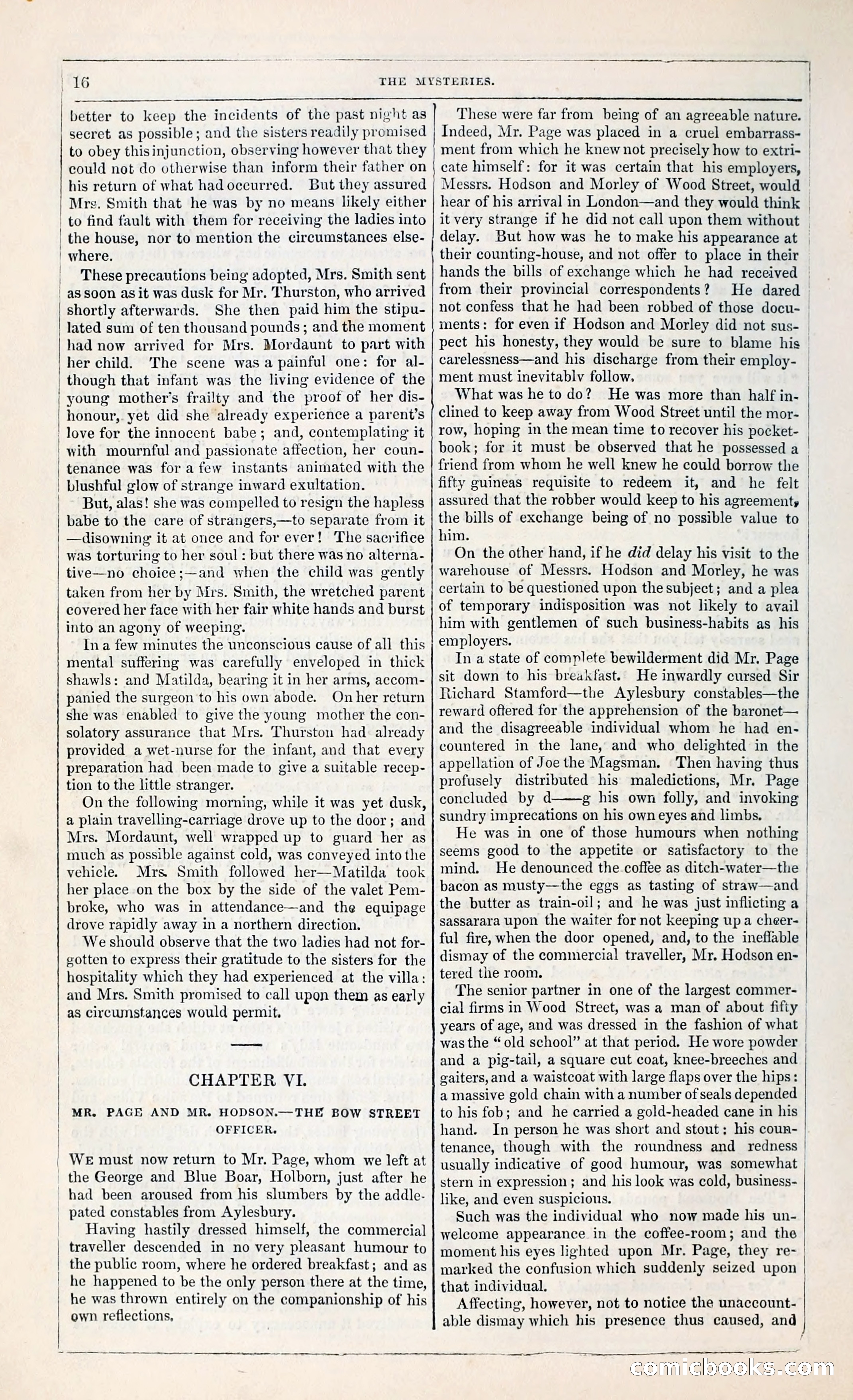
A restored page from Penny Dreadfuls, 1849. Page through the whole issue in the reader above.
📄 Transcribed text from this page (OCR, searchable)
Machine-transcribed from the original scan — historical spelling and the odd misread are preserved.
16 _ better to keep the incidents of the past night as secret as possible; and the sisters readily promised to obey thisinjunction, observing however that they could not do otherwise than inform their father on his return of what hadoccurred. But they assured Mrs. Smith that he was by no means likely either to find fault with them for receiving the ladies into i | ee ee —_—_—_-.- ee the house, nor to mention the circumstances else- where. These precautions being adopted, Mrs. Smith sent as soon asit was dusk for Mr. Thurston, who arrived shortly afterwards. She then paid him the stipu- lated sum of ten thousand pounds ; and the moment had now arrived for Mrs. Mordaunt to part with her child. ‘The scene was a painful one: for al- though that infant was the living evidence of the young mother’s frailty and the proof of her dis- honour,. yet did she already experience a parent’s love for the innocent babe; and, contemplating it with mournful and passionate affection, her coun- tenance was fora few instants animated with the blushful glow of strange inward exultation. But, alas! she was compelled to resign the hapless babe to the care of strangers,—to separate from it —disowning it at once and for ever! The sacrifice was torturing to her soul: but there was no alterna- tive—no choice;—and when the child was gently taken from her by Mrs. Smith, the wretched parent covered her face with her fair white hands and burst into an agony of weeping. Ina few minutes the unconscious cause of all this mental suffering was carefully enveloped in thick shawls: and Matilda, bearing it in her arms, accom- panied the surgeon to his own abode. On her return she was enabled to give the young mother the con- solatory assurance that Mrs. Thurston had already provided a wet-nurse for the infant, and that every preparation had been made to give a suitable recep- tion to the little stranger. On the following morning, while it was yet dusk, a plain travelling-carriage drove up to the door; and Mrs. Mordaunt, well wrapped up to guard her as much as possible against cold, was conveyed into the vehicle. Mrs. Smith followed her—Matilda took her place on the box by the side of the valet Pem- broke, who was in attendance—and the equipage drove rapidly away in a northern direction. We should observe that the two ladies had not for- cotten to express their gratitude to the sisters for the hospitality which they had experienced at the villa: and Mrs. Smith promised to call upon them as early as circumstances would permit. CHAPTER VI. MR. PAGE AND MR. HODSON.—THE BOW STREET OFFICER. WE must now return to Mr. Page, whom we left at the George and Blue Boar, Holborn, just after he had been aroused from his slumbers by the addle- pated constables from Aylesbury. Having hastily dressed himself, the commercial traveller descended in no very pleasant humour to the public room, where he ordered breakfast; and as ' he happened to be the only person there at the time, he was thrown entirely on the companionship of his own reflections, THE MYSTERIES. These were far from being of an agreeable nature. Indeed, Mr. Page was placed in a cruel embarrass- | ment from which he knew not precisely how to extri- cate himself: for it was certain that his employers, — Messrs. Hodson and Morley of Wood Street, would hear of his arrival in London—and they would think | it very strange if he did not call upon them without delay. But how was he to make his appearance at their counting-house, and not offer to place in their hands the bills of exchange which he had received from their provincial correspondents? He dared not confess that he had been robbed of those docu- ments: for even if Hodson and Morley did not sus- pect his honesty, they would be sure to blame his carelessness—and his discharge from their employ- ment must inevitablv follow, What was he to do? He was more than half in- clined to keep away from Wood Street until the mor- row, hoping in the mean time to recover his pocket- book; for it must be observed that he possessed a | friend from whom he well knew he could borrow the fifty guineas requisite to redeem it, and he felt assured that the robber would keep to his agreementy the bills of exchange being of no possible value to him. On the other hand, if he did delay his visit to the warehouse of Messrs. Hodson and Morley, he was certain to be questioned upon the subject; and a plea of temporary indisposition was not likely to avail him with gentlemen of such business-habits as his employers. In a state of complete bewilderment did Mr. Page sit down to his breakfast. He inwardly cursed Sir Richard Stamford—the Aylesbury constables—the reward oftered for the apprehension of the baronet— and the disagreeable individual whom he had en- countered in the lane, and who delighted in the appellation of Joe the Magsman. Then having thus profusely distributed his maledictions, Mr. Page concluded by d——g his own folly, and invoking sundry imprecations on his own eyes and limbs. He was in one of those humours when nothing seems good to the appetite or satisfactory to the mind. He denounced the coffee as ditch-water—the bacon as musty—the eggs as tasting of straw—and the butter as train-oil; and he was just inflicting a sassarara upon the waiter for not keeping up a cheer- ful fire, when the door opened, and, to the ineffable dismay of the commercial traveller, Mr. Hodson en- tered the room. The senior partner in one of the largest commer- cial firms in Wood Street, was a man of about fifty years of age, and was dressed in the fashion of what was the “old school” at that period. He wore powder and a pig-tail, a square cut coat, knee-breeches and gaiters, and a waistcoat with large flaps over the hips: a massive gold chain with a number of seals depended to his fob; and he carried a gold-headed cane in his hand. In person he was short and stout: his coun- tenance, though with the roundness and redness usually indicative of good humour, was somewhat stern in expression ; and his look was cold, business- like, and even suspicious. Such was the individual who now made his un- welcome appearance in the coffee-room; and the moment his eyes lighted upon Mr. Page, they re- marked the confusion which suddenly seized upon that individual. Affecting, however, not to notice the unaccount- able dismay which his presence thus caused, and —_ a ; SS sessile sss COLMA EloOOKS. CORN