
Penny Dreadfuls, 1849 · page 291 of 394
The Mysteries of the Court of London — page 291: what you’re looking at
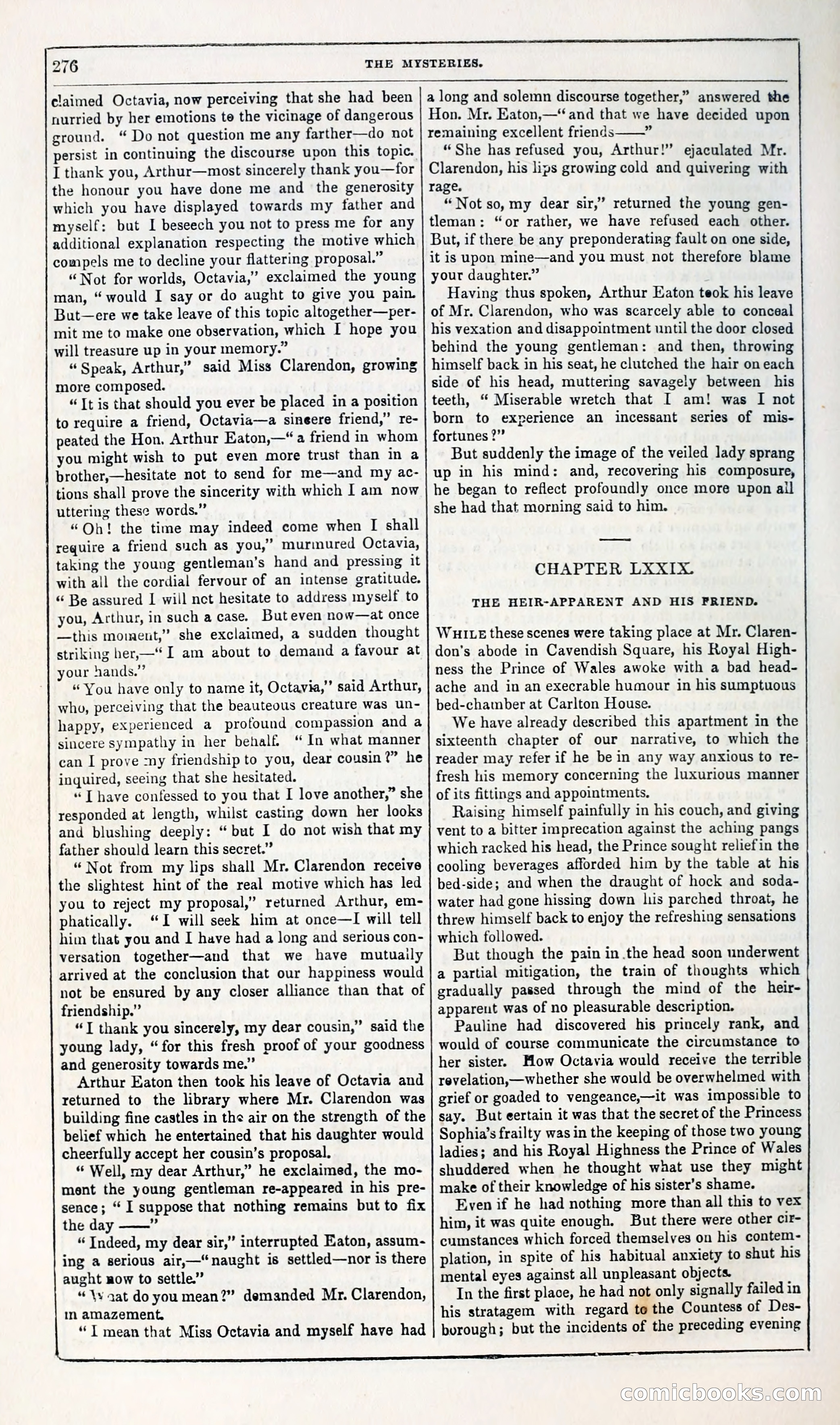
A restored page from Penny Dreadfuls, 1849. Page through the whole issue in the reader above.
📄 Transcribed text from this page (OCR, searchable)
Machine-transcribed from the original scan — historical spelling and the odd misread are preserved.
276 claimed Octavia, now perceiving that she had been nurried by her emotions te the vicinage of dangerous ground. “Do not question me any farther—do not persist in continuing the discourse upon this topic. I thank you, Arthur—most sincerely thank you—for the honour you have done me and the generosity which you have displayed towards my father and myself; but I beseech you not to press me for any additional explanation respecting the motive which compels me to decline your flattering proposal.” “Not for worlds, Octavia,’ exclaimed the young man, “would I say or do aught to give you pain. But—ere we take leave of this topic altogether—per- mit me to make one observation, which I hope you will treasure up in your memory.” “Speak, Arthur,” said Miss Clarendon, growing more composed. “Tt is that should you ever be placed in a position to require a friend, Octavia—a sineere friend,” re- peated the Hon, Arthur Eaton,—“a friend in whom you might wish to put even more trust than In a | brother,—hesitate not to send for me—and my ac- tions shall prove the sincerity with which I am now uttering these words.” “Oh! the time may indeed come when [ shall require a friend such as you,” murmured Octavia, taking the young gentleman’s hand and pressing it with all the cordial fervour of an intense gratitude. « Be assured I will nct hesitate to address myself to you, Arthur, in such a case. Buteven now—at once —this moment,” she exclaimed, a sudden thought striking her,—“ I am about to demand a favour at your hands.” “You have only to name it, Octavia,” said Arthur, who, perceiving that the beauteous creature was un- happy, experienced a profound compassion and a sincere sympathy in her behalf “ In what manner can I prove ny friendship to you, dear cousin ?” he inquired, seeing that she hesitated. “ [ have confessed to you that I love another,” she responded at length, whilst casting down her looks and blushing deeply: “ but I do not wish that my father should learn this secret.” “Not from my lips shall Mr. Clarendon receive the slightest hint of the real motive which has led you to reject my proposal,” returned Arthur, em- phatically. “I will seek him at once—I will tell him that you and I have had a long and serious con- versation together—and that we have mutuaily arrived at the conclusion that our happiness would not be ensured by any closer alliance than that of friendship.” “T thank you sincerely, my dear cousin,” said the young lady, “for this fresh proof of your goodness and generosity towards me.” Arthur Eaton then took his leave of Octavia and returned to the library where Mr. Clarendon was building fine castles in the air on the strength of the belief which he entertained that his daughter would cheerfully accept her cousin’s proposal. “ Well, my dear Arthur,” he exclaimed, the mo- ment the young gentleman re-appeared in his pre- sence; “ I suppose that nothing remains but to fix the day ——” “ Indeed, my dear sir,” interrupted Eaton, assum- ing a serious air,—“naught is settled—nor is there aught now to settle.” “\y¥ qat do you mean?” demanded Mr. Clarendon, In amazement. “T mean that Miss Octavia and myself have had THE MYSTERIES. a long and solemn discourse together,” answered the Hon. Mr. Eaton,— and that we have decided upon remaining excellent friends ” “She has refused you, Arthur!” ejaculated Mr. Clarendon, his lips growing cold and quivering with rage. “Not so, my dear sir,’ returned the young gen- tleman: “or rather, we have refused each other. But, if there be any preponderating fault on one side, it is upon mine—and you must not therefore blame your daughter.” Having thus spoken, Arthur Eaton teok his leave of Mr. Clarendon, who was scarcely able to conceal his vexation and disappointment until the door closed behind the young gentleman: and then, throwing himself back in his seat, he clutched the hair on each side of his head, muttering savagely between his teeth, “ Miserable wretch that [I am! was I not born to experience an incessant series of mis- fortunes ?” But suddenly the image of the veiled lady sprang up in his mind: and, recovering his composure, he began to reflect profoundly once more upon ail she had that morning said to him. —— CHAPTER LXXIX. THE HEIR-APPARENT AND HIS FRIEND. WHILE these scenes were taking place at Mr. Claren- don’s abode in Cavendish Square, his Royal High- ness the Prince of Wales awoke with a bad head- ache and in an execrable humour in his sumptuous bed-chamber at Carlton House. We have already described this apartment in the sixteenth chapter of our narrative, to which the reader may refer if he be in any way anxious to re- fresh his memory concerning the luxurious manner of its fittings and appointments. Raising himself painfully in his couch, and giving vent to a bitter imprecation against the aching pangs which racked his head, the Prince sought reliefin the cooling beverages afforded him by the table at his bed-side; and when the draught of hock and soda- water had gone hissing down lis parched throat, he threw himself back to enjoy the refreshing sensations which followed. But though the pain in.the head soon underwent a partial mitigation, the train of thoughts which gradually passed through the mind of the heir- apparent was of no pleasurable description. Pauline had discovered his princely rank, and would of course communicate the circumstance to her sister. How Octavia would receive the terrible revelation,—whether she would be overwhelmed with grief or goaded to vengeance,—it was impossible to say. But eertain it was that the secret of the Princess Sophia’s frailty was in the keeping of those two young ladies; and his Royal Highness the Prince of Wales shuddered when he thought what use they might make of their knowledge of his sister’s shame. Even if he had nothing more than all this to vex him, it was quite enough. But there were other cir- cumstances which forced themselves on his contem- plation, in spite of his habitual anxiety to shut his mental eyes against all unpleasant objects. In the first place, he had not only signally failed in his stratagem with regard to the Countess of Des- borough; but the incidents of the preceding evening er (C(O) nn) Cc 6)(0)() ‘S.Cco