
Penny Dreadfuls, 1849 · page 278 of 394
The Mysteries of the Court of London — page 278: what you’re looking at
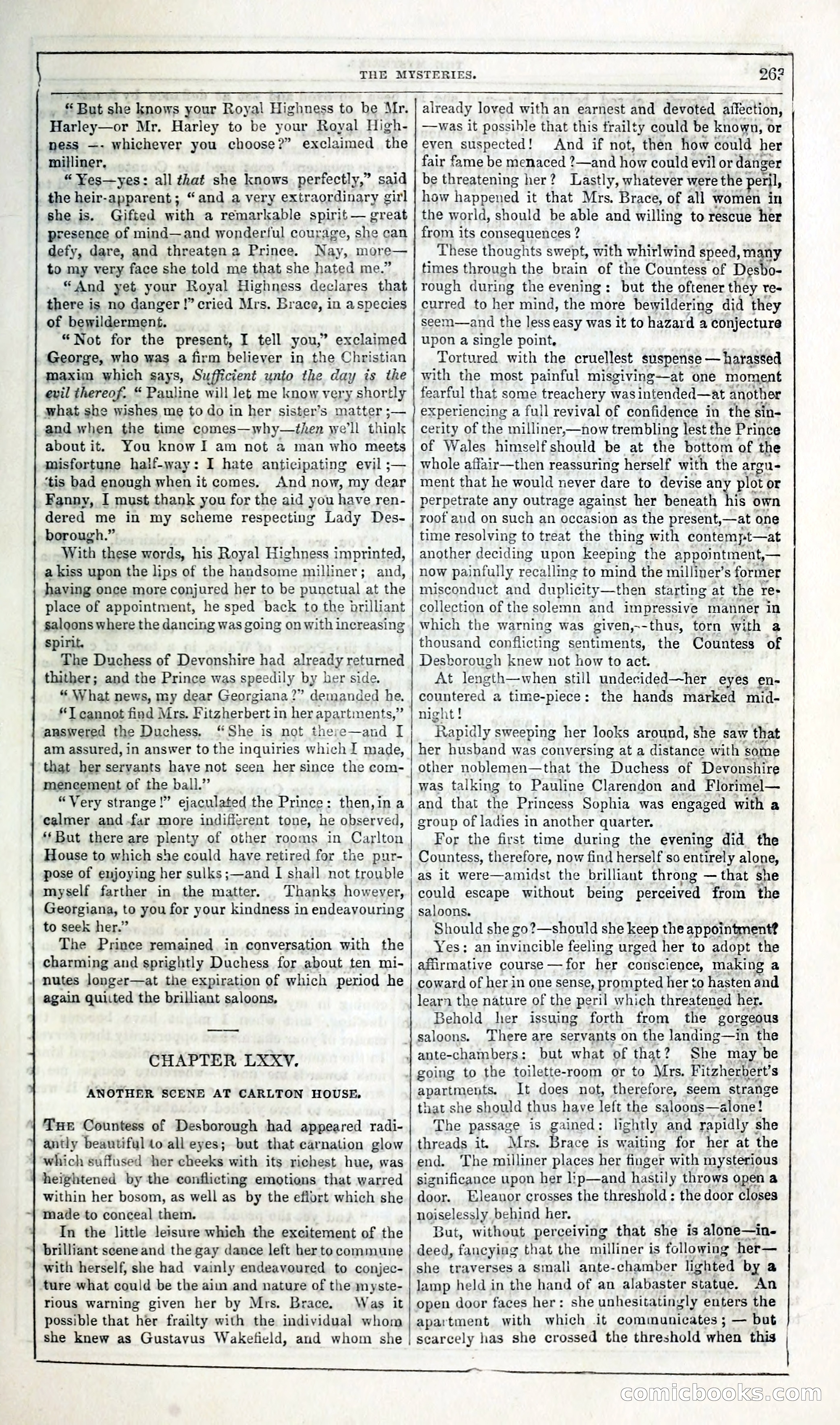
A restored page from Penny Dreadfuls, 1849. Page through the whole issue in the reader above.
📄 Transcribed text from this page (OCR, searchable)
Machine-transcribed from the original scan — historical spelling and the odd misread are preserved.
_ © But she knows your Royal Highness to be Mr. Harley—or Mr. Harley to be your Royal High- ness —- whichever you choose?” exclaimed the milliner, “ Yes—yes: all that she knows perfectly,” said the heir-apparent; “and a very extraordinary girl she is. Gifted with a remarkable spirit — great presence of mind—and wonderful courage, she can defy, dare, and threatena Prince. Nay, more— to my very face she told me that she hated me.” “And yet your Royal Highness declares that there is no danger!” cried Mrs. Brace, in aspecies of bewilderment. “Not for the present, I tell you,’ exclaimed George, who was a firm believer in the Christian maxim which says, Sufficient unto the day is the evil thereof. “ Pauline will let me know very shortly what she wishes me to do in her sister’s matter ;— and when the time comes—why—then we'll think about it. You know I am not a man who meets misfortune half-way: I hate anticipating evil ;— ‘tis bad enough when it comes. And now, my dear Fanny, I must thank you for the aid you have ren- dered me in my scheme respecting Lady Des- borough.” With these words, his Royal Highness imprinted, a kiss upon the lips of the handsome milliner; and, having once more conjured her to be punctual at the place of appointment, he sped back to the brilliant saloons where the dancing was going on with increasing spirit. The Duchess of Devonshire had already returned thither; and the Prince was speedily by her side. “What news, my dear Georgiana?” demanded he. *T cannot find Mrs. Fitzherbert in her apartments,” answered the Duchess. “She is not there—and I am assured, in answer to the inquiries which I made, that her servants have not seen her since the com- menecement of the ball.” “Very strange!” ejaculated the Prince: then,in a calmer and far more indifferent tone, he observed, ‘*But there are plenty of other rooms in Carlton House to which she could have retired for the pur- pose of enjoying her sulks;—and I shall not trouble myself farther in the matter. Thanks however, Georgiana, to you for your kindness in endeavouring to seek her.” The Prince remained in conversation with the charming and sprightly Duchess for about ten mi- | nutes longer—at the expiration of which period he again quiited the brilliant saloons, +e e CHAPTER LXXV. ANOTHER SCENE AT CARLTON HOUSE, | THE Countess of Desborough had appeared radi- antly beautifulto all eyes; but that carnation glow | which suffused her cheeks with its richest hue, was heightened by the conflicting emotions that warred within her bosom, as well as by the eflort which she made to conceal them. In the little leisure which the excitement of the brilliant scene and the gay dance left her tocommune with herself, she had vainly endeavoured to conjec- ture what could be the aim and nature of the myste- rious warning given her by Mrs. Brace. Was it possible that her frailty with the individual whom she knew as Gustavus Wakefield, and whom she THE MYSTERIES. | saloons. | ante-chambers: already loved with an earnest and devoted aifection, —was it possible that this frailty could be known, or eyen suspected! And if not, then how could her fair fame be menaced ?—and how could evil or danger be threatening her? Lastly, whatever were the eril, how happened it that Mrs. Brace, of all women in the world, should be able and willing to rescue her from its consequences ? These thoughts swept, with whirlwind speed, many times through the brain of the Countess of Desbo- rough during the evening: but the oftener they re- curred to her mind, the more bewildering did they seem—and the less easy was it to hazard a conjecture upon a single point, Tortured with the cruellest suspense — harassed with the most painful misgiving—at one moment fearful that some treachery was intended—at another experiencing a full revival of confidence in the sin- cerity of the milliner,—now trembling lest the Prince of Wales himself should be at the bottom of the whole affair—then reassuring herself with the ari ment that he would never dare to devise any plot or perpetrate any outrage against her beneath his own roof and on such an occasion as the present,—at one time resolving to treat the thing with contempt—at another deciding upon keeping the appointment,— now painfully recalling to mind the milliner’s former misconduct and duplicity—then starting at the re> collection of the solemn and impressive manner in which the warning was given,--thus, torn with a thousand conflicting sentiments, the Countess of Desborough knew not how to act. At length—when still undecided—her eyes en- countered a time-piece: the hands marked mid- night! ‘Rapidly sweeping her looks around, she saw that her husband was conversing at a distance with some other noblemen—that the Duchess of Devonshire was talking to Pauline Clarendon and Florimel— and that the Princess Sophia was engaged with a group of ladies in another quarter. For the first time during the evening did the Countess, therefore, now find | herself so entirely a as it were—amidst the brilliant throng — that sh could escape without being perceived from the saloons. Should she go?—should she keep the appointment? Yes; an invincible feeling urged her to adopt the affirmative course — for her conscience, making a coward of her in one sense, prompted her to hasten and learn the nature of the peril which threatened her. Behold her issuing forth from the gorgeous There are servants on the landing—in the but what of that? She may ‘be going to the toilette-room or to Mrs. Fitzherbert’s apartments. It does not, therefore, seem strange hat she should thus have left the saloons—alone! The passage is gained: lightly and rapidly she threads it Mrs. Brace is waiting for her at the end. ‘The milliner places her finger with mysterious significance upon her lip—and hastil y throws open a door. Eleanor crosses the threshold: the door closes noiselessly behind her. But, without perceiving that she is alone—in- deed, fancying that the milliner is following her— she traverses a smali ante-chamber lighted by a lamp held in the hand of an alabaster statue. An open door faces her: she unhesitatingly enters the apartment with which it communicates ; — but scarcely has she crossed the threshold when this COmMicoookSs.€®