
Penny Dreadfuls, 1849 · page 254 of 394
The Mysteries of the Court of London — page 254: what you’re looking at
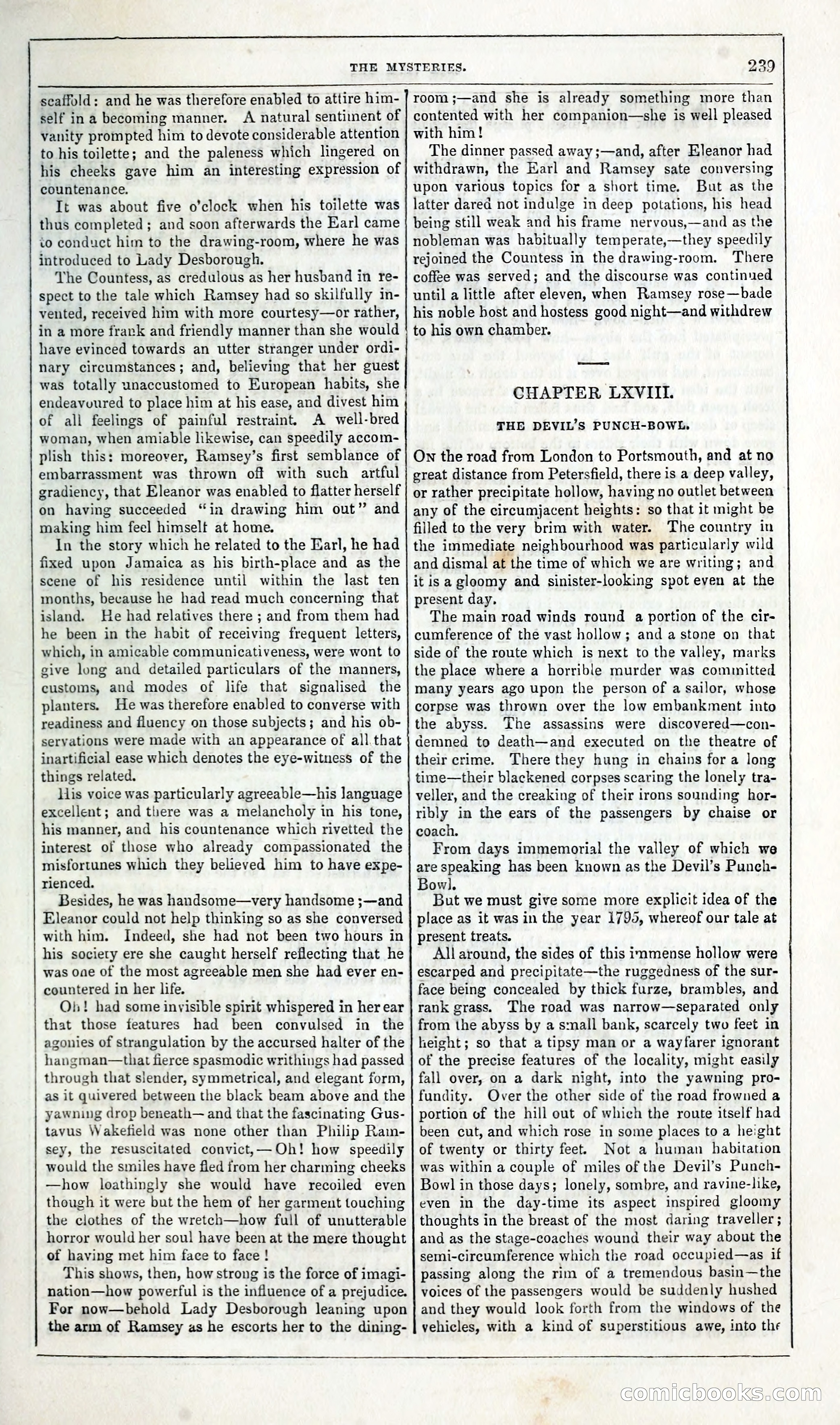
A restored page from Penny Dreadfuls, 1849. Page through the whole issue in the reader above.
📄 Transcribed text from this page (OCR, searchable)
Machine-transcribed from the original scan — historical spelling and the odd misread are preserved.
THE MYSTERIES. ee 239 seaffold: and he was therefore enabled to attire him- self ina becoming manner. A natural sentiment of vanity prompted him to devote considerable attention to his toilette; and the paleness which lingered on his cheeks gave him an interesting expression of countenance. It was about five o’clock when his toilette was thus completed; and soon afterwards the Earl came to conduct him to the drawing-room, where he was introduced to Lady Desborough. The Countess, as credulous as her husband in re- spect to the tale which Ramsey had so skilfully in- vented, received him with more courtesy—or rather, in a more frark and friendly manner than she would have evinced towards an utter stranger under ordi- nary circumstances; and, believing that her guest was totally unaccustomed to European habits, she endeavuured to place him at his ease, and divest him of all feelings of painful restraint. A well-bred woman, when amiable likewise, can speedily accom- plish this: moreover, Ramsey’s first semblance of embarrassment was thrown off with such artful egradiency, that Eleanor was enabled to flatter herself on having succeeded “in drawing him out” and making him feel himself at home. In the story which he related to the Earl, he had fixed upon Jamaica as his birth-place and as the scene of his residence until within the last ten months, because he had read much concerning that island. He had relatives there ; and from them had he been in the habit of receiving frequent letters, which, in amicable communicativeness, were wont to give long and detailed particulars of the manners, customs, and modes of life that signalised the planters. He was therefore enabled to converse with readiness and fluency on those subjects; and his ob- seryations were made with an appearance of all.that inartificial ease which denotes the eye-witness of the things related. liis voice was particularly agreeable—his language excellent; and there was a melancholy in his tone, his manner, and his countenance which rivetted the interest of those who already compassionated the misfortunes which they believed him to have expe- rienced. Besides, he was handsome—very handsome ;—and Eleanor could not help thinking so as she conversed with him. Indeed, she had not been two hours in his society ere she caught herself reflecting that he was one of the most agreeable men she had ever en- countered in her life. Ol! had some invisible spirit whispered in her ear that those features had been convulsed in the agonies of strangulation by the accursed halter of the hangman—that fierce spasmodic writhings had passed through that slender, symmetrical, and elegant form, as it quivered between the black beam above and the yawning drop beneath— and that the fascinating Gus- tavus Wakefield was none other than Philip Ram- sey, the resuscitated convict,— Oh! how speedily would the smiles have fled from her charming cheeks —how loathingly she would have recoiled even though it were but the hem of her garment touching the clothes of the wretech—how full of unutterable horror would her soul have been at the mere thought of having met him face to face! This shows, then, how strong is the force of imagi- nation—how powerful is the influence of a prejudice. For now—behold Lady Desborough leaning upon the arm of Ramsey as he escorts her to the dining- room ;—and she is already something more than contented with her companion—she is well pleased with him! The dinner passed away ;—and, after Eleanor had withdrawn, the Harl and Ramsey sate conversing upon various topics for a short time. But as the latter dared not indulge in deep potations, his head being still weak and his frame nervous,—and as the nobleman was habitually temperate,—they speedily rejoined the Countess in the drawing-room. There coffee was served; and the discourse was continued until a little after eleven, when Ramsey rose—bade his noble host and hostess good night—and withdrew to his own chamber. €raeees CHAPTER LXVIII. THE DEVIL’S PUNCH-BOWL, On the road from London to Portsmouth, and at no creat distance from Petersfield, there is a deep valley, or rather precipitate hollow, having no outlet between any of the circumjacent heights: so that it might be filled to the very brim with water. The country in the immediate neighbourhood was particularly wild and dismal at the time of which we are writing; and it isa gloomy and sinister-looking spot even at the present day, The main road winds round a portion of the cir- cumference of the vast hollow; and a stone on that side of the route which is next to the valley, marks the place where a horrible murder was committed many years ago upon the person of a sailor, whose corpse was thrown over the low embankment into the abyss. The assassins were discovered—con- demned to death—and executed on the theatre of their crime. There they hung in chains for a long time—their blackened corpses scaring the lonely tra- veller, and the creaking of their irons sounding hors ribly in the ears of the passengers by chaise or coach. From days immemorial the valley of which we are speaking has been known as the Devil’s Punch- Bowl. But we must give some more explicit idea of the place as it was in the year 1795, whereof our tale at present treats. All around, the sides of this immense hollow were escarped and precipitate—the ruggedness of the sur- face being concealed by thick furze, brambles, and rank grass. The road was narrow—separated only from the abyss by a small bank, scarcely two feet in height; so that a tipsy man or a wayfarer ignorant of the precise features of the locality, might easily fall over, on a dark night, into the yawning pro- fundity. Over the other side of the road frowned a portion of the hill out of which the route itself had been cut, and which rose in some places to a height of twenty or thirty feet. Not a human habitation was within a couple of miles of the Devil’s Punch- Bowl in those days; lonely, sombre, and ravine-like, even in the day-time its aspect inspired gloomy thoughts in the breast of the most daring traveller ; and as the stage-coaches wound their way about the semi-circumference which the road occupied—as if passing along the rim of a tremendous basin—the voices of the passengers would be suddenly hushed and they would look forth from the windows of the vehicles, with a kind of superstitious awe, into the (C(O) 6)(0)(©) CS, (C(O)