
Penny Dreadfuls, 1849 · page 242 of 394
The Mysteries of the Court of London — page 242: what you’re looking at
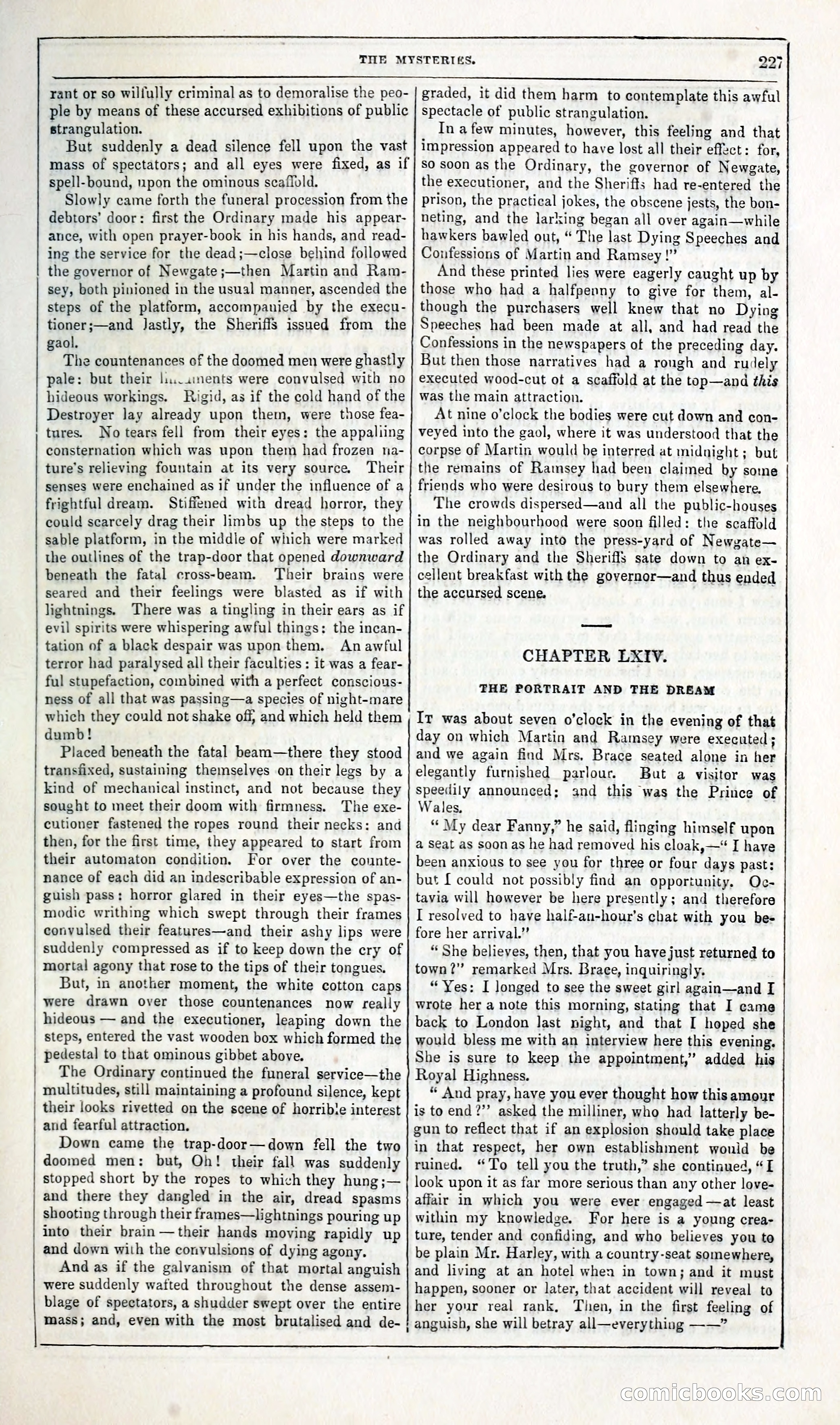
A restored page from Penny Dreadfuls, 1849. Page through the whole issue in the reader above.
📄 Transcribed text from this page (OCR, searchable)
Machine-transcribed from the original scan — historical spelling and the odd misread are preserved.
THE MYSTERIES. rant or so wilfully criminal as to demoralise the peo- ple by means of these accursed exhibitions of public strangulation. But suddenly a dead silence fell upon the vast mass of spectators; and all eyes were fixed, as if spell-bound, npon the ominous scaffold. Slowly came forth the funeral procession from the debtors’ door: first the Ordinary made his appear- ance, with open prayer-book in his hands, and read- ing the service for the dead;—close behind followed the governor of Newgate;—then Martin and Ram- sey, both pinioned in the usual manner, ascended the steps of the platform, accompanied by the execu- tioner;—and Jastly, the Sheriffs issued from the gaol, The countenances of the doomed men were ghastly pale: but their li..iments were convulsed with no hideous workings. Rigid, as if the cold hand of the Destroyer lay already upon them, were tnose fea- tures. No tears fell from their eyes: the appaliing consternation which was upon them had frozen na- ture’s relieving fountain at its very source. Their senses were enchained as if under the influence of a frightful dream. Stiffened with dread horror, they could scarcely drag their limbs up the steps to the sable platform, in the middle of which were marked the outlines of the trap-door that opened downward beneath the fatal cross-beam. Their brains were seared and their feelings were blasted as if with lightnings. There was a tingling in their ears as if evil spirits were whispering awful things: the incan- tation of a black despair was upon them. An awful terror had paralysed all their faculties: it was a fear- ful stupefaction, combined with a perfect conscious- ness of all that was passing—a species of night-mare which they could not shake off, and which held them dumb! Placed beneath the fatal beam—there they stood transfixed, sustaining themselves on their legs by a kind of mechanical instinct, and not because they sought to meet their doom with firmness. The exe- cutioner fastened the ropes round their necks: and then, for the first time, they appeared to start from their automaton condition. For over the counte- nance of each did an indescribable expression of an- guish pass: horror glared in their eyes—the spas- modic writhing which swept through their frames convulsed their features—and their ashy lips were suddenly compressed as if to keep down the cry of mortal agony that rose to the tips of their tongues. But, in another moment, the white cotton caps were drawn over those countenances now really hideous — and the executioner, leaping down the steps, entered the vast wooden box which formed the pedestal to that ominous gibbet above. The Ordinary continued the funeral service—the multitudes, still maintaining a profound silence, kept their looks rivetted on the scene of horrible interest and fearful attraction. Down came the trap-door—down fell the two doomed men: but, Oh! their fall was suddenly stopped short by the ropes to which they hung ;— and there they dangled in the air, dread spasms shooting through their frames—lightnings pouring up into their brain—their hands moving rapidly up and down with the convulsions of dying agony. And as if the galvyanism of that mortal anguish were suddenly wafted throughout the dense assem- blage of spectators, a shudder swept over the entire mass; and, even with the most brutalised and de- graded, it did them harm to contemplate this awful spectacle of public strangulation. In a few minutes, however, this feeling and that impression appeared to have lost all their effect: for, so soon as the Ordinary, the governor of Newgate, the executioner, and the Sheriffs had re-entered the prison, the practical jokes, the obscene jests, the bon- neting, and the larking began all over again—while hawkers bawled out, “ The last Dying Speeches and Confessions of Martin and Ramsey !”” And these printed lies were eagerly caught up by those who had a halfpenny to give for them, al- though the purchasers well knew that no Dying Speeches had been made at all, and had read the Confessions in the newspapers of the preceding day. But then those narratives had a rough and rudely executed wood-cut ot a scaffold at the top—and this was the main attraction. At nine o'clock the bodies were cut down and con- veyed into the gaol, where it was understood that the corpse of Martin would be interred at midnight; but the remains of Ramsey had been claimed by some friends who were desirous to bury them elsewhere, The crowds dispersed—and all the public-houses in the neighbourhood were soon filled: the scaffold was rolled away into the press-yard of Newgate— the Ordinary and the Sheriffs sate down to an ex- cellent breakfast with the goyvernor—and thus ended the accursed scene. CHAPTER LXIV. THE PORTRAIT AND THE DREAM It was about seven o’clock in the evening of that day on which Martin and Ramsey were executed; and we again find Mrs. Brace seated alone in her elegantly furnished parlour. But a visitor was speedily announced; and this was the Prince of Wales, ) ““ My dear Fanny,” he said, flinging himself upon a Seat as soon as he had removed his cloak, —“ I have been anxious to see you for three or four days past: but { could not possibly find an opportunity. Oc- tavia will however be here presently; and therefore I resolved to have half-au-hour’s chat with you be- fore her arrival.” “ She believes, then, that you have just returned to town?” remarked Mrs. Braee, inquiringly. “Yes: I longed to see the sweet girl again—and I wrote her a note this morning, stating that I came back to London last night, and that I hoped she would bless me with an interview here this evening. She is sure to keep the appointment,” added his Royal Highness. “ And pray, have you ever thought how this amour is to end ?’’ asked the milliner, who had latterly be- gun to reflect that if an explosion should take place in that respect, her own establishment would be ruined. “To tell you the truth,” she continued, “I look upon it as far more serious than any other love- affair in which you were ever engaged —at least within my knowledge. For here is a young crea- ture, tender and confiding, and who believes you to be plain Mr. Harley, with a country-seat somewhere, and living at an hotel when in town; and it must happen, sooner or later, that accident will reveal to her your real rank, Then, in the first feeling of ‘ anguish, she will betray all—everything —-—” 227 Eee ee ee eee ee eee COMnnicloOokS.c@