
Penny Dreadfuls, 1849 · page 230 of 394
The Mysteries of the Court of London — page 230: what you’re looking at
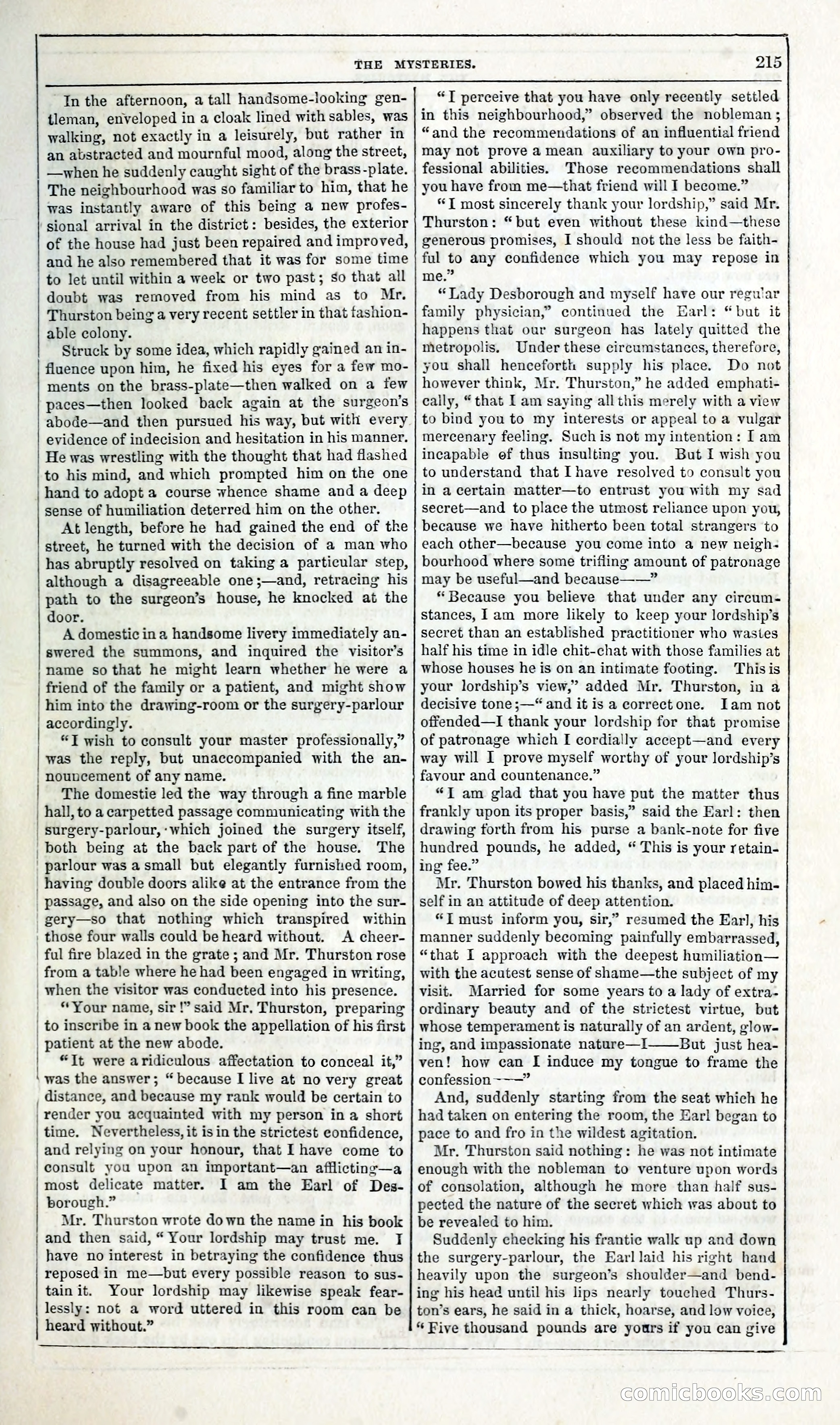
A restored page from Penny Dreadfuls, 1849. Page through the whole issue in the reader above.
📄 Transcribed text from this page (OCR, searchable)
Machine-transcribed from the original scan — historical spelling and the odd misread are preserved.
In the afternoon, a tall handsome-looking gen- tleman, enveloped in a cloak lined with sables, was walking, not exactly in a leisurely, but rather in an abstracted and mournful mood, along the street, —when he suddenly caught sight of the brass-plate. The neighbourhood was so familiar to him, that he was instantly aware of this being a new profes- sional arrival in the district: besides, the exterior of the house had just been repaired and improved, and he also remembered that it was for some time to let until within a week or two past; So that all doubt was removed from his mind as to Mr. Thurston being a very recent settler in that fashion- able colony. Struck by some idea, which rapidly gained an in- fluence upon him, he fixed his eyes for a few mo- ments on the brass-plate—then walked on a few paces—then looked back again at the surgeon’s nT evidence of indecision and hesitation in his manner. He was wrestling with the thought that had flashed to his mind, and which prompted him on the one hand to adopt a course whence shame and a deep sense of humiliation deterred him on the other. At length, before he had gained the end of the street, he turned with the decision of a man who has abruptly resolved on taking a particular step, although a disagreeable one ;—and, retracing his path to the surgeon’s house, he knocked at the door. A domestic ina handsome livery immediately an- swered the summons, and inquired the visitor’s name so that he might learn whether he were a friend of the family or a patient, and might show him into the drawing-room or the surgery-parlour accordingly. “JT wish to consult your master professionally,” was the reply, but unaccompanied with the an- | nouncement of any name. —_— CC -hlh re oe. C0_—0_—_ EW rT The domestie led the way through a fine marble | hall, to a carpetted passage communicating with the _surgery-parlour,:which joined the surgery itself, _both being at the back part of the house. The parlour was a small but elegantly furnished room, having double doors alike at the entrance from the _ passage, and also on the side opening into the sur- _gery—so that nothing which transpired within _ those four walls could be heard without. A cheer- | ful fire blazed in the grate ; and Mr. Thurston rose from a table where he had been engaged in writing, | when the visitor was conducted into his presence. _ Your name, sir!” said Mr, Thurston, preparing _to inscribe in a new book the appellation of his first | patient at the new abode. | “It were aridiculous affectation to conceal it,” was the answer; “because I live at no very great distance, and because my rank would be certain to render you acquainted with my person in a short time. Nevertheless, it isin the strictest confidence, and relying on your honour, that Ihave come to consult you upon an important—an afflicting—a most delicate matter. I am the Earl of Des- borough.” Mr. Thurston wrote down the name in his book and then said, “ Your lordship may trust me. I have no interest in betraying the confidence thus reposed in me—but every possible reason to sus- tain it. Your lordship may likewise speak fear- lessly: not a word uttered in this room can be heard without.” a THE MYSTERIES. 215 abode—and then pursued his way, but with every ) a “T perceive that you have only recently settled in this neighbourhood,” observed the nobleman ; “and the recommendations of an influential friend may not prove amean auxiliary to your own pro- fessional abilities. Those recommendations shall you have from me—that friend will I become.” *T most sincerely thank your lordship,” said Mr. Thurston: “but even without these kind—these generous promises, I should not the less be faith- ful to any confidence which you may repose in me.” “Lady Desborough and myself have our regular family physician,” continued the Earl: “but it happens that our surgeon has lately quitted the metropolis. Under these circumstances, therefore, you shall henceforth supply his place. Do not however think, Mr. Thurston,” he added emphati- cally, “that I am saying allthis merely with a view to bind you to my interests or appeal to a vulgar mercenary feeling. Such is not my intention: I am incapable ef thus insulting you. But I wish you to understand that [have resolved to consult you in a certain matter—to entrust you with my sad secret—and to place the utmost reliance upon you, because we have hitherto been total strangers to each other—because you come into a new neigh- bourhood where some trifling amount of patronage may be useful—and because——” * Because you believe that under any circum- stances, 1am more likely to keep your lordship’s secret than an established practitioner who wastes half his time in idle chit-chat with those families at whose houses he is on an intimate footing. Thisis your lordship’s view,’ added Mr. Thurston, in a decisive tone ;—“ and it is a ecorrectone. Iam not offended—I thank your lordship for that promise of patronage which I cordially accept—and every way will I prove myself worthy of your lordship’s favour and countenance.” “JT am glad that you have put the matter thus frankly upon its proper basis,” said the Earl: then drawing forth from his purse a bank-note for five hundred pounds, he added, “ This is your retain- ing fee.” Mr. Thurston bowed his thanks, and placed him- self in an attitude of deep attention. “JT must inform you, sir,” resumed the Earl, his manner suddenly becoming painfully embarrassed, “that I approach with the deepest humiliation— with the acutest sense of shame—the subject of my visit. Married for some years to a lady of extra- ordinary beauty and of the strictest virtue, but whose temperament is naturally of an ardent, glow- ing, and impassionate nature—I But just hea- ven! how can I induce my tongue to frame the confession -——” And, suddenly starting from the seat which he had taken on entering the room, the Earl began to pace to and fro in the wildest agitation. Mr. Thurston said nothing: he was not intimate enough with the nobleman to venture upon words of consolation, although he more than half sus- pected the nature of the secret which was about to be revealed to him. Suddenly checking his frantie walk up and down the surgery-parlour, the Earl laid his right hand heavily upon the surgeon’s shoulder—and bend- ing his head until his lips nearly touched Thurs- ton’s ears, he said in a thick, hoarse, and low voice, “Five thousand pounds are yours if you can give ee ee — —— So Comniclooe (C(O)